



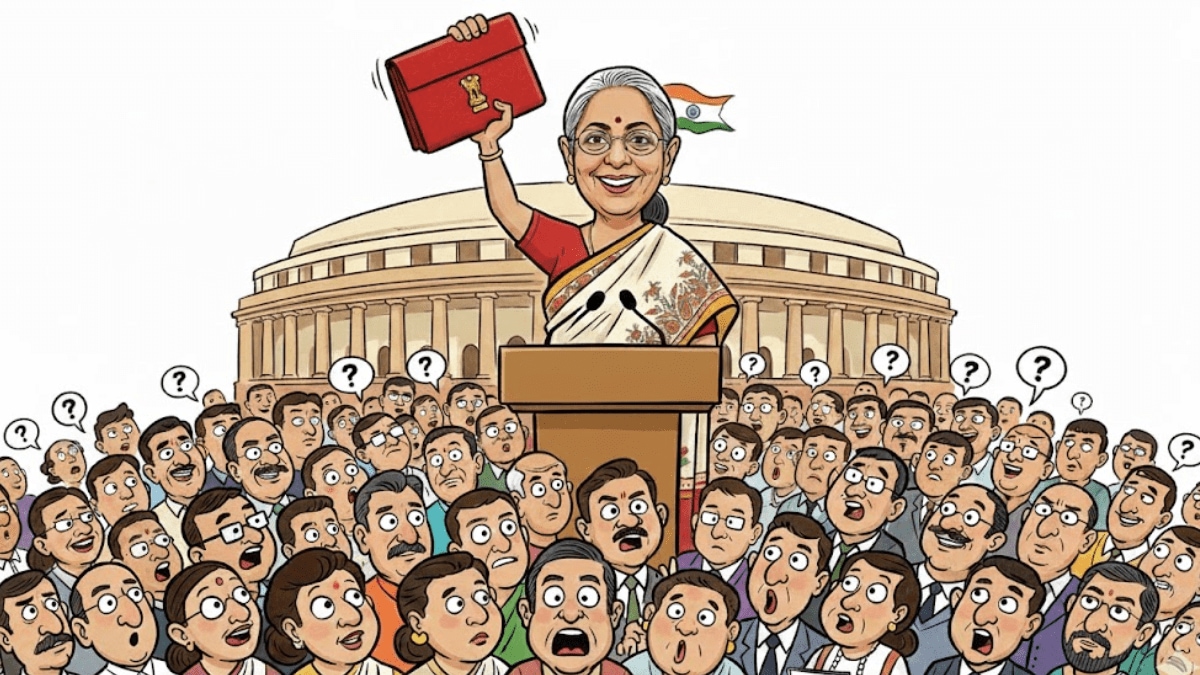
In just a few hours from now, Finance Minister Nirmala Sitharaman will be making history, presenting the ninth consecutive Budget. But this Budget is an attention-grabbing one, not just because of that. Even the timing is fraught with striking factors. Globally, the geopolitical tension and steep US tariffs, coupled with a strong dollar and volatile commodity prices, are keeping investors on tenterhooks. In sharp contrast, locally the economy is in a classic ‘Goldilocks period’. In this scenario, what are the big expectations from the Budget?
The overall market expectations from the Union Budget remain measured, with investors largely focused on policy continuity rather than headline reforms. That said, one of the key aspects that investors are watching out for in this Budget is how the Government is set to navigate the role of a “capex enabler from a capex spender” while balancing the consumption. The persistent capital outflows and possible measures to assuage investor sentiment are another factor that the street is watching out for.
Here is a detailed analysis of the key expectations from the Budget –
Budget 2026: Top 5 expectations
The Finance Minister is expected to walk the tightrope balancing infrastructure growth and social reforms in the upcoming Budget. Development-focused schemes and the big infrastructure push from the construction of roads, bridges, and metros to other infrastructure projects are likely to continue.
#Fiscal Consolidation
The government is expected to prioritise achieving and maintaining macro stability by pursuing a fiscal consolidation path while balancing growth and stability effectively. We expect the FY25 fiscal deficit to be kept below 4.9%, with a vision of achieving 4.5% by FY26.
#Hike in capex allocation for select sectors
Capex allocation for key sectors is expected to see a boost. According to Axis Securities, “overall capex spending is anticipated to range between Rs 11-11.5 trillion, reflecting a 15-17% increase compared to the revised spending for FY25.
As per Gautam Duggad, Head of Research, Institutional Equities at Motilal Oswal, higher allocations are expected “across sectors such as defence, infrastructure, affordable housing, power, capital goods.”
Additionally, emphasis on increasing capex spending to advance the development of public infrastructure is expected to remain in focus.
The overall focus of the capex boost is also seen as a channel to create more jobs and achieve investment-driven growth. Furthermore, the private Capex, which has been sluggish for the last several years, is expected to receive a much-needed push in the upcoming budget.
#Spurring consumption and job creation
Consumption is the other key theme of this Budget. The government may utilise this Budget to spur consumption via incremental reforms.
JM Financial’s Hitesh Suvarna added that, “we expect the Budget announcements for FY27 to gradually evolve towards a more balanced growth framework that supports both capex (3% of GDP) and consumption, while maintaining fiscal prudence.”
Considering uneven global growth and external trade-related uncertainties, JM Financial expect “the Budgetary announcements to be more inward-looking and focusing on domestic demand resilience, supply chain self-reliance and macroeconomic stability.”
Additionally, the anticipated announcement of the 8th Pay Commission, likely in the next fiscal year, “would have limited immediate fiscal implications, with its budgetary impact expected to be reflected more meaningfully in subsequent years’ fiscal math,” JM Financial added.
#Policy reforms set to continue
Additionally, the government’s policy reforms, such as Atmanirbhar Bharat, Make in India, and the PLI scheme, are likely to continue in FY26 as well and would receive further impetus.
According to Motilal Oswal, “FM may announce several procedural reform measures as well, continuing with the GoI’s endeavours to improve the ease of living and ease of doing business.”
The manufacturing sector is expected to gain additional momentum as the scope of the PLI scheme may expand beyond the current sectors.
#Tax tweaks to assuage market sentiment
Motilal Oswal’s Duggad also expects “a few capital market measures aimed to assuage investor sentiments. Market veteran, Arun Kejriwal, reiterated, “Steps beneficial for longer-term players who have been investing in the market are likely. Moreover, the tinkering in long-term tax rate last year may be reversed.”
#Boosting rural spending, MSME lending
There are also expectations that measures aimed at aiding flows into smaller lending segments, such as MFIs and MSME loans, may be announced in the upcoming Budget. Other measures to boost rural spending are also on the wish list of most analysts. “The rural economy is still not showing signs of a full recovery to pre-Covid levels. Consequently, we expect higher rural spending in the upcoming budget, with a greater focus on affordable housing. Further steps are expected to improve demand in the broader section of the economy,” JM Financial added.
Budget 2026 preview: What’s the big challenge?
Any discussion on expectation cannot be complete without outlining the challenges-
Tariff and global trade challenges
With geopolitical uncertainty reshaping global supply chains, the big question and concern is how India navigates the speedbreakers in international trade, and how the Budget can address this.
Elara Capital pointed out that “a simpler and more predictable customs framework could materially enhance the competitiveness of exports and improve FTA effectiveness, without posing meaningful fiscal risks.”
Not just that, a fragmented duty structure with eight slabs, multiple exemptions and overlapping levies adds to compliance complexity. Most market observers pointed out that this also increases the scope for classification disputes.
Although India has signed several FTAs, Garima Kapoor, Chief Economist of Elara Capital, pointed out that, “related utilisation remains limited due to extensive documentation requirements, stringent rules of origin and post -clearance audit risks.” The popular consensus on the street is that the Government should address these challenges in the upcoming Budget.
The capex-consumption tightrope
The key challenge for the Finance Minister will be to “avoid any disruptive tax announcements that could unsettle market sentiment or strain the fiscal math further,” said Hitesh Suvarna, Macro Economist, JM Financial Institutional.
Markets have largely priced in prevailing fiscal constraints and a likely moderation in the pace of consolidation. Against this backdrop, Suvarna pointed out that “the Budget will need to carefully balance capex and consumption support, while avoiding any sharp compression in capex below 3% of GDP, which would impinge on growth.”
Lower allocation to social schemes
However, the capacity creation phase has had challenges that resulted in lower allocation to social schemes. As a result, social reforms are also something that market and economic observers will watch out for.
Will the government announce bold measures?
This Budget is crucial not just in terms of the global headwinds ahead but also the domestic political situation. Will the government choose to announce bold structural reforms before turning populist in the run-up to the general elections in 2029? It’s a wait-and-watch for now.