



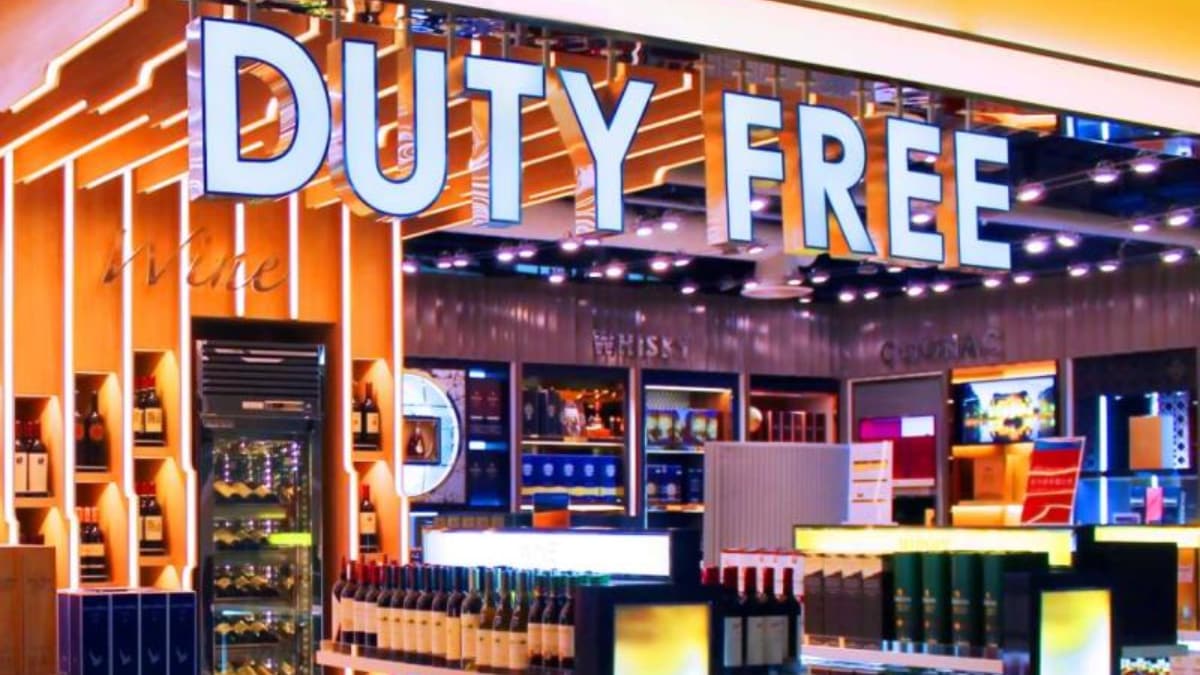
Airports make the most money from alcohol, who would have thought?
For years, airports were seen as regulated utilities, monopolies that made money primarily through landing fees, passenger charges, and other aeronautical tariffs. This doesn’t seem like the case anymore. The real anchor driving Indian airports today is their increasing non-aeronautical revenue, which consists of duty-free, retail, food and beverage, lounges, car parking and advertising.
As per a report by JM Financial on GMR Airport, the only listed private airport operator in India. Non-aero revenue can contribute 50-60% of an airport’s total revenue, but because it carries lower operating costs, it can contribute more than 70% of operating profit.
If this were to be simplified, airports are really turning into high-margin consumption businesses with a side of planes.
Alcohol: the anchor tenant of Indian duty-free
If you want the most blunt evidence of what Indian passengers buy, it’s in the category split.
JM Financial’s analysis shows that wine and spirits account for 58% of travel retail and duty-free sales in India, specifically in the airports operated by GMR Airports, far ahead of fragrances and cosmetics (16%). In China, by contrast, fragrances and cosmetics dominate at 61%. GMR Airports operates the Delhi, Hyderabad and North Goa airports in India currently.
As per the financial statements of Adani Airport Holdings, accessed from the exchange filings, the Duty Free segment was their largest single non-aeronautical revenue stream, generating Rs 1,585 crore in the first nine months of FY26.
The report notes that Indian duty-free spending has historically been arrival-heavy and alcohol-heavy, though operators are now pushing for a shift toward departures and a broader category mix. “We believe this may be due to excessively high tax rates on alcohol, especially in states like Maharashtra,” JM Financial analysts said.
The real business model: regulated aeronautics + unregulated consumption
The airport operator’s playbook is a healthy mix of infrastructure and luxury retail. Under the Joint Venture (JV) model, aeronautical tariffs are regulated by Airports Economic Regulatory Authority (AERA) to provide a fixed return, which typically comes up to 15.5% RoE on the regulated asset base. This is done to ensure that the operator earns a fixed return. And under the hybrid till mechanism, 30% of non-aeronautical revenue is used to cross-subsidise aeronautical tariffs, which helps keep passenger-facing charges lower.
This is the reason non-aero matters so much: it doesn’t just add profit, it also strengthens the airport’s competitiveness as an airline hub.
Delhi shows the future: Non-aero is already the main business
Delhi’s Indira Gandhi International Airport (DIAL) is one of the cleanest examples of how far the shift has already progressed. JM Financial estimates that non-aero revenue formed 61% of DIAL’s gross revenue in FY25, and projects 12% CAGR in non-aero revenue over FY26–FY28, driven by both passenger growth and rising spend per passenger.
In numbers, Delhi airport’s non-aero revenue is estimated at Rs 3,517 crore in FY26, rising to Rs 4,431.3 crore by FY28. Over the same period, aero revenue rises from Rs 2,995.5 crore to Rs 3,478.3 crore. The regulated side of India’s metro airports is becoming the base businesses with the real show stopper being retail.
Hyderabad is the “non-aero catch-up” story
JM Financial notes that Hyderabad’s spend per passenger is significantly lower than Delhi/Mumbai, which creates headroom. It estimates 19% CAGR in Hyderabad’s non-aero revenue over FY26–FY28, driven by 12% CAGR in passengers and 6% CAGR in spend per passenger.
Furthermore, Hyderabad’s non-aero revenue is estimated at Rs 763.4 crore in FY26, rising to Rs 1,085.9 crore by FY28. GMR has taken over Hyderabad’s duty-free operations onto its own platform, which JM Financial expects will lead to a sharper focus on store formats and better monetisation.
Duty-free still under-penetrated
If you’re wondering whether airports are already maxed out, the data suggests the opposite: India is still early. JM Financial notes that duty-free penetration at Indian metros is about 10%, compared with 15% for Dubai and 18% for Singapore, even though duty-free footfall is comparable at around 40%.
So the story isn’t just that airports are making money from shopping. It’s that they’re still only scratching the surface.
Adani’s airports: Non-aero is already the biggest line item
If GMR is the listed pure-play, Adani is the scale story, embedded within Adani Enterprises.
Adani Enterprises’ investor presentation for 9M FY26 shows that in Adani Airports Holdings Ltd (AAHL), non-aero is the largest revenue bucket. For the first nine months of FY26, AAHL reported a non-aero revenue of Rs 4,743 crore, almost half of its total revenue. The Aero revenue came out to be Rs 3,495 crore, Cargo accounted for Rs 591 crore, and others accounted for Rs 823 crore. The total revenue for 9MFY26 was Rs 9,652 crore.
Non-aero grew 33% YoY, and Adani explicitly links this to ‘digital and duty-free initiatives,’ while noting that non-aero penetration is at an ‘all-time high’, in the company’s investor presentation from the exchanges.
Why alcohol wins: Taxes, psychology, and the airport loophole
JM Financial offers a simple but powerful explanation for why airport alcohol sales can outperform domestic retail. It notes that alcohol sales at airports are “trending significantly ahead” of domestic sales, and attributes this partly to excessively high tax rates on alcohol, especially in states such as Maharashtra.
Duty-free isn’t just about convenience. For many travellers, it’s simply the one place where a premium bottle feels like a ‘smart buy’. And alcohol has an edge: it’s easy to pick up as a gift, and even easier to justify as a travel indulgence. That’s why it remains the most dependable category for airport retailers.
It seems like airports are becoming a mall with a monopoly, and the numbers are starting to reflect it. What makes airport retail especially powerful in India is that it doesn’t operate like a normal mall. It doesn’t need to pull people in with discounts or marketing. The customers are already there, they can’t really leave, and they have time to kill between security, boarding and baggage. Add to that the natural monopoly airports enjoy, new ones are typically not allowed within a 150-km radius, and retail starts looking less like a cyclical business and more like a steady, predictable income stream. And with India’s affluent traveller base expanding, JM Financial points to a sharp rise in millionaire households; this “side business” is fast becoming the main growth engine.
India’s airport boom is also a consumption boom
India is building airports at a speed with new terminals, longer runways, and bigger capacity. But the real financial flywheel is increasingly not the aircraft. It’s the passenger who clears immigration, walks past a wall of duty-free, and leaves with a bottle in hand. In Indian airports today, wine and spirits account for 58% of duty-free and travel retail sales, making alcohol the single biggest driver of the non-aeronautical revenues that are quietly making airports richer.