



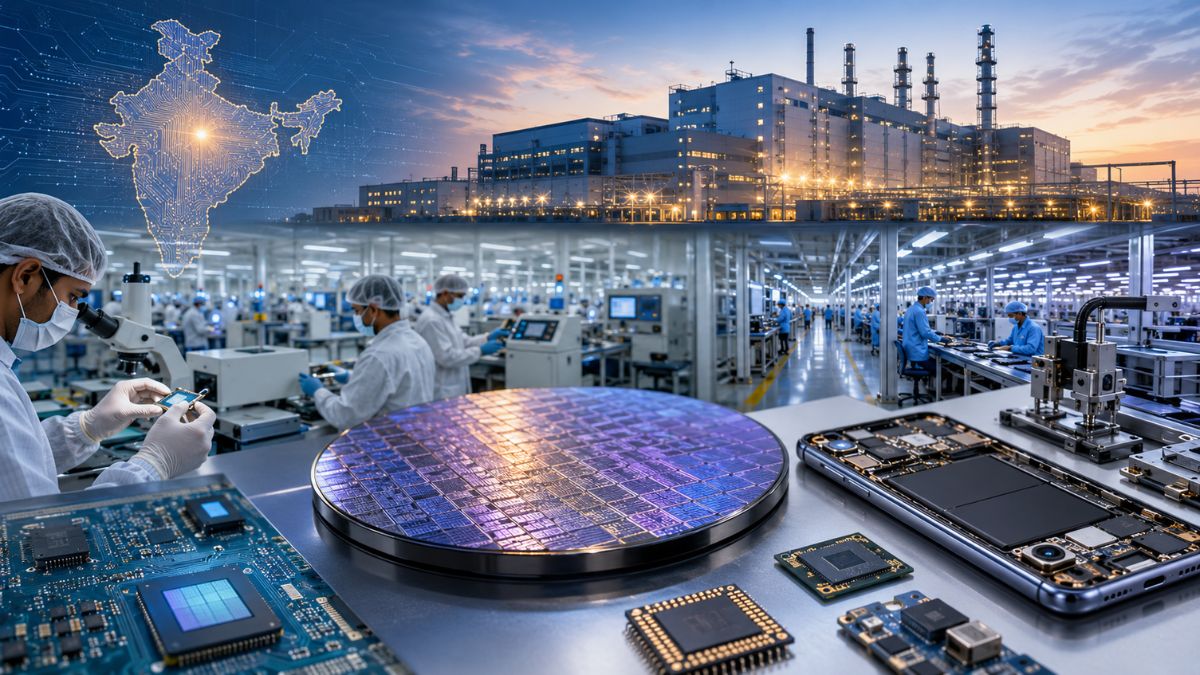
If there is one business within the Tata Group‘s sprawling portfolio of newer ventures that appears to have turned a corner—not just in aspiration but in execution—it is Tata Electronics.
That is a meaningful distinction in the current moment. While Air India and Tata Digital—arguably the two most high-profile bets of N Chandrasekaran’s tenure as chairman—are expected to continue reporting losses for at least the next three years. Tata Electronics, by contrast, has a different kind of story to tell.
According to estimates, the company is on track to exit FY26 with revenues of Rs 1 lakh crore—and, crucially, with a profit. While other businesses were fielding questions about turnaround timelines and loss containment, Tata Electronics had shifted the conversation to execution and scale. By all accounts, it emerged as one of the strongest positive stories of the day, with the board expressing clear confidence in the group’s electronics and semiconductor ambitions.
The speed of Tata Electronics’ transformation is worth pausing on. Not long ago, the company was a relatively modest precision manufacturing operation. Today, it is the vehicle through which the Tata Group is attempting something far more ambitious: building an end-to-end presence across electronics manufacturing, iPhone supply chains, semiconductor fabrication and chip packaging.
Staggering numbers
The numbers attached to these plans are staggering. Tata Electronics is leading the construction of a Rs 91,000-crore semiconductor fabrication plant in Dholera, Gujarat, and a separate Rs 27,000-crore semiconductor assembly and testing facility in Assam. Together, these projects represent one of the largest industrial investments ever undertaken by an Indian conglomerate—and a critical plank in India’s national effort to build a domestic semiconductor ecosystem and reduce its dependence on imports.
On the electronics manufacturing side, the company has established itself as a meaningful player within Apple’s global supply chain, assembling iPhones in India and supplying components to major global technology brands. Early acquisitions of stakes in contract manufacturers Wistron and Pegatron gave Tata Electronics a running start—and, just as importantly, a degree of credibility within Apple’s notoriously demanding supply chain. “This further helps in building perception,” as one industry expert put it.
The broader strategic context is working in its favour. Geopolitical pressure on global technology companies to reduce their manufacturing dependence on China has accelerated the search for alternative production bases. India, backed by its production-linked incentive schemes and a large, cost-competitive workforce, has emerged as the most credible alternative at scale. Tata Electronics is well-positioned to be the primary beneficiary of that shift.
“Of course, the biggest opportunity is India’s growing electronics market, which consumes all sorts of components including chipsets,” said Faisal Kawoosa, founder and chief analyst at Techarc. “Then we also have several global brands which have made India their second most important destination after the home country on their supply chain map.”
The business also benefits from a structural advantage that most of the Tata Group’s newer consumer-facing ventures do not enjoy. Unlike digital platforms that burn capital chasing customer acquisition, Tata Electronics is tied to long-term manufacturing demand, supply-chain localisation and government-backed industrial policy. “The company is not attempting to create new consumer behaviour,” as one industry veteran observed. “It is positioning itself inside global manufacturing and technology supply chains that already exist.”
In a recent media interview, CEO and MD Randhir Thakur has articulated an even more expansive ambition—building Tata Electronics into a $30-billion business, with the semiconductor fabrication play at the heart of that vision.
None of this means the path ahead is straightforward. Semiconductor manufacturing is among the most capital-intensive and technologically unforgiving industries in the world. Gestation periods are long, technological cycles are rapid, and global competition—from established players in Taiwan, South Korea and the United States—is fierce. The ultimate test for Tata Electronics will not be whether it can break ground on a fab plant, but whether it can achieve competitive yield rates, win customers beyond the Indian market, and remain viable once government support is eventually phased out.
Kawoosa flagged a more fundamental question: “We need to see how Tata will do it differently and develop things fundamentally out of India, minimising dependence on the global supply chain as much as possible. Otherwise, we only become a ‘pass-through’ of value addition.”
Geopolitical volatility, too, cuts both ways. The same global supply-chain disruptions that are driving manufacturing investment into India could also constrain access to raw materials, equipment and critical technology partnerships—particularly in semiconductors, where export controls and technology licensing are increasingly fraught terrain.
Yet within the larger arc of Chandrasekaran’s tenure, Tata Electronics is beginning to look like the one that may vindicate the strategy most clearly. It combines the industrial scale, national strategic relevance and long-term demand visibility that the group’s other newer ventures have struggled to demonstrate simultaneously.
For a group that has spent much of the past decade navigating the turbulence of aviation losses, digital platform competition and legacy restructuring, Tata Electronics represents something rarer and more valuable: a bet that has moved, decisively, from promise to proof.
The numbers that matter
- From obscure precision parts maker to Rs 1 lakh crore in revenue — with a profit — in just a few years
- Rs 1.18 lakh crore committed to semiconductors alone; a $30 billion revenue target on the horizon
The smart moves
- The only Indian conglomerate playing simultaneously in iPhone assembly, semiconductor fabrication and chip packaging
- India’s first serious private semiconductor fab isn’t being built by the government — it’s being built by Tata
The structural advantage
- Doesn’t need to change consumer behaviour or chase platform metrics — the global demand already exists
- Every major tech company wants out of China. Tata Electronics is quietly becoming the answer in India
- Apple now makes roughly 15–20% of its iPhones in India. That number is only going one way.