



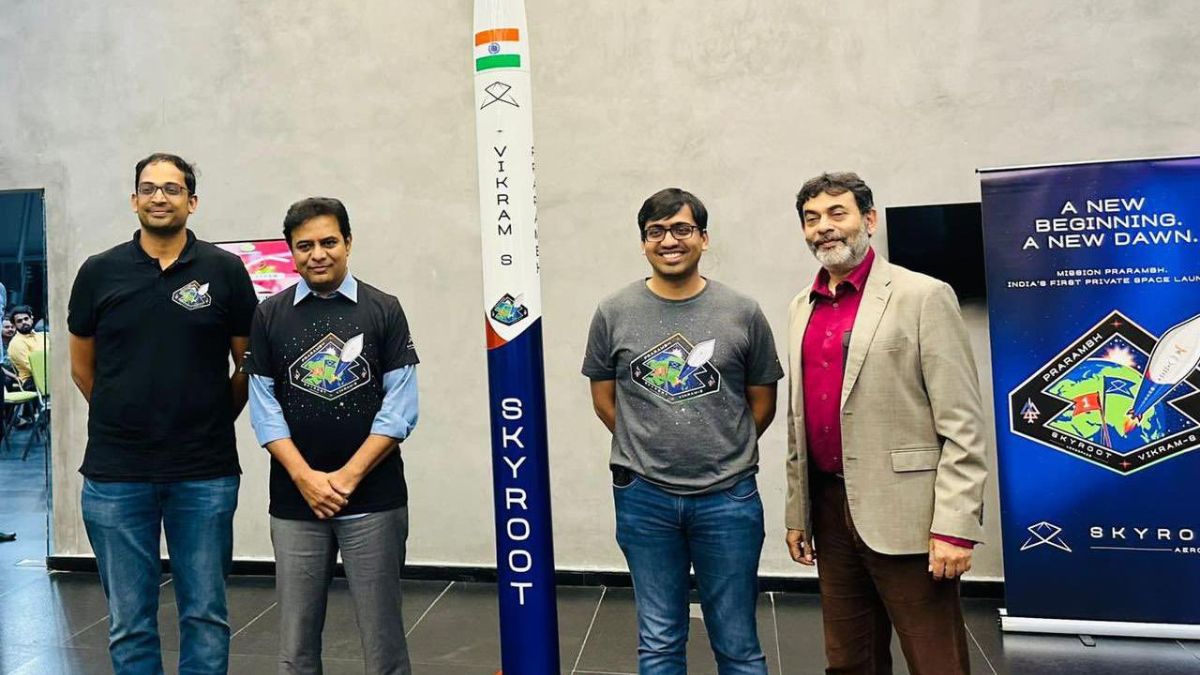
After Vikram-1’s successful launch, Skyroot Aerospace has joined a select group of private companies globally to have developed an orbital launch vehicle. CEO and co-founder Pawan Kumar Chandana and COO and co-founder Bharath Daka in an interview with Poulomi Chatterjee and Rishi Raj on Sunday, spoke at length about building India’s first space-tech unicorn, the road to commercial launches and the challenges of creating a deep-tech business. Excerpts:
What opportunity did you two spot that prompted you to leave Isro and start Skyroot?
Pawan: We saw the global space sector moving towards a model where governments and private companies worked together. In India, private firms were largely manufacturing components, not building rockets or satellites. We believed that would change and that India would eventually open its space programme to private innovation. We took that leap of faith in 2018. At the time, we thought it would take about a decade for the ecosystem to mature, but the reforms came much faster. India has only around a 2% share of the global space economy despite being among the top five space-faring nations in terms of capability. That gap represented the opportunity.
How do you make the business sustainable over the long term?
Bharath: Reaching orbit is the hardest milestone and we achieved that in our first attempt, which is extremely rare. But the bigger challenge begins now. We have to repeat this consistently. As we move into production, the focus shifts from engineering excellence to manufacturing quality and operational discipline. The objective is to build rockets reliably at scale. We are targeting a launch cadence of one mission a month by next year and will scale up from there.
How much of Vikram-1 is made in India and what gives you a cost advantage?
Pawan: Vikram-1 is entirely designed and manufactured in India, with over 90% of the components sourced domestically.
That itself is a significant achievement. A low import content helps keep costs competitive. India also has a mature manufacturing ecosystem built through aerospace and defence, along with highly skilled engineering talent available at competitive costs.
What were the biggest hurdles in building Vikram-1?
Pawan: Raising capital was one of the toughest challenges because space technology requires patient capital. Revenues come much later and the technology risks are high. When we started, there wasn’t a single investor in India with a dedicated space-tech thesis. We had to raise capital even before the space policy was announced, which meant convincing investors to back a sector that did not yet exist commercially. The second challenge was talent. More than 90% of our workforce had never worked in the space sector. We had to train them from scratch. And then there is the complexity of rocket technology itself, where only a handful of countries and companies have real expertise.
What is Skyroot’s competitive advantage globally?
Bharath: Our market is global, so we compete with international players from day one. Today, the differentiator is not price but reliability because launch capacity globally remains constrained. Once customers know your rocket can consistently reach orbit, the market opens up. Pricing becomes important only when there are many proven launch providers. India already enjoys a reputation for delivering cost-effective space missions and that gives us a natural advantage as the market matures.
When do launches become the company’s primary source of revenue?
Pawan: Launches will eventually become our core business, although it is difficult to estimate the revenue mix today. Vikram-1 is only the beginning. We are also developing Vikram-2, which will carry payloads of up to 1,000 kg, nearly three times that of Vikram-1, allowing us to serve a larger customer base. We are targeting its first launch by the end of next year. We are also working on reusable launch vehicles, although those are still a few years away. Commercially, the market opens up after two successful orbital launches. That is when customers gain confidence and we can fully price the vehicle. Even the first mission is semi-commercial. While it is not profitable, it does generate revenue.
What is holding back India’s deep-tech ecosystem?
Pawan: In mature deep-tech markets, governments act as anchor customers. SpaceX, for instance, received significant Nasa contracts very early, even before it had fully proven itself. That created confidence and helped build a sustainable business. In comparison, it took Skyroot nearly seven years to raise $100 million. India has made tremendous progress on the regulatory front. IN-SPACe has streamlined approvals, while Isro has supported us with launch infrastructure and integration facilities. The next step is for government agencies to become meaningful customers as well. That will provide predictable demand and help create a sustainable private space ecosystem.