


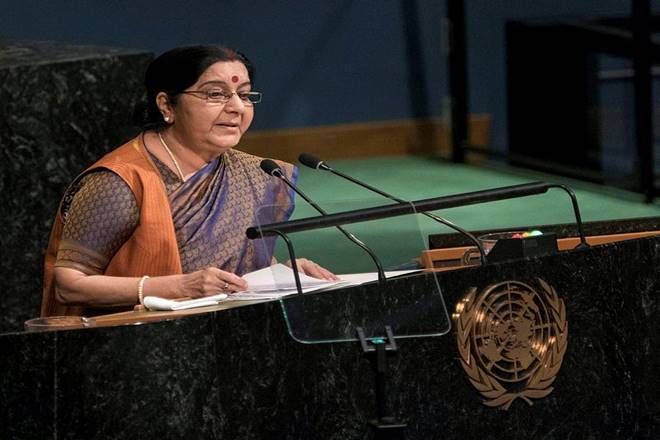

Sushma Swaraj on Saturday addressed United Nations General Assembly for the second time. Swaraj spoke vividly on a number of issues including terrorism, climate change, and India’s efforts to curb poverty. Swaraj described terrorism as an “existentialist danger” to mankind and wondered how the international community will fight the menace if UN Security Council cannot agree on the listing of terrorists. Swaraj said terrorism is at the very top of problems for which the United Nations is searching for solutions. “If we cannot agree to define our enemy, how can we fight together? If we continue to differentiate between good terrorists and bad terrorists, how can we fight together? If even the United Nations Security Council cannot agree on the listing of terrorists, how can we fight together?” she said.
Without naming, Swaraj was apparently referring to China. “I would like to request this august assembly to stop seeing this evil with self-defeating and indeed meaningless nuance. Evil is evil. Let us accept that terrorism is an existentialist danger to humankind. There is absolutely no justification for this barbaric violence,” she said. The EAM also called on the UN member states to display their new commitment by reaching agreement on the Comprehensive Convention on International Terrorism this year itself. Lambasting Pakistan, Swaraj said that Pakistan PM Shahid Khakan Abbasi wasted too much time. “We are completely engaged in fighting poverty; alas our neighbour Pakistan is engaged in fighting us,” she said. “On Thursday, from this dais, Pakistan’s Prime Minister Shahid Khakan Abbasi wasted rather too much of his speech in making accusations against us. He accused India of State-sponsored terrorism, and of violating human rights. Those listening had only one observation: “Look who’s talking!” she added.
On climate change, Swaraj said, “Nature sent its warning to the world even before the world’s leadership gathered in New York at the United Nations through Harvey,” she said. The EAM added that once the gathering of world leaders at the UNGA began, an earthquake struck Mexico and a hurricane landed in Dominica. “We must understand, this requires more serious action than talk. The developed world must listen more carefully than others, because it has more capacities than others. It must help the less fortunate through technology transfer and Green Climate Financing – that is the only way to save future generations,” Swaraj said.