


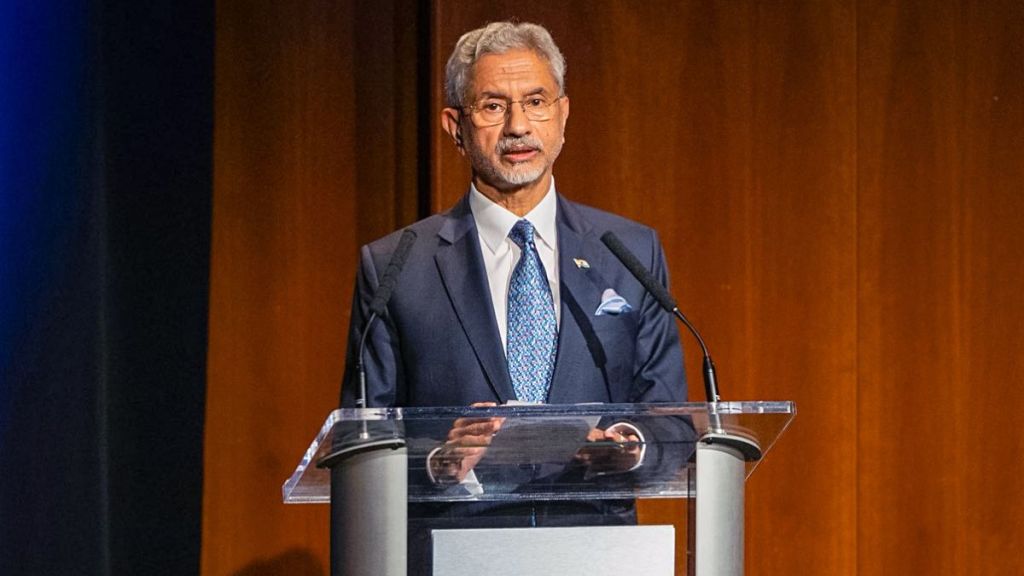

Days after External Affairs Minister Dr S Jaishankar reiterated that India will exercise its right to defend itself against terrorism, he flagged the United States’ “lack of empathy” towards how the country continues to face persistent Pakistan-orchestrated cross-border terror threats. Without mincing words, he underscored that America’s approach emerged as a major hurdle in India-US relations, further complicating trade talks between the two democracies.
The top Indian official delivered his bold remarks at an event hosted by the Asia Society in New York on Monday. Like his address at the United Nations General Assembly, Jaishankar left no doubt about which nation he was referring to while raising concerns about state-sponsored terrorism even though he didn’t actually name Pakistan during either speech.
What did Jaishankar say about India-US ties?
“Perhaps there are very few countries which have been subjected to the kind of terrorism that we have from a neighbour as part of a deliberate conscious policy over many, many decades,” Jaishankar said of Pakistan weaponising terrorism.
He particularly emphasised that if a security issue remains “particularly important” to India but foreign policies fail to show “enough understanding or appreciation or empathy of that”, it creates a problem on the diplomatic front as well.
As India has repeatedly made its position on relations with Pakistan clear, US President Donald Trump, on the other hand, has extended cordial ties with Islamabad time and again. Even currently, Pakistan has emerged as one of the key mediators between the US and Iran amid the ongoing West Asia conflict that began in late February following America and Israel’s joint military action against Tehran.
In April, Pakistan celebrated its role in helping negotiate a short-lived ceasefire between the US and Iran, with peace talks being held in Islamabad.
The US even notably hosted several top Pakistani officials, including Pakistan’s Army Chief Asim Munir, shortly after India and Pakistan were embroiled in a days-long military conflict last year following the Pahalgam terror attacks in April and India’s subsequent punitive Operation Sindoor in May. In a rare move, the US president hosted a luncheon meeting for the Pakistani Army Chief in June 2025.
Last year saw Trump persistently take credit for brokering a ceasefire deal between India and Pakistan after Operation Sindoor. Prime Minister Narendra Modi, however, vehemently rejected any similar assertions, firmly stating that India will “never accept” mediations in such cases. India’s top officials maintained that the South Asian neighbours stopped their military actions following direct talks between the two militaries without any US mediation.
What did Jaishankar say at the UNGA
Days ago, Jaishankar also took the stage at the 81st UN General Assembly in New York, where he flagged Pakistan as a “serial practitioner of terrorism.” Although he refrained from name-dropping the South Asian neighbour, the Indian EAM directly referenced claims made by Pakistani PM Shehbaz Sharif’s speech at the forum the previous day.
“Yesterday, a serial practitioner of terrorism misrepresented fact before this assembly. Arguments were invoked to normalise terrorism and claim immunity for its consequences,” Jaishankar said at the UNGA. “That will not stand.”
Asserting India’s zero-tolerance approach towards terrorism, he continued, “Our right to defend ourselves against terrorism will be exercised. Friendship and goodwill cannot coexist with terrorism, and understandings premised on that will naturally be called into question. It is for the perpetrator of terrorism to mend its ways.”
The previous day, the Pakistani prime minister alluded to India’s Operation Sindoor, which involved targeting terror infrastructure in Pakistan and Pakistan-occupied Kashmir, as an act of “external aggression” launched under a “false pretext.”
In addition to praising Pakistan’s Field Marshal Asim Munir for “silencing” the “enemy,” Sharif went on to thank Trump for his “timely intervention” in the yesteryear India-Pakistan conflict.