


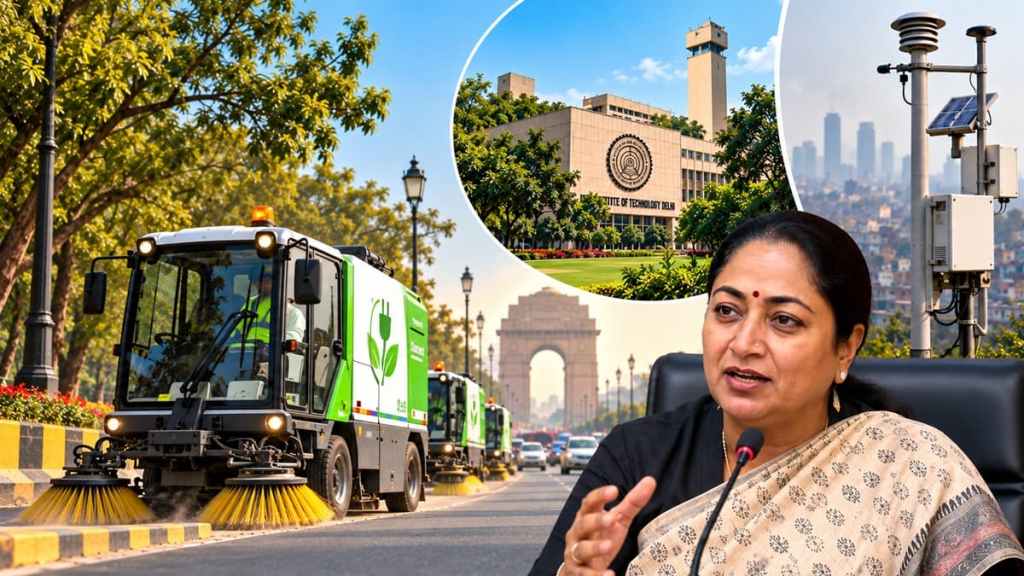

The Delhi Cabinet on Tuesday approved a Rs 413-crore pollution-control package focused on reducing road dust and tracking the sources of particulate pollution in real time, ahead of the winter season. The decisions were taken at a Cabinet meeting chaired by Chief Minister Rekha Gupta and are part of the Delhi government’s Winter Action Plan 2026-27, according to a government release.
The package includes the deployment of as many as 30 electric vehicle-based mechanical road-sweeping machines on smaller roads where mechanised cleaning is currently unavailable. The government has also approved a five-year collaboration with IIT Delhi to continuously monitor and analyse the sources of PM2.5 and PM10 pollution.
Rs 393.73 crore for 30 electric road sweepers
Under the road-cleaning programme, mechanised sweeping will be expanded to around 609 km of roads with a right of way of less than 10 metres. The government has identified 854 roads across 250 wards for the initiative.
The 30 electric sweeping machines are estimated to cost Rs 393.73 crore over a period of 10 years. The machines will be procured using a grant from the Delhi government, while the Municipal Corporation of Delhi (MCD) will be responsible for operating them on the ground.
The government said the use of electric machines is intended to help reduce road dust while ensuring that the cleaning process itself remains environmentally cleaner.
The dust on road is among the sources that the government plans to address as part of its wider pollution-control strategy.
IIT Delhi to track pollution sources in real time
The second component of the Cabinet’s decision involves a Rs 19.22-crore project with IIT Delhi for real-time monitoring of PM2.5 and PM10 sources, The Indian Express reported.
The collaboration will run for five years and seek to identify how different pollution sources contribute to Delhi’s particulate pollution at different times of the day.
According to The Indian Express, the monitoring system will examine sources including vehicle emissions, road dust and biomass burning.
The project will also involve the reactivation of the existing super site at Rouse Avenue and a mobile laboratory.
A real-time dashboard and analytical reporting system will be developed under the initiative. The government also plans to strengthen the technical capacity of officials of the Delhi Pollution Control Committee (DPCC) to use and analyse the data generated by the system.
The aim is to provide authorities with more detailed information on the sources contributing to pollution, allowing pollution-control measures to be targeted at specific sources.
Delhi government targets year-round pollution control
Chief Minister Rekha Gupta said the government’s pollution-control efforts would not be restricted to the winter months.
She said various government departments, the MCD, DPCC and scientific institutions would work together to tackle pollution from multiple sources, including road dust, vehicles, construction activity, industries and waste or biomass burning.
The two Cabinet decisions are part of Delhi’s Winter Action Plan 2026-27, which seeks to combine ground-level measures with clean technology and scientific monitoring.
The government said the approach would focus on identifying and addressing pollution at its sources rather than relying only on seasonal measures during the winter months.