



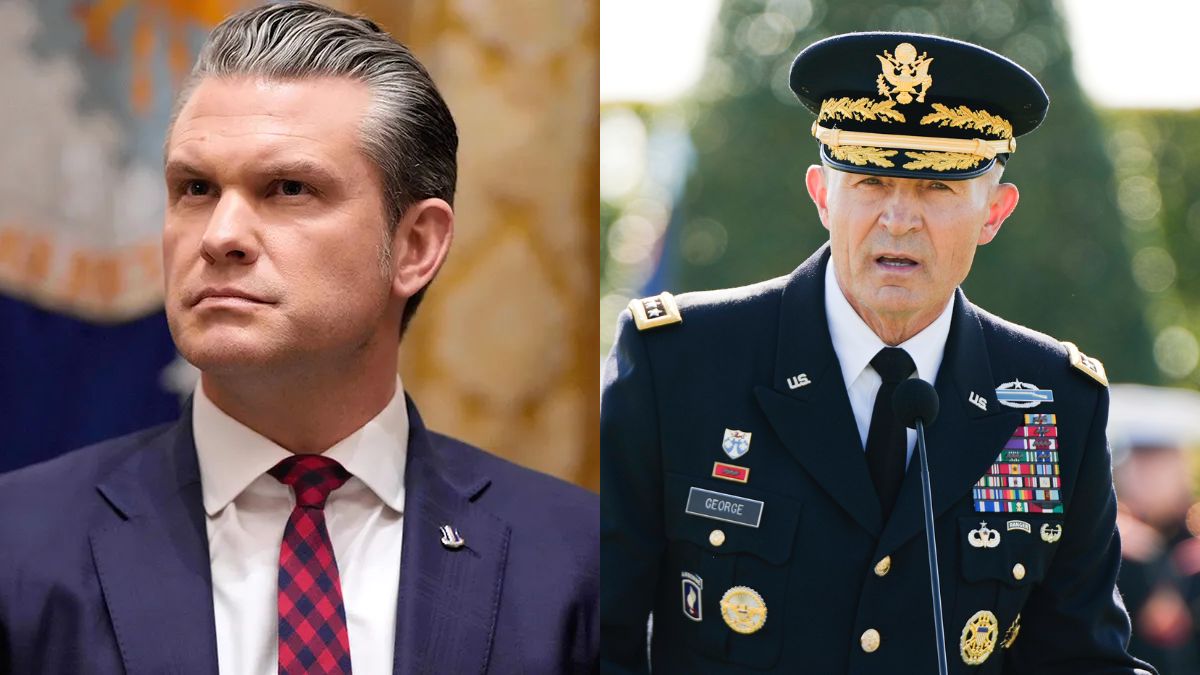
US Defense Secretary Pete Hegseth has asked Army Chief of Staff Randy George to step down and retire, a US official told NPR. Shortly after, Pentagon spokesperson Sean Parnell confirmed that General George is “retiring effective immediately.” He is expected to be replaced by Christopher LaNeve, who earlier worked closely with Hegseth as his senior military assistant at the Pentagon.
According to the NYT, General George, who took over the role in 2023, was informed about the decision during a phone call on Thursday around 4 pm. News of his firing broke almost at the same time.
This decision comes at a tense moment. The war in the Middle East has now entered its fifth week, with fighting showing no signs of slowing down.
Why Hegseth fired Army chief Randy George?
People familiar with the situation told NYT that this decision did not come from any major disagreement over the Army’s strategy. Instead, it was the result of long-running tensions. Hegseth has had a difficult relationship with Army leaders, especially with Army Secretary Daniel P. Driscoll. Over the past year, Driscoll and General George had built a strong working partnership, which officials say may have added to the friction.
The defence secretary had also been pushing for changes in Army personnel decisions, something both George and Driscoll resisted.
Dispute over promotions raised concerns
One of the biggest reasons, according to the NYT, was Hegseth’s decision to block the promotion of four Army officers to one-star general rank. Out of these four officers, two were Black and two were women. They were part of a larger list of 29 officers, most of whom were white men. Hegseth’s move raised eyebrows within the military.
Two weeks ago, General George even asked for a meeting with Hegseth to discuss the issue and what he saw as unnecessary interference in Army matters. That meeting never happened. Hegseth reportedly declined to sit down with him.
The situation became more public when Laura Loomer, a far-right figure close to Hegseth and President Donald Trump, posted online that the defence secretary was “seriously considering” removing General George.
Other top officials also removed
General George was not the only one shown the door. Hegseth also removed David M. Hodne, who had recently been given a key role overseeing Army training and transformation. In addition, Maj. Gen. William Green Jr., the Army’s top chaplain, was also fired.
According to the NYT, inside the house, the reaction has been strong.
Senior officers described George’s removal as another blow to a force that already feels under pressure. In recent months, several experienced three- and four-star generals, many with combat experience in Iraq and Afghanistan, have either been pushed out or sidelined.
Back in October, Vice Chief of Staff James J. Mingus was forced to step down earlier than expected, in a move that also caught many by surprise.
Focus on modern warfare
As the NYT reports, George also pushed for faster use of low-cost drones and new targeting systems, taking lessons from the war in Ukraine. He also launched a program called “transformation in contact,” where Army units tested new tools and tactics in real conditions.
To fund these changes, he cut back on older systems. One example was the M-10 Booker light tank. Despite costing over $1 billion to develop, it was seen as too vulnerable to cheap drone attacks. Instead, he backed lighter and faster vehicles like the Infantry Squad Vehicle, which relies on speed and mobility rather than heavy armour. He also supported the development of a new version of the Abrams tank, designed to be lighter and more flexible on the battlefield.