



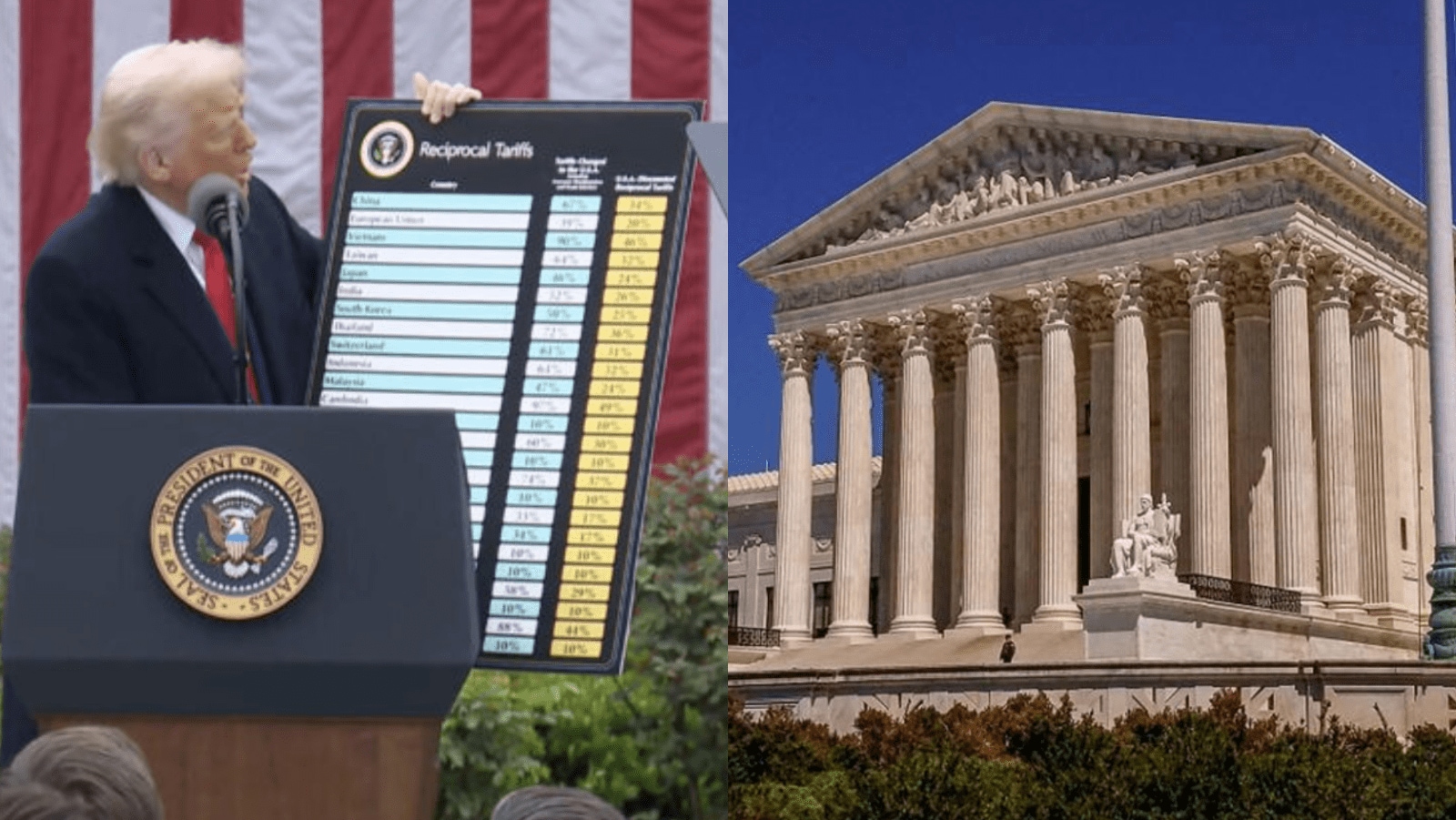
The US Supreme Court has postponed its decision on a major legal challenge to President Donald Trump’s tariff policy. The delay means there will be no final ruling for several more weeks. According to Bloomberg, the court is about to begin a four-week recess.
The earliest likely date for a decision is now February 20, when the justices are next expected to release opinions. This is the third-straight time the ruling was not released as expected. It also did not issue a ruling on January 9 in cases questioning whether Trump overstepped his authority in imposing the tariffs.
A ruling against the administration could have wide-ranging consequences. Analysts say it could lead to more than $130 billion in tariff refunds. It could also weaken Trump’s ability to threaten new trade penalties in the future. Such a decision would mark Trump’s biggest legal defeat since returning to the White House.
Case focuses on “liberation day” tariffs
The dispute centres on Trump’s April 2 tariff announcement, which he branded the “Liberation Day” initiative. Under this plan, the administration imposed tariffs ranging from 10% to 50% on a wide range of imported goods.
Separate duties were also placed on imports from Canada, Mexico and China. The White House defended these measures over fentanyl trafficking and national security. It relied on a 1977 law that allows presidents to take special action during declared national emergencies.
Judges raise concerns over presidential powers
During arguments on November 5, several Supreme Court justices appeared uncomfortable with the administration’s legal argument. They questioned whether the 1977 emergency law actually allows tariffs of such size and scope. Because the court agreed to fast-track the case, critics had expected a speedy decision. Instead, the lack of a ruling this week has extended uncertainty for businesses, investors and foreign governments.
Huge financial and political stakes
Treasury Secretary Scott Bessent has strongly defended the tariff policy. Speaking on NBC’s Meet the Press, he said, “The national emergency is avoiding a national emergency.” He added that the administration is using, “the economic might of the US to avoid a hot war.” Over the past year, Trump has repeatedly declared national emergencies to justify tariffs tied to trade deficits, drug trafficking and broader security concerns.
At the same time, officials have hinted at alternative options. Trade adviser Jamieson Greer said that if the Supreme Court limits presidential powers under the emergency law, Trump could rely on other trade laws, such as Section 301 — a tool frequently used against China during Trump’s first term.
Trump has framed the case as critical to national security. He recently warned, “if the Supreme Court rules against the United States of America on this National Security bonanza, WE’RE SCREWED!”