



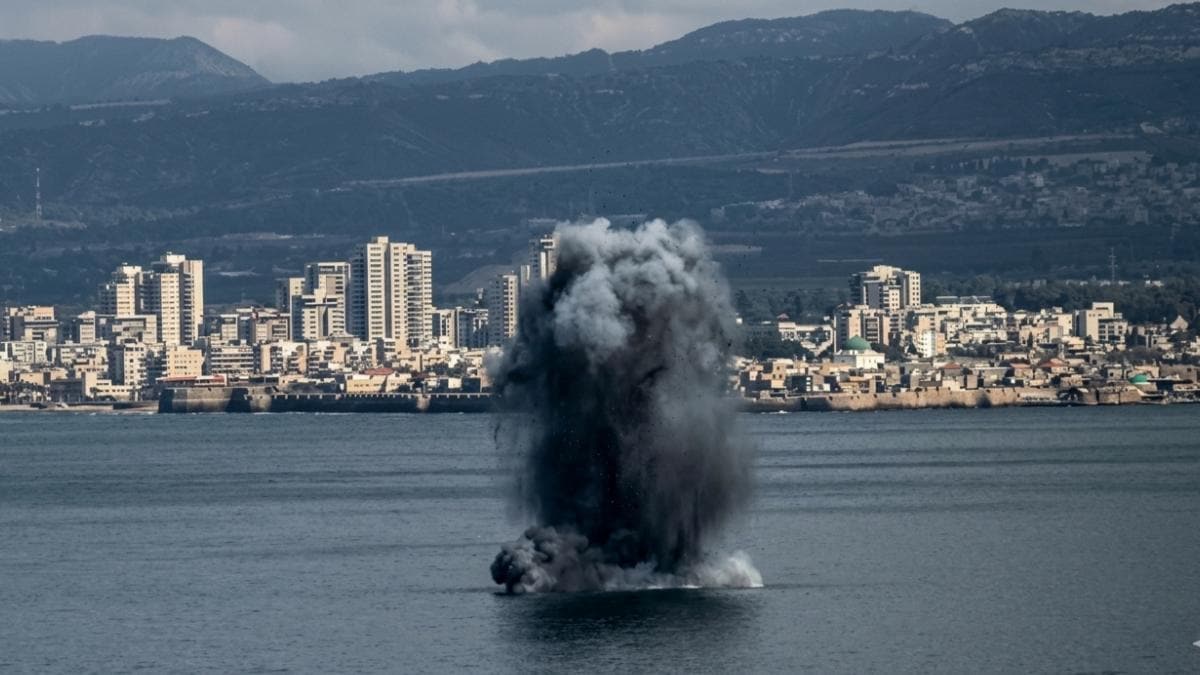
The skies above Abu Dhabi lit up with explosions as Iran unleashed a sweeping ballistic missile barrage across the Gulf. The latest escalation between the US-Israel alliance and Iran has now dragged the United Arab Emirates — one of the world’s most consequential business hubs — into the most dangerous regional conflict in decades.
The strikes were Iran’s retaliatory answer to a major joint US-Israel military operation against Iranian soil earlier in the day. Tehran’s Islamic Revolutionary Guard Corps (IRGC) left little room for ambiguity by stating, “All Israeli and US military targets in the Middle East have been struck by the powerful blows of Iranian missiles.” IRGC added that “this operation will continue relentlessly until the enemy is decisively defeated”.
Why did Iran attack UAE?
The UAE was not a diplomatic adversary of Iran — it was collateral ground. Iran’s missiles targeted US military infrastructure hosted on Emirati soil, using Gulf host nations as the battlefield in a war between Tehran and Washington.
UAE air defenses intercepted several incoming projectiles, but the shield was imperfect. Debris from one missile tore into a residential area in Abu Dhabi, resulting in the first civilian casualty on Emirati soil. Across Dubai, the scene descended into chaos. The UAE temporarily shut its airspace as Emirates airline scrambled to divert flights, while Air Arabia cancelled regional routes wholesale.
UAE’s tough response on Iran strikes
The UAE Ministry of Defense called it “a blatant attack” handled “with high efficiency”. “The UAE reaffirmed its categorical rejection of the use of the territories of regional states as arenas for settling disputes or expanding the scope of conflict, warning of the grave consequences of continued violations, which undermine regional and international security and threaten global economic stability and energy security,” an official statement by the UAE’s Ministry of Foreign Affairs stated.
The UAE said it reserves its full and legitimate right to respond to the attacks in a way that protects its sovereignty, national security and territorial integrity. “[The UAE will] ensure the safety of its citizens and residents, in accordance with international law. The UAE will not tolerate any compromise to its security or sovereignty under any circumstances,” the statement read.
Oman remains untouched
As the crisis spreads across the Gulf, Oman stands out as the lone holdout so far. At the time of writing this report, it is the only member of the six-nation Gulf Cooperation Council that has not been targeted by Iranian strikes.
For years, Muscat has played the region’s quiet diplomat, acting as a trusted channel between Iran and the outside world. It also hosted recent indirect talks between Tehran and Washington in Oman and Geneva.
Just hours before the conflict erupted, Oman’s Foreign Minister Badr Albusaidi had said that peace was “within reach” after Iran reportedly agreed not to stockpile enriched uranium. That optimism vanished overnight. With US and Israeli strikes on Iran, the fragile dialogue now lies in ruins.
Expressing deep dismay at the escalation, Albusaidi urged Washington to avoid deeper involvement. “Neither the interests of the United States nor the cause of global peace are well served by this. And I pray for the innocents who will suffer. I urge the United States not to get sucked in further. This is not your war,” he posted on X.
What it means for the Gulf
Dubai’s entire economic identity — the safe harbour, the neutral meeting ground, the city above war — has taken a direct hit. The Burj Al Arab being struck by drone debris is not just structural damage; it is reputational damage to the idea of Dubai as untouchable.
Qatar, Kuwait, Bahrain and the UAE all temporarily closed their airspace. With the Strait of Hormuz also blocked, the Gulf is simultaneously cut off by air and by sea — an unprecedented dual closure.
Saudi Crown Prince Mohammed bin Salman called UAE President Sheikh Mohamed bin Zayed, expressing full solidarity and placing all the Kingdom’s capabilities at the UAE’s disposal. Riyadh, which had been carefully managing its Iran relationship, is now publicly in the anti-Iran camp.
The India Impact
This directly affects India’s 3.5 million in the UAE and 8 million across the Gulf. The UAE was the fallback, the safe Gulf destination where stranded Indians could wait out instability elsewhere. That buffer is now gone. Indian missions in Abu Dhabi and Dubai have both issued shelter-in-place alerts. FlyDubai is grounded. Air India has cancelled European routes routed through Gulf airspace. The assumption that Dubai would always be open is no longer valid.