



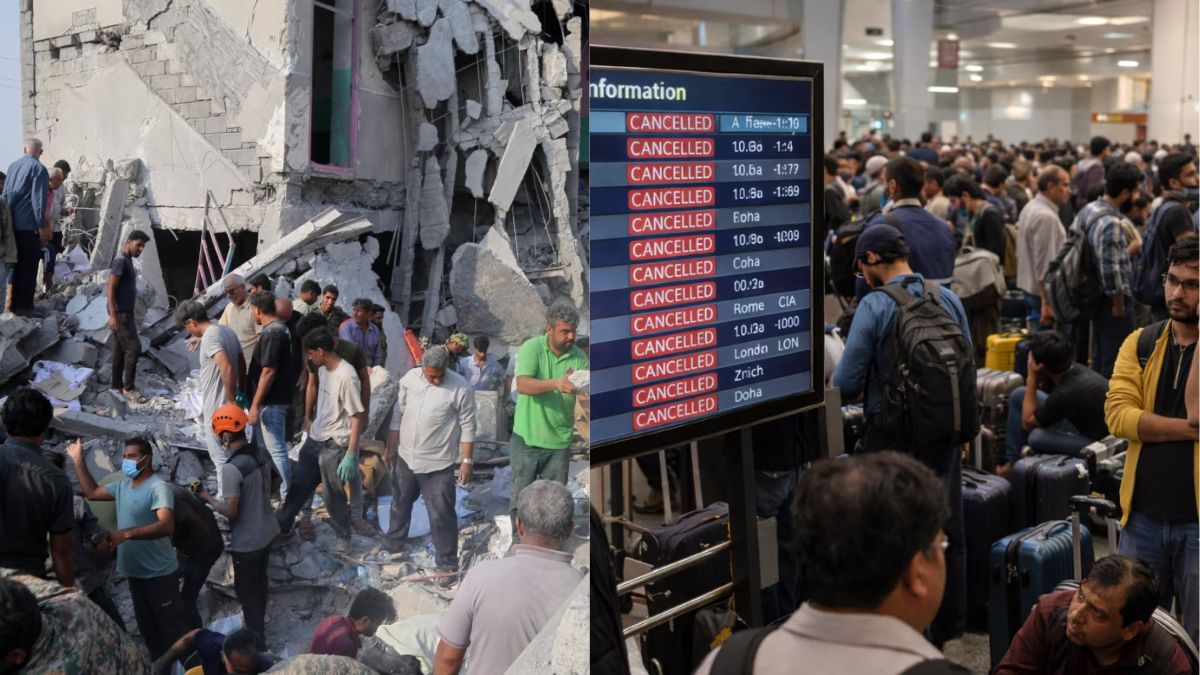
A chilling “four-week” countdown has begun. US President Donald Trump’s latest declaration, that the ongoing military operations against Iran will be a “great deal” and could be wrapped up in just 28 to 35 days, has sent shockwaves through the Indian diaspora.
As Operation “Epic Fury” intensifies, the 9 million Indians living and working in the Middle East are no longer just spectators; they are in the line of fire. From the shuttered airports of Dubai to the makeshift bunkers in Kuwait, the fear is palpable.
Searching for bunkers, not bread
For the millions of blue-collar workers who built the skylines of the GCC, the dream of a better life has turned into a nightmare of sirens and uncertainty. One Indian worker in Dubai posted a video on Instagram that instantly went viral. “I came here for a livelihood, but I am now seeking a bomb shelter. I request Modi Ji and the Indian government to evacuate us from here,” he captioned the video.
In Kuwait, the situation feels even more serious. Smoke was seen rising near the US Embassy there today. Ananya Datta, who lives in Kuwait, told reporters that the constant threat of missile and drone attacks has changed daily life completely. “Streets that were once busy now look empty. Many people are staying indoors,” she wrote in a one X post.
Workers say most residential buildings in Gulf cities do not have proper bomb shelters. Some also claim their employers are reluctant to let them leave, worried that businesses will collapse if workers go home during this “four-week” period.
Back in India, families are growing restless. Social media is flooded with posts from worried parents and spouses. As news slowly comes in about Iranian retaliatory strikes hitting targets in the UAE and Saudi Arabia, fear is spreading faster than official updates.
Saibal Basu, an engineer in Doha, told Bengali media that he saw missiles being intercepted near a US airbase. “There is a curtain of black smoke around the Doha skyline,” he said.
In Abu Dhabi, Mohammad Musim from Bihar narrowly escaped a missile blast just 200 metres from his work camp. His words struck a chord online: “If I had employment in my own country, why would I come here?”
Indians stuck in Gulf amid aviation chaos- “We Just Want to Come Home”
In Thane, 23 tourists, including 12 senior citizens, remain stuck in Dubai. In Gujarat, families are video-calling their children every hour. Stranded passengers from Punjab say they have run out of local currency.
Air travel across the region has been badly hit. Anyone planning to fly to or through the Middle East is facing cancellations, diversions, or long delays. Air India has suspended all flights to the UAE, Qatar and Saudi Arabia until further notice. IndiGo and SpiceJet have either rerouted hundreds of flights through Central Asia or cancelled them mid-journey. Meanwhile, Emirates and Etihad Airways have largely frozen operations at their Dubai and Abu Dhabi hubs.
VIDEO | Dubai, UAE: Tourists from Karnataka’s Ballari stranded at Dubai Airport seek government help after airspace closures across the UAE and parts of the Middle East following US-Israel strikes on Iran.
— Press Trust of India (@PTI_News) March 1, 2026
(Source: Third Party) pic.twitter.com/74VGlLgsNY
On X, the hashtag #DubaiAirport is trending. Videos show thousands of passengers, many of them Indians, sleeping on terminal floors, surrounded by luggage, confused about their next steps.
Subhashree, who was transiting through Doha, shared her frustration online: “There is no information. The ‘4-week’ promise feels like an eternity when you’re stuck in an airport with missiles flying overhead.”
Around 3,000 Indian students, many from Kashmir, are currently in Iran. With airspace shut and internet services unstable, they feel cut off.
Ayesha, a medical student in Tehran, described the situation, “We are hearing bomb sounds every 15 minutes. It is very disturbing here. When the embassy gave us the advisory to leave, our university said if you leave, you will fail.”
India is issuing advisories and helplines
The Ministry of External Affairs has activated evacuation protocols for around 10,000 Indians currently in Iran. Most of them are students and pilgrims. On February 28 and March 1, the MEA issued a strong advisory asking all Indian nationals to leave Iran immediately using any available commercial flights.
Embassy of India, Kuwait (@indembkwt) officials continue to be in touch with and assist the Indian nationals stranded in Kuwait due to the temporary airspace shutdown.
— All India Radio News (@airnewsalerts) March 1, 2026
The Embassy is constantly following up on the matter with the local Authorities concerned, the management of… pic.twitter.com/hblRx2MEKY
However, leaving Iran is not simple right now. Much of the regional airspace is either restricted or shut. India is exploring the use of Indian Air Force C-17 Globemaster aircraft, but flying directly in and out has become complicated due to security risks.
For the Indians living and working in Gulf countries like the UAE, Qatar and Kuwait, there is no evacuation order yet. The government’s current approach is focused on safety and coordination rather than pulling people out immediately. External Affairs Minister S. Jaishankar has been in direct touch with his counterparts in the UAE, Qatar and Kuwait. These governments have assured India that the safety of Indian workers will be a priority.
Indian embassies in the region have asked citizens to register on the MADAD portal, keep their passports and travel documents ready, and strictly follow local civil defence instructions, including “shelter-in-place” advisories if issued.
In a reciprocal gesture, India has also offered visa extensions to foreign nationals who are stuck in India and unable to return to the Middle East because of the conflict.
For families worried about loved ones in the region, the Ministry of External Affairs has activated 24/7 emergency helplines. Indian missions in affected countries are responding to distress calls and helping citizens register their details in case evacuation orders are issued.
What happens next?
Over nine million Indians live across Gulf nations. The UAE alone houses nearly 3.5 million Indians, forming the largest expatriate community there. India’s Ministry of External Affairs has set up 24/7 helplines to assist citizens. But with many regional airspaces closed and tensions still rising, a large-scale evacuation like the Vande Bharat mission during the pandemic may not be easy right now.
Trump’s statement that the war could last four weeks has triggered fresh panic among Indian workers whose visas, jobs and salaries depend on stability in the Gulf. An ongoing conflict means Continued airspace closures, salary delays in affected sectors, rising oil prices impacting remittances and expenses, students unable to travel back and workers reconsidering overseas jobs.