



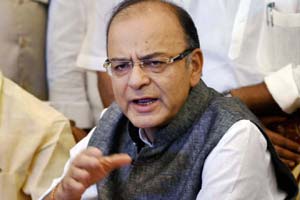
Finance minister Arun Jaitley on Wednesday almost admitted that the government’s goal to usher in the goods and services tax (GST) by April 1, 2016, may not be met, reports fe Bureau in New Delhi.
After the Congress conveyed its resolve to persist with its demands on GST including prescribing the composite rate of the tax at 18% in the Constitution, the government decided to prorogue the monsoon session of Parliament that was adjourned sine die on August 17, the minister said. The session was not called off earlier because the government hoped that if the Congress is brought on board, the GST Constitutional Amendment Bill could be passed by reconvening the House’s monsoon session.
When asked if the GST could be launched by April 1, 2016 as planned, the minister said, “On that, your guess is as good as mine.”
He was speaking at a press conference called to announce Wednesday’s series of Cabinet decisions.
Earlier, speaking at ‘India Summit 2015’ organised by the UK-based Economist magazine, he had said: “I would like to see GST being implemented by April 1, 2016. But if this kind of obstructionism remains, then perhaps the Congress party will succeed in hurting India’s economy and delaying (the GST) for some more time.”
For the entire monsoon session, the Congress continuously disrupted the Rajya Sabha where the Bill needs to be passed by a majority of two-thirds of the members present (it was earlier passed by the Lok Sabha) by sticking to its demand for action against external affairs minister Sushma Swaraj and the chief ministers of Rajasthan and Madhya Pradesh for their alleged misconduct in office. Jaitley flayed the Congress for its “obstructionist” approach. “The Congress party’s anger seems to be against not only the (NDA) government but the people of India who reduced the party to 44 seats (in the Lok Sabha),” he said.
The minister said the government was well-prepared for GST introduction and the only hurdle was the Congress’s alleged disruptive stance that makes it difficult to get the Constitutional Bill passed in the Rajya Sabha. While this Bill needs to be passed by passed two-thirds of the state assemblies also, two central laws (on central GST and interstate GST) and one state law (on state GST) need to be passed by Parliament and state assemblies respectively before the uniform countrywide indirect tax is rolled out. Jaitley said the three drafts of legislation were almost ready and would be finalised by the empowered committee on state finance ministers shortly. The IT backbone was also ready for the roll-out, he said.
The ruling National Democratic Alliance, which lacks numbers in the Rajya Sabha, needed the support of opposition parties to get the Bill approved. The government has a comfortable majority in the Lok Sabha.
Analysts say India badly needed GST to simplify and rationalise the complex structure of taxes at the central and state levels to boost economic activity. There has been a clamour for a tax reform of this nature, the latest being in the high-level meeting convened by Modi on Tuesday with industrialists, bankers and economists, to discuss steps needed to strengthen the economy.
Separately, the finance minister said the government would announce in the next few days the first phase of corporate tax exemptions and incentives to be phased out. In the last Budget, Jaitley had announced a reduction in the corporate tax rate from 30% to 25% over the next four years, but said that this would be accompanied by the elimination of exemptions that have allowed corporates to keep their effective tax rate much below the marginal rate.
Speaking on the health of public sector banks, Jaitley said the government was aware of the high bad loans on the books of the banks and that it was taking steps to de-stress some of the sectors which contribute most towards the rise in bad assets. The sectors include steel, textiles, highways and power distribution companies. He said the government was open to consolidation of fragile banks in the public sector if steps such as recapitalisation of public sector banks did not improve the situation in some cases.