



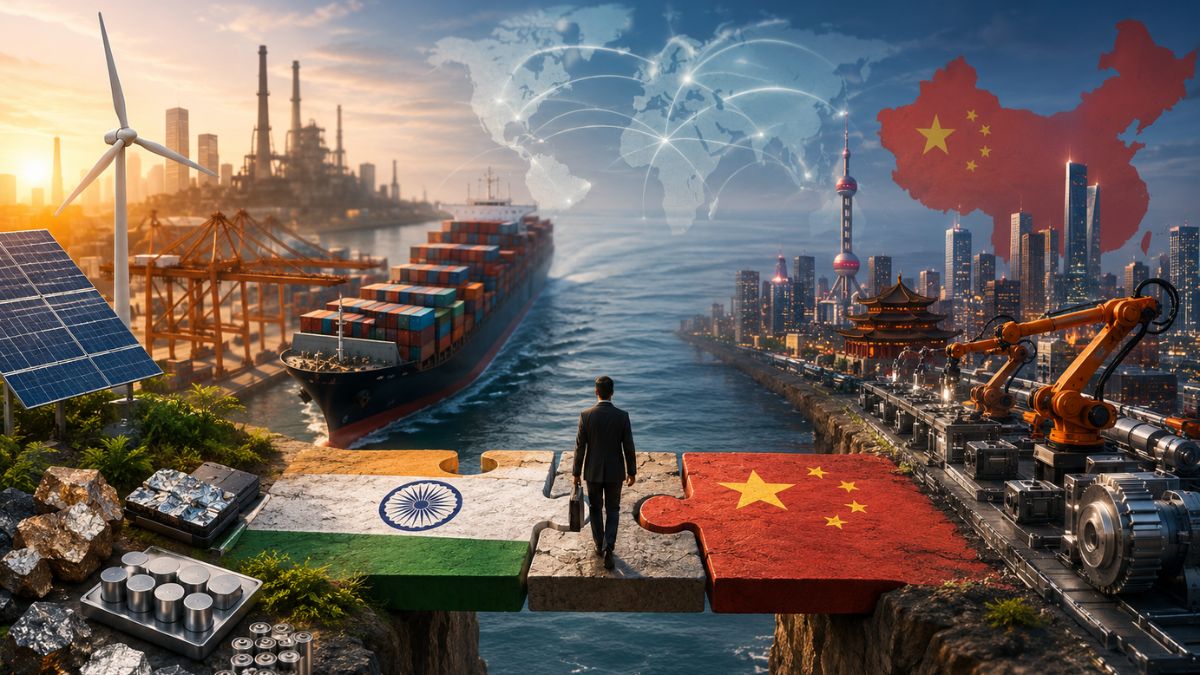
Notwithstanding a set of import substitution policies aimed at giving a head start to new-age manufacturing, India’s dependence on the external world for critical inputs and production technologies has grown manifold. As FE recently reported, China’s grip over the country’s clean-energy and advanced manufacturing supply chains has grown stronger over the past few years.
In FY26, China accounted for nearly 85% of our lithium-ion battery requirements, 78% of permanent magnet supplies, and half of our lithium carbonate needs. Import reliance is equally significant for strategic minerals like germanium and rare earth elements, with key supplies, apart from China, coming from South Korea, Japan, Russia, and the UAE.
We are attempting to diversify the sourcing of these and other foundational materials for emerging production systems, pivoting around the strategic QUAD alliance. The India-US critical minerals framework signed on May 26 in this context seeks to gradually reshape supply chains, and build “trusted” alternatives to China-dominated networks.
Though these are welcome initiatives and align well with New Delhi’s long-vaunted ambition to become a key player in the rapidly transforming global manufacturing landscape, it cannot be reasonably expected that a fully self-reliant ecosystem will evolve anytime soon.
A choice between two
The choice therefore is between an overzealous emphasis on indigenisation and being pragmatic enough to grab a decent share in the changing, tech-driven world of global industrial production. After all, except in a few sectors like solar manufacturing, policies to drive indigenisation haven’t yielded satisfactory outcomes yet.
Time is a critical factor when global supply chains are in an unprecedented flux, and geopolitical developments are unpredictable. In November 2019, India walked away from the China-led Regional Comprehensive Economic Partnership (RCEP), fearing that eliminating tariffs for Chinese goods could exacerbate an already massive bilateral trade deficit with that country and hurt its agriculture and dairy sectors, and local industry.
Since then, the policy rhetoric has been consistent with that stand. Stricter oversight was imposed on foreign direct investment from China and other neighbouring countries, only to relax them recently as these were seen to hamper capacity creation.
However, ironically, India’s trade with China has only soared amid such ostensible policy wariness; China’s trade surplus with India swelled to $112.4 billion in 2025-2026 from $44 billion in FY21. Even the US’s imposition of high tariffs on Chinese goods in 2018 and rising protectionism across the globe hasn’t reversed China’s ascendancy.
New Delhi, in the meantime, has aggressively pursued bilateral trade deals. With all RCEP countries except China, India now has preferential trade pact. It is estimated that 75% of India’s trade will be conducted through the preferential route within a year or so, once the agreements with the US and the European Union take effect.
At the same time, India’s goods exports have seen a severe stagnation in the last decade. Our exports under the regular most-favoured nation route have grown even faster than preferential route shipments, demonstrating that export competitiveness is less a function of tariffs and relies more on structural efficiency and innovation.
India continues to depend heavily on China for even conventional sectors like active pharmaceutical ingredients and synthetic fabrics. The production-linked incentive schemes too have generated business for Chinese firms in a big way. But our goods exports to the giant economy across the border remained abysmally low at $19.5 billion in FY26. India should strive to develop competitive domestic capabilities. Self-interest and pragmatism ought to be the cardinal features of policy.