



By- Sarika Panda Bhatt
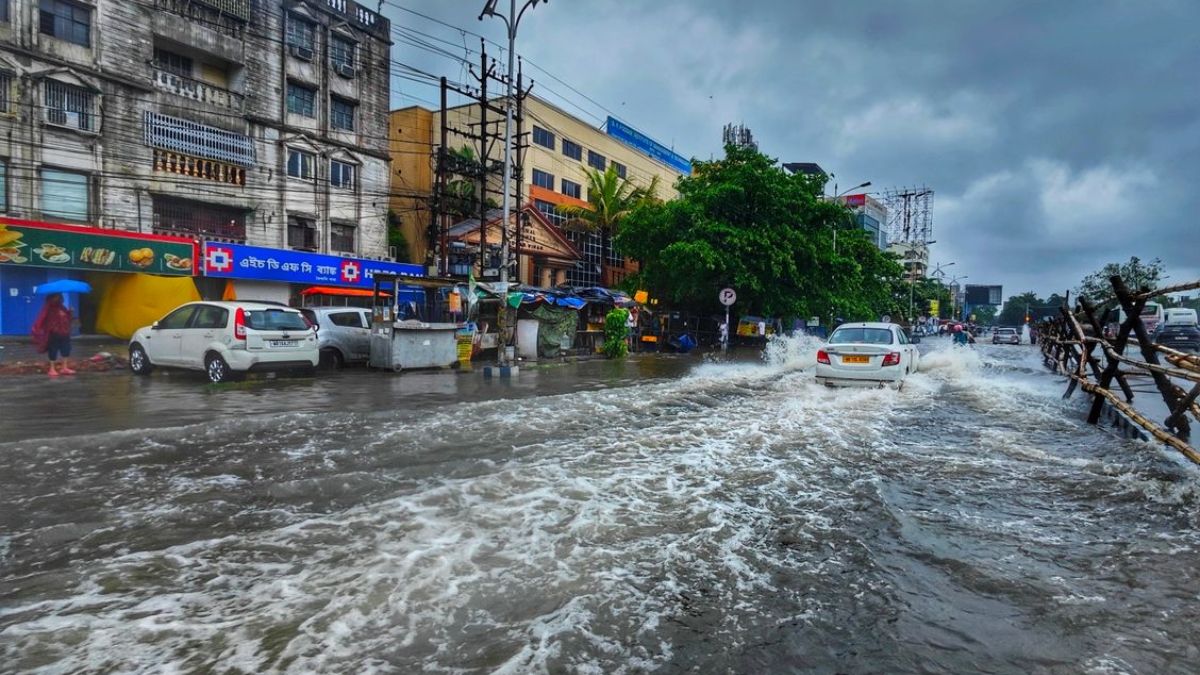
Every monsoon in urban India unfolds in much the same way. The roads fill with water and the underpasses turn into ponds, traffic seizes up for the better part of a day, and within a few weeks the same city that was drowning is gasping under a heat dome. By the time winter arrives, its residents are breathing some of the most toxic air found anywhere in the world.
There is nothing accidental about any of this. It is precisely what our present way of building and running cities produces, year after year, whether or not anyone sets out to produce it.
The scale of the problem is easy to miss until the figures are laid out together. On current trends, roughly two-thirds of urban Indians could be exposed to flooding by 2030. Bengaluru’s built-up area grew close to tenfold between 1973 and 2023, and over the same span, the city’s green cover fell by about 88 per cent and its water bodies by nearly 79 per cent. Delhi absorbed 228 mm of rain in a single day in 2024, and much of the capital simply went under; and in that same year, by the Lancet Countdown’s reckoning, the country lost around $373 million in labour capacity to heat stress. 35 of the 50 most polluted cities in the world are in India. Set that beside the mounting waste and the steady disappearance of lakes, wetlands and trees, and the picture becomes difficult to argue with.
The reflex, when confronted with all this, is to reach for the familiar explanation that there simply is not enough money, when the truer explanation is that our cities are governed weakly and in fragments. Look a little closer, and the anachronism becomes difficult to ignore: we are well into the twenty-first century, and yet we go on planning, designing and developing our urban systems to a template that belongs to the nineteenth, as though the intervening hundred years of learning about how cities live and breathe had passed us by entirely. Five recurring failures account for most of what goes wrong.
The first is a shortage of expertise. The departments that plan and build our cities are staffed overwhelmingly by civil engineers, and by very little else. In most rooms where these decisions are taken, and over the years I have sat in a fair number of them, you will struggle to find an urban planner, and you will almost never find a landscape architect, an urban designer, an ecologist, a transport planner, a sociologist or an economist. A NITI Aayog report found vacancies of up to 42 per cent in state town and country planning departments and recommended creating more than 8,000 new planner posts, and in several states, remarkably, a planning qualification is not even a requirement for a planning job. A city is a living system, and when it is planned through a single professional lens the outcome is the one we now live with.
The second is the absence of long-term, integrated planning. What passes for development is fragmented and reactive, a string of reflexes rather than anything that deserves the name of a plan. When the traffic backs up we widen the road and fell the trees along it; when a locality floods we divert the water elsewhere for a day or two; when the air turns poisonous we wheel out mist fans and smog guns. Every one of these fixes quietly manufactures the next crisis, as the wider road draws in more cars, the felled trees push the temperature higher, and the drain built to carry water away faster merely delivers the flood to the next neighbourhood downstream.
The third is our attachment to the lowest bidder. Public works are still awarded, for the most part, through the L1 system, under which the contract goes to whoever quotes the least, and it is a false economy of the most predictable sort. The cheapest bid usually comes from the least experienced contractor, who then makes up the difference by cutting corners on material and workmanship. The Union government has amended its financial rules to permit Quality-cum-Cost-Based Selection, which weighs technical quality against price, and yet most departments continue to fall back on L1 for the plain reason that no official wishes to be questioned later for having exercised any judgement. The saving at the tender stage is small, and the city goes on paying for it for years afterwards.
The fourth is poor design, which follows almost inevitably from the first. Where engineering is the only discipline in the room, the answer to every question turns out to be concrete, and our rivers and drains end up encased in cement and rebranded as progress. Singapore offers an instructive contrast. Through its Active, Beautiful, Clean Waters programme the city took a dead-straight concrete canal at Bishan and returned it to something like a natural river, one that now absorbs floodwater, cleans itself and doubles, on an ordinary weekend, as one of the best-loved parks in the country. A single piece of infrastructure doing several jobs at once is exactly what a properly multidisciplinary team tends to produce.
The fifth failure lies in the delivery itself. A great deal of construction proceeds with no real work plan, no binding timeline, and no process worth the name, instead being improvised from one week to the next. This highly ad hoc approach is compounded by a severe lack of accountability for delays or poor workmanship. When the Comptroller and Auditor General examined Bengaluru’s civic body, it found work orders issued before the necessary sanctions were in place, basic records left unmaintained, and drains abandoned half-finished while the money allocated for them was drawn down in full. Ultimately, a project can be generously funded and still collapse on the ground when nothing holds its execution together.
None of this is beyond reach, and the proof lies in cities that were once in worse shape than our own. Medellin, in Colombia, was a hot and unforgiving place until, starting in 2016, its planners laid out 30 green corridors along the city’s roads and waterways at a cost of around $ 16 million. They planted close to 880,000 trees and several million smaller plants, and trained gardeners drawn from the poorest neighbourhoods to tend them. Within a few years, the temperature along those corridors had dropped by about two degrees, the air had grown cleaner, and wildlife had begun to return, all of it the work of city planners holding to a long-term vision rather than to the lifespan of a single contract.
Some of the best templates already exist within India but have simply never been allowed to travel. The National Urban Transport Policy asked every million-plus city to set up a Unified Metropolitan Transport Authority (UMTA) to steer transport planning as a coherent system, yet nearly two decades on, it is really only Chennai, through a statutory authority operational since 2019, and more recently Bengaluru, that have given the idea any genuine teeth; most other cities either ignored it or reduced it to a committee that meets sporadically.
Meanwhile, the Delhi Development Authority (DDA) is among the very few urban institutions in the country to run a landscape department of any real size, which is one reason its public spaces tend to be planned rather than merely paved. New York manages all of this through a single Department of Transportation that owns its streets, footpaths, cycle networks, and public plazas end to end. In every one of these cases, the reform has already been invented, tested, and shown to work, and the only thing missing is the will to make it standard practice across every municipal corporation and municipality rather than a fortunate exception in one city or two.
This is where the argument about money ought to end. Our urban bodies routinely fail to spend even the funds they have already been handed. One analysis of Bengaluru’s civic budget found that the corporation had used barely 385 crore rupees of a 1,627 crore rupee allocation in a single year; of the 50 crore set aside for education it spent nothing whatsoever, and of the 125 crore earmarked for health it managed to release a single crore. Municipal spending across the country remains a small fraction of what the states and the Centre get through. Cities are hardly short of things worth spending on; what they lack is the capacity to plan, procure and deliver, which is an entirely different problem from an empty treasury.
It is time, then, to stop pretending that the shortfall is a financial one. We tell ourselves that we cannot afford to subsidise public transport, cannot afford good design, cannot afford safe streets or a genuinely liveable neighbourhood, all the while promising that this or that city will one day stand comparison with Singapore, London, Paris or Tokyo. That day never comes, because the promise is never backed by any serious effort to repair the machinery that might deliver it.
The remedy is unglamorous and well within our means. It asks us to staff our planning bodies with the full range of professionals a modern city needs; to plan for the long term and across sectors instead of in sealed silos; to procure for quality ahead of the lowest quoted price; to design with the grain of the landscape a city sits in; and to build to a real work plan against a firm timeline for which someone can be held answerable.
None of this calls for turning every Indian city into a world-class city overnight. A smaller, more honest test would serve us better: whether we can take one city and make it genuinely work end-to-end for the people who actually live in it. Build the system, and the city will follow in time. Leave it as it is, and no budget, however generous, will be enough to save us.
The Author is an urban development expert and Co-Founder of the Raahgiri Foundation.
Disclaimer: The views expressed are the author’s own and do not reflect the official policy or position of Financial Express.