



By Ashok Gulati and Sulakshana Rao, respectively, Distinguished Professor and Senior Fellow, ICRIER
Few industries have shaped India’s civilisation as profoundly as textiles. Long before modern concepts of global value chains emerged, textiles were already woven into India’s economic, cultural, and commercial fabric. For nearly two millennia, Indian fabrics clothed consumers across Asia, West Asia, and Europe. India accounted for one-fourth of global economic output in 1700, according to Angus Maddison. Then the industrial revolution happened, and disruptive technologies changed the rules of the game. Competitive advantage stopped being about artisanal skill and became about technology, productivity, and economies of scale. India increasingly became a supplier of cotton to Lancashire mills and a market for manufactured textiles.
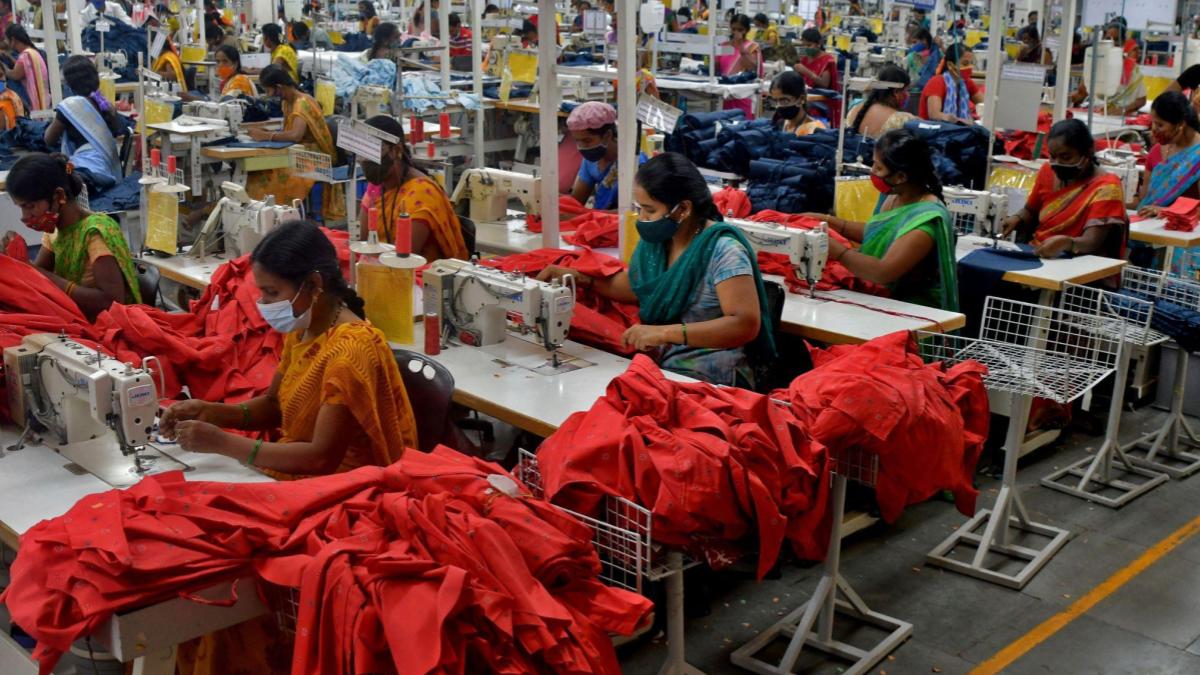
Independent India’s textile journey has been an effort to reverse this. India today possesses a fully integrated textile value chain. The key catch is the employment intensity of the sector. Apparel alone generates 153 jobs for every Rs 1 crore invested, against 27 in automobiles, and 14 in steel. Yet its share of global apparel exports has stagnated at around 3% for over two decades even as Bangladesh’s rose from 2.2% to 9% and Vietnam’s from 1% to 6%. How does a civilisation that once clothed the world end up with 3% of a $521-billion global apparel market?
This is the question our new book, Stitching India’s Apparel Export Strategy: From Farm to Foreign, released last week at BharatTex 2026 in New Delhi, sets out to answer. The book presents a comparative policy analysis of China, Bangladesh, and Vietnam through five pillars of competitiveness: scale and ecosystem; capital; labour and skilling; clusters and institutions; and market access and trade facilitation.
The lesson from China is an ecosystem approach — vertically integrated clusters, concessional finance, and the Sinosure model of export credit insurance and institutional governance have made China the largest apparel exporter. Bangladesh leveraged Least Developed Country preferences through readymade garment-specific finance, back-to-back letters of credit, and export processing zones offering plug-and-play infrastructure and one-stop regulatory services. Vietnam aligned foreign investment, industrial parks, and free trade agreements (FTAs) into one integrated strategy and established industry-academia partnerships to attract global manufacturers. Each country followed a different path, but all created integrated ecosystems that enabled firms to compete at scale. Besides these, one very important but much less talked about aspect is the undervalued Chinese currency. Estimates by the IMF, US Treasury, 2026, and Goldman Sachs suggest the yuan has been undervalued by 16-30% against the US dollar, acting as an implicit export subsidy.
To realise the government’s ambition of $100 billion in textile and apparel (T&A) exports by 2030, India must strengthen these fundamentals of competitiveness across the value chain. The first is scale and ecosystem development. The “missing middle” of mid-sized, export-ready firms capable of handling large, fast turnaround orders remains a constraint. Equally relevant is fibre mix. Global apparel trade is dominated by man-made fibre (MMF). India’s textile industry remains skewed towards cotton, with a 60:40 cotton-to-non-cotton fibre consumption ratio, in contrast to the global average of 25:75. This mismatch locks India out of the fastest-growing segments such as activewear, technical textiles, and athleisure. The recent rationalisation of the inverted duty structure in the MMF segment must now be complemented by investment in MMF spinning and weaving.
The second is capital. India’s real interest rates of 6.2-8.2% remain significantly higher than China (3.1%), Vietnam (~1%), and Bangladesh (negative real rates). Delays in GST refunds and export incentive disbursals also constrain liquidity. The next is labour and skilling. India’s apparel sector is highly dependent on migrant labour, moving from Bihar, Odisha, and Jharkhand into production clusters such as Bengaluru, Tiruppur, and Surat. There are high attrition and absenteeism during the festival season, when assembly lines fall short. In our opinion, a more sustainable model is to move factories to where the cheap labour is. The gains are multiple — higher female labour participation, lower migration costs, and a pathway for labour-surplus states like Bihar to accelerate manufacturing-led growth. Finally, with the Comprehensive Economic and Trade Agreement with the UK and the EU FTA, India has finally achieved tariff parity with competitors such as Bangladesh and Vietnam. India needs seamless end-to-end integration of trade processes so that exporters can move goods, documents, and approvals with speed, predictability, and minimal compliance costs.
The reform agenda for India is clear — building an ecosystem approach to competitiveness. PM-MITRA (Mega Integrated Textile Region and Apparel) parks, announced in 2021, embody this approach by integrating the five pillars of competitiveness — scale, infrastructure, finance, skills, and market access — within a single institutional framework. Their timely implementation is critical if India wants to seize the current window of opportunity in global apparel trade. Complemented by the export promotion mission and the integrated programme for textiles, these reforms can reposition India as a scale-driven, digitally-enabled, sustainable, and gender-inclusive global sourcing hub. The future will depend on whether India can stitch together an ecosystem where firms, finance, institutions, and supply chains move with the speed, scale, and predictability that global value chains demand.
Disclaimer: The views expressed are the author’s own and do not reflect the official policy or position of Financial Express.