



Should a family’s tax bill depend on how income is divided between spouses? That question was raised in Parliament on Monday after Rajya Sabha member Raghav Chadha proposed introducing optional joint filing of income tax returns for married couples in India.
Speaking in the Upper House, Aam Aadmi Party MP Chadha argued that the current tax system can treat families with similar total income very differently — simply because of how the earnings are split between spouses.
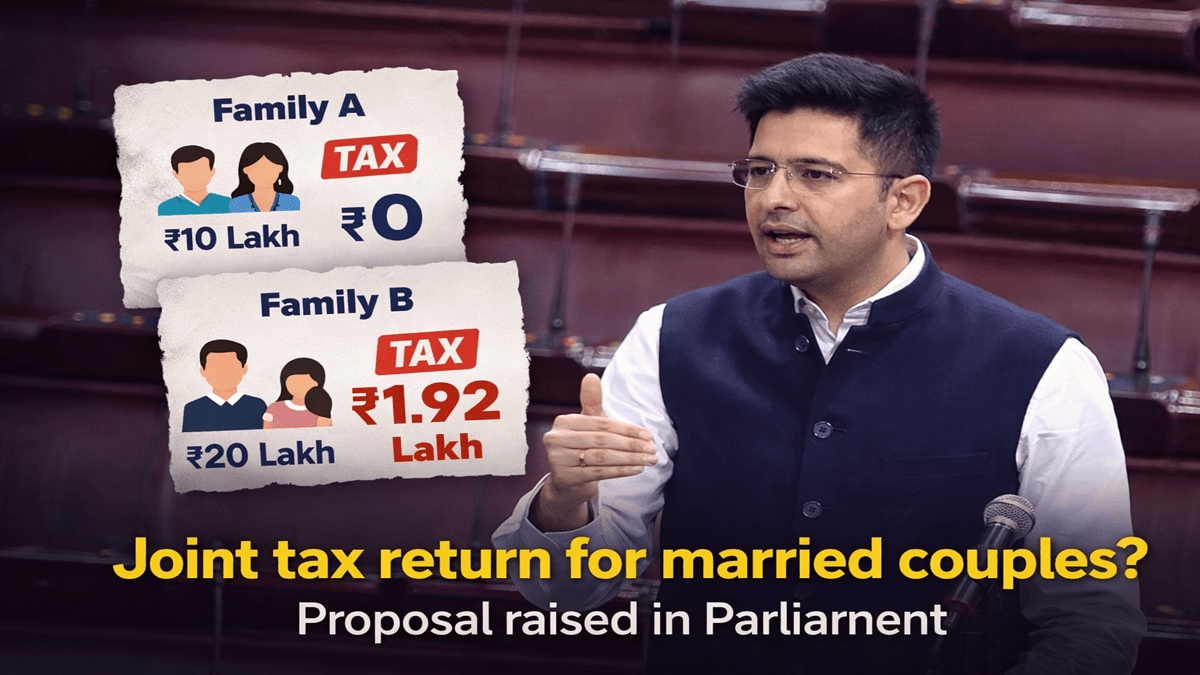
To illustrate his point, he shared the following example on social media.
“In Parliament today I proposed optional Joint filing of Income Tax Returns for married couples,” says Chadha.
Family A
Both spouses earn ₹10 lakh each.
Total household income is ₹20 lakh.
Tax: zero
Family B
One spouse earns ₹20 lakh. The other stays home to raise their child.
Total household income is ₹20 lakh.
Tax: ₹1.92 lakh
The only difference is how the salary is split between the two spouses, his post says.
“One roof. One kitchen. One household budget. But when tax time comes, the family disappears.”
“The tax system sees two individuals. A husband and wife become strangers. No clubbing of income or rebates.”
“In Parliament today I proposed optional joint filing of Income Tax Returns for married couples, so families with uneven incomes are not unfairly penalised. If implemented, then Family A and Family B both will pay Zero Tax,” he writes.
What is the current rule for married couples?
Under India’s existing income-tax framework, each individual is treated as a separate taxpayer.
This means that even if two people are married, they must file their income tax returns separately. Their income is not combined while calculating tax liability.
This structure often works well for dual-income households, because both spouses can individually use basic exemption limits, tax slabs, deductions and rebates.
For example, under the new tax regime, a salaried individual can effectively pay zero tax on income up to ₹12 lakh due to the rebate under Section 87A and standard deduction benefits.
However, the system may feel less equitable for single-income families or households where one spouse earns significantly more than the other.
In such cases, the entire income is taxed in the hands of one individual, which can push that person into higher tax slabs, resulting in a higher tax burden for the family even though the overall household income may be similar to a dual-income family.
Why joint taxation is being discussed again
The idea of joint taxation for married couples is not new in India.
The Institute of Chartered Accountants of India (ICAI) has repeatedly recommended introducing optional joint filing in its pre-budget memorandums to the government. The proposal was also included in its recommendations ahead of Budget 2026.
Several tax experts have also argued that such a system could make the tax structure more equitable for single-income families, particularly where one spouse stays home to care for children or elderly family members.
How joint filing could change tax calculation
Under a joint filing system, a married couple could combine their incomes and file a single tax return.
This could help distribute the tax burden more evenly across the household.
For instance, if a couple together earns ₹20 lakh but only one spouse earns the income, the combined income could potentially be taxed differently compared to the current system where the entire ₹20 lakh is taxed in the hands of one individual.
Supporters say such a system could reduce the tax burden for single-income families, recognise households as a single economic unit, simplify tax compliance for families.
Countries like the United States and the United Kingdom already allow forms of joint or family-based taxation for married couples.
Concerns around introducing joint taxation
Despite the potential benefits, tax experts say implementing joint taxation in India would require careful policy design.
Some of the key concerns include possible misuse through income shifting, maintaining financial independence of spouses, and ensuring fairness in cases of separation or divorce. Because of these complexities, the government has so far not introduced joint filing in India.
Will the government consider the proposal?
Chadha’s intervention in Parliament has once again brought the issue into public debate.
However, it remains unclear whether the government will seriously consider the idea of optional joint filing for married couples in the near future.
For now, married couples in India must continue to file their income tax returns individually, even if they share the same household and financial responsibilities.