



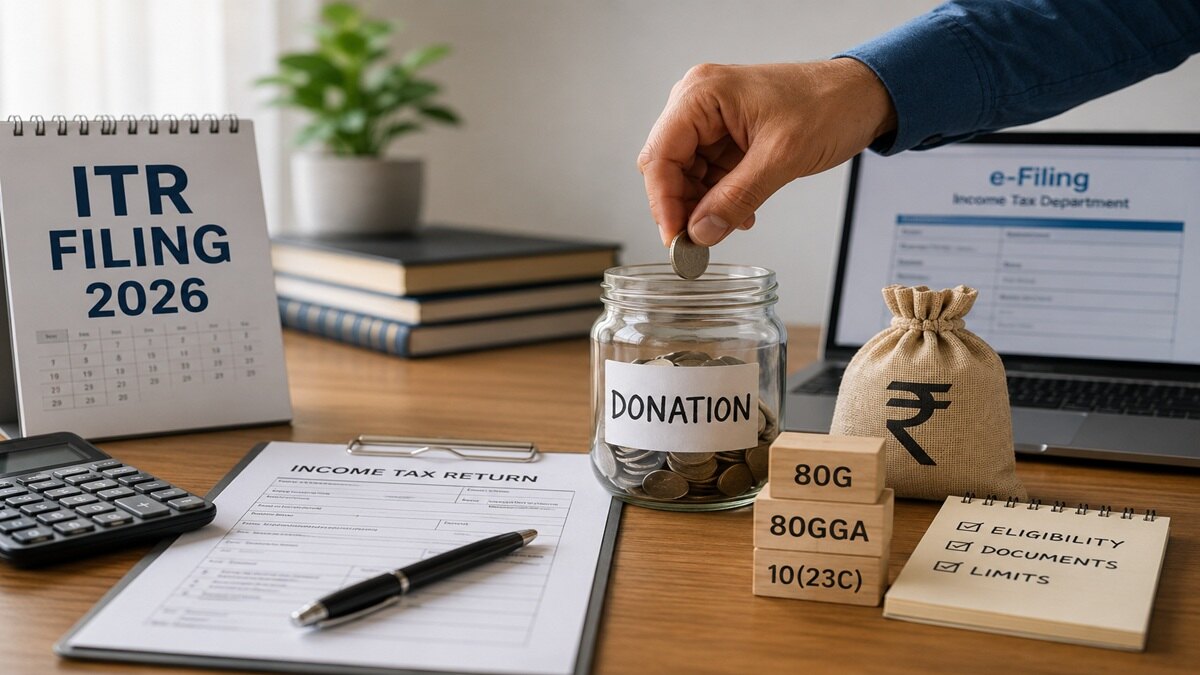
Many taxpayers make donations during the financial year believing that the entire amount will automatically qualify for a tax deduction. However, when it comes to claiming tax benefits under Section 80G of the Income Tax Act, not every donation gets a 100% deduction.
In fact, some donations qualify for a full deduction, some qualify for only a 50% deduction, and certain donations are also subject to an income-linked ceiling. This means the tax benefit you receive depends on where you donate and whether the institution is eligible under the tax laws.
Moreover, deductions under Section 80G can be claimed only by taxpayers who have opted for the old tax regime. Taxpayers choosing the new tax regime under Section 115BAC cannot claim this deduction.
Are all donations 100% exempt from tax?
The simple answer is no.
According to Rajiv Thakkar, Partner Direct Tax – Bhuta Shah & Co LLP: “No. All donations are not eligible for a 100% tax deduction.
Under Section 133 (erstwhile section 80G) of the Income-tax Act 2025, the tax benefit on donations depends on the organization or fund to whom the donation is made. Some donations qualify for a 100% deduction (may/may not be subject to a limit based on the taxpayer’s income), while others qualify for only a 50% deduction. The said class of deductions are listed below with examples:
100% deduction without qualifying limit – e.g., donations to the Prime Minister’s National Relief Fund and certain notified funds.
50% deduction without qualifying limit – certain approved charitable institutions.
100% deduction subject to qualifying limit – some government-approved projects and funds.
50% deduction subject to qualifying limit – many charitable and religious institutions.
Further, there are certain other conditions that needs to be considered for determining the eligibility of deduction viz. donations in cash shall not exceed Rs 2,000, the organization (as listed at Sr. 2 above) receiving the donation must have a valid registration under section 332 (erstwhile section 80G) and so on.
Therefore, before claiming a deduction under section 133 (erstwhile section 80G), taxpayers should check whether the institution is eligible under Section 332 (erstwhile section 80G) and the percentage of deductions available for the donation made.”
The Income Tax Department’s FAQs also explain that donations under Section 80G broadly fall into four categories—100% deduction without limit, 50% deduction without limit, 100% deduction subject to a qualifying limit, and 50% deduction subject to a qualifying limit.
The four categories of donation deductions
Understanding these categories is important because they determine how much tax benefit you can actually claim.
- 100% deduction without any limit
This is the most favourable category. The entire donation amount is deductible and there is no upper cap linked to income.
Examples include donations made to specified government and national funds such as the Prime Minister’s National Relief Fund and PM CARES Fund. The Income Tax Department’s FAQ also lists several other funds that fall under this category.
- 50% deduction without any limit
In this category, only half of the donated amount qualifies for deduction.
The FAQ notes that donations to the Prime Minister’s Drought Relief Fund fall under this category.
- 100% deduction subject to a qualifying limit
Here, the full donation amount is eligible, but only up to a specified limit linked to the taxpayer’s adjusted gross total income.
Mihir Tanna, Associate Director of Direct Tax at SK Patodia & Associate LLP, explains: “Donations to all trusts are not eligible for 100% deductions. There are 4 categories of deductions for donations. Firstly, a 100% deduction is allowed for donations made to specified funds like the PM Cares Fund and the CM Relief Fund. Secondly, a 50% deduction is allowed for donations made to specified funds like the Prime Minister’s Drought Relief Fund. Thirdly, a 100% deduction is allowed subject to 10% of adjusted income for donations made to specified government institutions that promote family planning or develop infrastructure for games in India.
Lastly, a 50% deduction is allowed for donations to charitable trusts that conduct specified charitable activities subject to 10% of adjusted income. Before donating, the donor should obtain a copy of Form 10AD issued by the income tax department and verify if the trust is registered under Clause (ii) of the 2nd proviso to Sec.80G(5) during the donation period. After the end of the financial year (tax year), typically in May/June, the trust issues Form 10BD to the donor, which helps the taxpayer claim the deduction.”
The Income Tax Department FAQ similarly notes that donations made to approved institutions for promoting family planning and certain sports infrastructure-related contributions can qualify for a 100% deduction, subject to the prescribed limit.
- 50% deduction subject to a qualifying limit
This category covers many charitable institutions and approved trusts. Taxpayers can claim only 50% of the donation amount, and that too within the prescribed qualifying limit.
What is the qualifying limit?
For donations that are subject to limits, the maximum eligible amount is generally restricted to 10% of the taxpayer’s adjusted gross total income. Any amount exceeding that limit is ignored for deduction purposes.
This is why two taxpayers making the same donation may end up getting different tax deductions depending on their income levels.
Important conditions taxpayers should not ignore
Even if the donation is made to a recognised institution, certain conditions must be satisfied before a deduction can be claimed.
Cash donations above Rs 2,000 are not eligible
No deduction is allowed if a donation exceeding Rs 2,000 is made in cash. Such donations should be made through banking channels or electronic modes.
Donations in kind do not qualify
Tax benefits are available only for monetary donations. Donations of clothes, food items, medicines, equipment or other goods do not qualify for deduction under Section 80G.
Verify the institution’s registration
Only donations made to approved and registered institutions qualify for deduction. Taxpayers should verify whether the trust, fund or institution has valid Section 80G registration before making the donation.
Keep supporting documents
To claim deduction while filing ITR, taxpayers should have the donation receipt, PAN of the donee, address, registration number under Section 80G and the donation amount details. The donee institution may also issue Form 10BE, which contains key details required for claiming the deduction.
Summing up…
If you are filing your income-tax return under the old tax regime, don’t assume every donation qualifies for a 100% tax deduction. Section 80G provides different levels of tax benefits depending on the recipient institution, and some donations are subject to income-based limits.
Before claiming a deduction, verify the institution’s registration status, keep the donation documents safely, and check whether your donation falls in the 100% or 50% deduction category. A little verification can help avoid mistakes in your ITR and ensure you receive the tax benefit you are actually entitled to.
Disclaimer: This article is for informational purposes only and should not be construed as tax, legal, or financial advice. Tax benefits on donations depend on the nature of the donation, the eligibility and registration status of the recipient institution, and the taxpayer’s individual circumstances. Taxpayers are advised to verify the latest provisions of the Income-tax Act and consult a qualified tax professional before claiming deductions in their income-tax returns.
Every financial journey has a turning point. What’s yours?
Financial Express is launching a new series highlighting real experiences with money, investments, and the taxman. Did a sudden tax rule catch you off guard? Did a piece of financial advice change your life? Your story could provide invaluable, practical lessons for thousands of fellow taxpayers. Share your experience with us. We respect your privacy: no stories will be featured without a direct conversation and your full consent. Thank you.