



Silver prices have fallen by about 6.3% from its all-time high of Rs 259,692 per kg on 8 January 2026, to Rs 243,324 per kg.
This pullback came after intensive buying in the first few days of the year. However, even after this decline, silver delivered around a 200% return in the last one year.
An asset that has already run up sharply begins to attract incremental buyers because of the fear of missing out. The assumption is that if silver has risen this far, the rally may still have legs.
Having said that, you should seriously consider whether to invest in a silver ETF at the current level or not.
Why the Silver Price Rising
Silver is considered a valuable metal because of its excellent electrical and thermal conductivity and high corrosion resistance, making it essential for the green energy transition.
Solar Photovoltaics (PV)
Thus, solar capacity is forecast to grow at a 17% compounded annual growth rate through 2030 and PVs accounts for 29% of total industrial silver demand, a significant increase from 11% in 2014.
While the falling silver per cell has slowed demand somewhat, new next-generation cells like TOPCon and SHJ require more silver than older models. TOPCon cells currently consume about 50% more silver than the previous industry standard.
Automotive and Electric Vehicles (EVs)
The shift toward electric mobility is another major driver. Global EV production is also forecast to grow at a 13% CAGR between 2025 and 2031.
Electric vehicles (EVs) use 67% to 79% more silver on average than internal combustion engine (ICE) vehicles, due to high electronic content, power systems, and connectivity requirements.
Global automotive silver demand is projected to grow at a 3.4% CAGR between 2025 and 2031, reaching roughly 94 million ounces.
This expansion will be driven by EVs which by 2027 are forecast to overtake ICE vehicles. This will be a source of silver demand within the automotive industry.
Building the necessary charging infrastructure also boosts demand, as charging cables and contacts often use silver-plated components to ensure high conductivity and rust protection.
Data Centres and Artificial Intelligence
As the backbone of the digital economy, data centres require massive amounts of silver for servers, semiconductors, and cooling systems.
IT Power Capacity
While exact silver loading data is difficult to isolate, global IT power capacity, a proxy for silver-rich hardware, grew by an estimated 53x between 2000 and 2025.
Even in the absence of precise silver loading data, the link is clear: a 5,252% increase in IT power
means more computing hardware and more demand for silver.
AI Hardware
AI adoption requires specialised hardware like GPUs, TPUs, and NPUs, all of which rely on silver-based solder, connections, and packaging.
In the US alone, data center construction is forecast to grow by 57% over the next 10 years, further driving demand for silver-rich components such as sensors and switches.
| Solar PV | Capacity CAGR | 17% through 2030 |
| Automotive | EV Production CAGR | 13% (2025-2031) |
| Automotive | Silver Usage | BEVs use about 79% more than ICE |
| Data Centers | US Construction | +57% over 10 years |
| AI/Electronics | 2024 Record Demand | 680.5 Moz total industrial |
Source: Oxford Economics on Silver
Demand Is Rising but Supply is Not
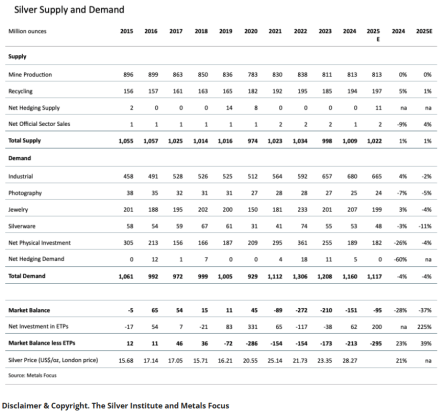
In 2025, demand is expected to decline by 4%, while supply is expected to increase by only 1%.
Despite this, demand continues to exceed supply. This explains some of the market tightness.
Historical Silver Supply and Demand
Source: The Silver Institute
Supportive Macroeconomic and Geopolitical Backdrop
Expectations that the US Federal Reserve (Fed) would start cutting policy rates were a principal driver, particularly following the rate cut in September 2024.
Uncertain macroeconomic conditions, higher US trade deficits, ballooning US debt, and expectations for further US rate cuts later in 2026 are also driving sustained investor interest.
This is because, like gold, silver is a non-yielding asset. It doesn’t pay interest, dividends, or coupons.
Therefore, when interest rates are high, investors can earn better returns from other assets (such as fixed deposits, government bonds).
However, when interest rates fall, the opportunity cost of holding both metals decreases.
Since peaking in April at over 107, the gold:silver ratio has trended lower to its current level of 58. Historically, higher ratios (70–80) indicate silver is undervalued, while lower ratios (50–60) suggest silver has already outperformed gold.
This suggests that silver is no longer cheap relative to gold. The easy gains driven have largely played out, and current prices reflect a much tighter relative valuation between the two metals.
Should You Invest in Silver ETFs at Record Highs?
The distinction between strong fundamentals and attractive entry points is critical.
Silver’s long-term demand drivers – renewable energy, electrification, AI, and digital infrastructure, remain firmly intact. From a structural perspective, the investment case for silver has arguably strengthened over the past decade.
However, investing in silver ETFs at current levels is not a valuation-driven decision. It’s a momentum and allocation-driven one. After a 200% rise in a year and a sharp compression in the gold–silver ratio, the margin of safety for fresh lump-sum allocations has narrowed.
Silver ETFs tend to mirror spot price movements closely and can be volatile during consolidation or correction phases. For investors without existing exposure, staggered allocation makes more sense than an aggressive entry.
For investors already holding silver ETFs, the case is more about holding rather than adding. The asset continues to serve as a hedge against macro uncertainty and a play on electrification trends, but incremental returns from here are likely to be more volatile and less linear.
Finally, silver ETFs work best as a satellite allocation, not a core holding. At this stage of the cycle, they are better suited for diversification and tactical exposures than chasing short term returns.
Happy investing.