




The defence sector has been one of the top-performing sectors this year, given all the geopolitical developments. This is very well indicated by the surge in the Nifty India Defence Index by 18.5% over the last year. (Source: NSE)
Interest in stocks in the defence sector skyrocketed during the months of June and July, taking valuations to record highs. Since then, the sector has remained more or less flat with a few instances of profit booking.
While both foreign institutional investors (FIIs) and domestic institutional investors (DIIs) invested heavily in these stocks during the past months, generally speaking, they started booking profits as well or just holding on to their previous investments.
While broad sector buying has cooled, one stock stands out as a high-conviction bet for both FIIs and DIIs: MTAR Technologies.
Let’s try to understand the possible rationale behind their joint interest in this defence engineering stock.
MTAR Technologies limited – Powering rockets and reactors
MTAR Technologies Ltd. is one of the leading manufacturers of engineered components and equipment for defence, aerospace, nuclear, and clean energy sectors. It offers critical and differentiated engineered products that are used across industries.
During the July-September quarter, FIIs increased their stake in this company by 1.64% points while DIIs increased their stake by 1.3% points, taking the total holding to 9.21% and 24.81% respectively.
So, what made these institutional investors pour more money into this stock?
The bull case: Why they are buying the dip
MTAR Technologies caters to different sectors with a prime focus on the aerospace & defence, nuclear power, and clean energy sectors.
For the defence sector, it develops and manufactures missile components for Agni ballistic missiles, Prithvi missiles, and others. It also develops gearboxes, actuation systems, and aerostructures for different uses in the defence space.
For the naval system, it develops subsystems such as Air Independent Propulsion (AIP) systems, which are used in submarines. The company is also engaged in developing air-breathing engine technology for future defence programs and a lot more.
For the aerospace segment, MTAR manufactures liquid propulsion engines, cryogenic engine sub-systems, electro-pneumatic modules, satellite valves, space launch vehicles, etc.
For the nuclear power and clean energy sector, this company manufactures a wide range of complex engineering components. It includes fuel machining head, bridge, and column, and drive mechanisms for nuclear reactors.
The clean energy sector offers power units, especially hot boxes, prototype hydrogen boxes, electrolyzers, and more.
Solid order book
MTAR’s order book can be another reason for the institutional investors piling into the company’s stocks. As of 30 September 2025, the orderbook stood at ₹1,297 crore with new orders worth ₹498 crore being added during the quarter.
Note: As of 5 November 2025, the orderbook surged again after an additional order worth ₹480 crore was booked by the company.
Management expects the orderbook to surge to ₹2,800 crore by the end of FY26, with orders mainly from the clean energy and nuclear segments.
The 2026 growth engine: Clean energy expansion
The institutional investors are likely looking at the expansion plans of the company, especially designed to ramp up the hot boxes products, which are critical in the clean energy sector. Currently, the capacity is 8,000 units per year, and the company wants to increase it to 12,000 units annually by the end of FY26, and that too within the existing plants/manufacturing units.
The company has plans of infusing ₹35 crore to ₹40 crore as capex for these expansion plans and has already placed purchase orders for furnaces and balancing equipment.
While these are the near-term plans, the company also has further plans to expand the production of hot boxes up to 20,000 units per year by the end of FY27. This will require a capex investment of around ₹60 crore, as indicated by the management.
Financials
During the Q2FY26, sales of MTAR have, however, dropped to ₹135.6 crore from ₹190.2 crore in Q2FY25, declining 28.7% YoY. The company’s profits also dipped to ₹4.6 crore from ₹18.8 crore during the period.
The numbers are definitely disappointing. But even then FIIs and DIIs have been buying into the company. Perhaps the institutional investors are looking beyond these quarterly numbers and focusing more on the future prospects of the company.
Management guidance
This brings us to the management outlook for the business. As per the management, the revenue for the whole of FY26 will surge by 30%-35% instead of their previous forecast of 25%. They also expect the FY26 Earnings Before Interest, Tax, Depreciation, and Amortization (EBITDA) margin to be around 21%.
Valuation
The stock is trading at a price/earnings (PE) ratio of 167.3x, which is way higher than the industry median of 63.3x, indicating a premium valuation.
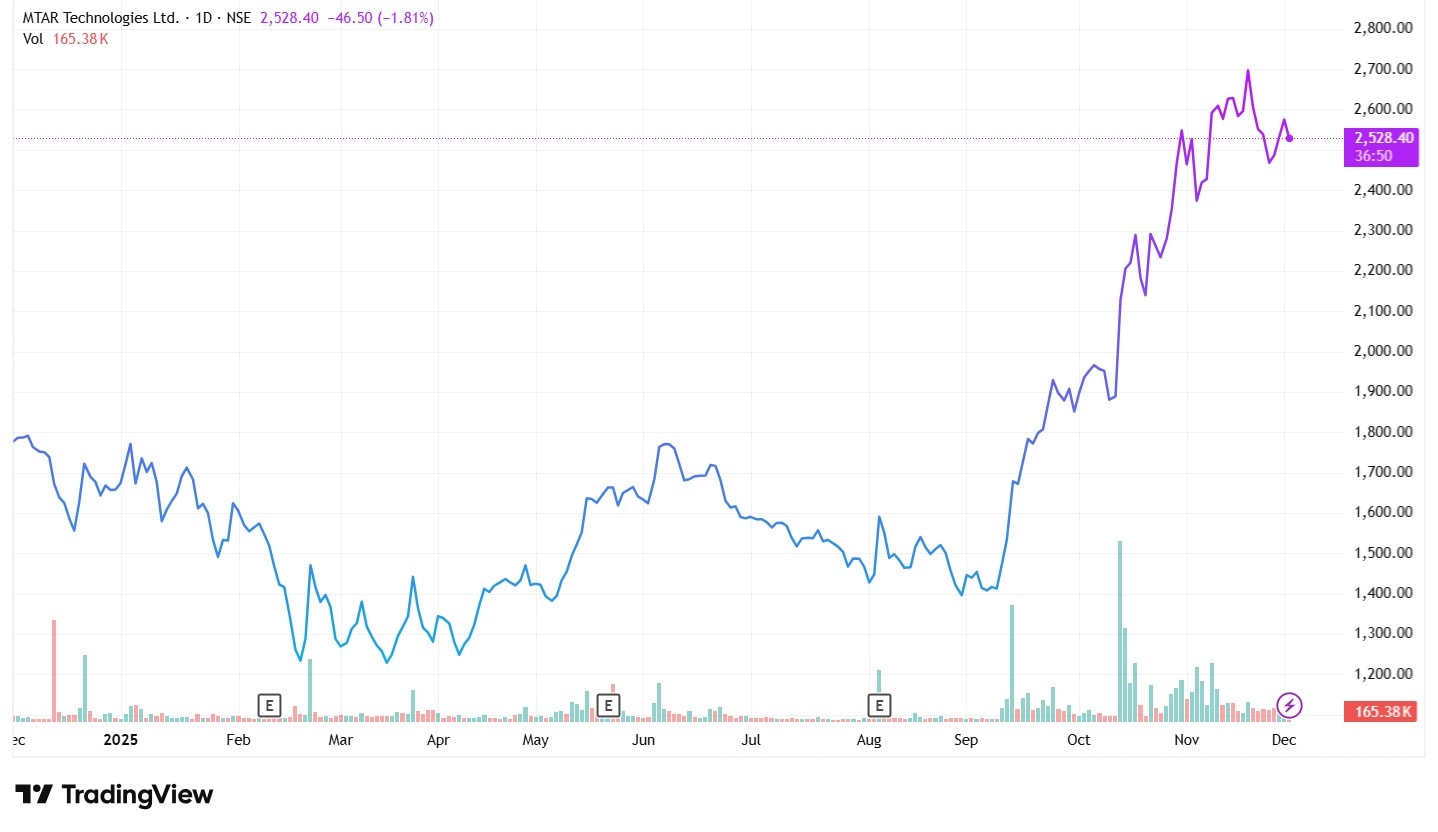
1-year Share Price Chart of MTAR Technologies Ltd.
Wrapping up
It is a rare occasion when both FIIs and DIIs invest in the same stock and especially when it is from the defence space. However, MTAR Technologies stood out even when some of the other defence stocks are witnessing the exit of institutional investors lately. It even attracted more investments when its own sales were dipping. It is perhaps the future prospects of the company that are driving the institutional investors to not only stay put, but actually increase their stake.
We have relied on data from www.Screener.in throughout this article. Only in cases where the data was not available have we used an alternate, but widely used and accepted source of information.
The purpose of this article is only to share interesting charts, data points, and thought-provoking opinions. It is NOT a recommendation. If you wish to consider an investment, you are strongly advised to consult your advisor. This article is strictly for educative purposes only.
Maumita Mitra is a seasoned writer specializing in demystifying the world of investment for a broad audience. She has a keen eye for detail and a knack for explaining complex financial concepts in the simplest manner possible.
Disclosure: The writer and her dependents do not hold the stocks discussed in this article.
The website managers, its employee(s), and contributors/writers/authors of articles have or may have an outstanding buy or sell position or holding in the securities, options on securities or other related investments of issuers and/or companies discussed therein. The content of the articles and the interpretation of data are solely the personal views of the contributors/ writers/authors. Investors must make their own investment decisions based on their specific objectives, resources and only after consulting such independent advisors as may be necessary.