




In the Union Budget 2026-27, the pharma sector emerged as one of the top priorities of the government. With different schemes such as Biopharma Shakti with an outlay of ₹10,000 crore for the development of more research centers and ramp-up of clinical trials, the pharma sector is expected to gain further traction.
In the global pharmaceutical and drugs market, India already holds a solid position with 5.71% market share (as of December 2025). It is the third-largest by volume, with 20% share in the global supply chain. India’s forte is generic medicine, and it is already the largest provider of generic medicine globally. (Source: IBEF)
Talking about generic medicines, during the Q3FY26, one company, which is known for its generic medicines, grabbed significant attention from both foreign institutional investors (FIIs) as well as domestic institutional investors (DIIs).
The company in focus is Zota Healthcare Limited.
Zota Health Care’s QIP: A Deep Dive into the ₹350 Crore Infusion
FIIs increased their stake in Zota Health by 4.6% points, taking the overall holding to 8.1%. DIIs increased their stake by another 2.3% points, taking their total holding to 7.2% points at the end of the quarter. The increase in stakes was the result of a qualified institutional placement (QIP) via which the company raised ₹350 crore.
Strategic Stake Increases
Amongst the top FIIs, Valiant Mauritius Partners Offshore Ltd. increased its stake from 1.84% to 3.47% while Valiant Mauritius Partners Ltd. bought 1.83% fresh stake.
Amongst the top DIIs, it is the 3P India Equity Fund that increased its stake from 1.34% to 2.44% during the quarter.
Let’s find out whether it is the generic medicine angle attracting the investors, or if there is more to this pharma giant.
The Differentiator – DAVAINDIA Movement
Zota Health Care Ltd. has a business structure that incorporates a domestic marketing business, export operations, and the DAVAINDIA Generic Pharmacy business. While DAVAINDIA was launched only in 2017, as of H1FY26, it is contributing to 74% of the revenue of the company.
DAVAINDIA is one of the largest networks of generic pharmacies in India. The model has two types of stores, one is COCO – Company owned Company operated. The other one is FOFO – Franchise owned, Franchise operated.
On August 15, 2025, the company achieved a milestone by opening 103 Davaindia stores across the country. The company is already on track to achieve its 800 new COCO store target by the end of this year, as it already added 355 new COCO stores in H1FY26 itself.
Davaindia offers quality generic medicines at prices which are upto 30% to 90% less than their branded equivalent. It is able to offer these discounts as the business model does not include any marketing company, distributors, or retailers in the supply chain. It operates with just three participants – Manufacturer, the Davaindia stores and the customers.
This direct business model and the vast expansion plans of Davaindia are perhaps one of the reasons why the institutional investors are piling onto this stock.
The Chronic Disease Play
As addressed in the Union Budget as well, India is facing growing chronic health challenges. Around 12 crore people are already diabetic, with 14 crore more in the pre-diabetic stage. The number of heart diseases, especially in young Indians, is rapidly rising, and cancer has become a household issue in today’s times. (Source: PIB)
As Zota Health’s 60% of the revenue (as of H1FY26) comes from the chronic diseases category, the company has a high realization and retention rate compared to its peers, as chronic ailment requires continuous and long-term treatment.
Benefiting from the Organized Pharmacy Retail Growth
In India, the organized pharmacy retail market is growing rapidly. From a 10% share in FY20, it has grown to 20% in FY25; and it is expected to rise to 25% by FY30. The primary drivers are the rising urban population, increasing health awareness, digital infrastructure growth, among others.
As Zota has an organized retail pharmacy model, it can benefit from this growing organized market across metros, mini-metros, and Tier I and II cities.
Sales Grew, So Did the Losses
Though sales grew from ₹72 crore in Q3FY25 to ₹143 crore in Q3FY26, growing at a whopping 98% year-on-year (YoY), net loss increased from ₹19 crore to ₹30 crore during the period. The company is however profitable at the operating level (EBITDA, trailing twelve months).
However, the increasing losses are perhaps due to their rapid expansion plans; another crucial cost driver is employee costs. The management, however, anticipates the employee cost to come down once the new stores start generating revenues.
The Profitability Paradox: Scaling vs. Margins
While the rapid expansion of the Davaindia stores has been helping the company scale up its revenue, it is straining its working capital and profitability. As they operate in a highly competitive market, where the margins are very thin, if the expansion doesn’t roll out as expected, it could further deepen the losses.
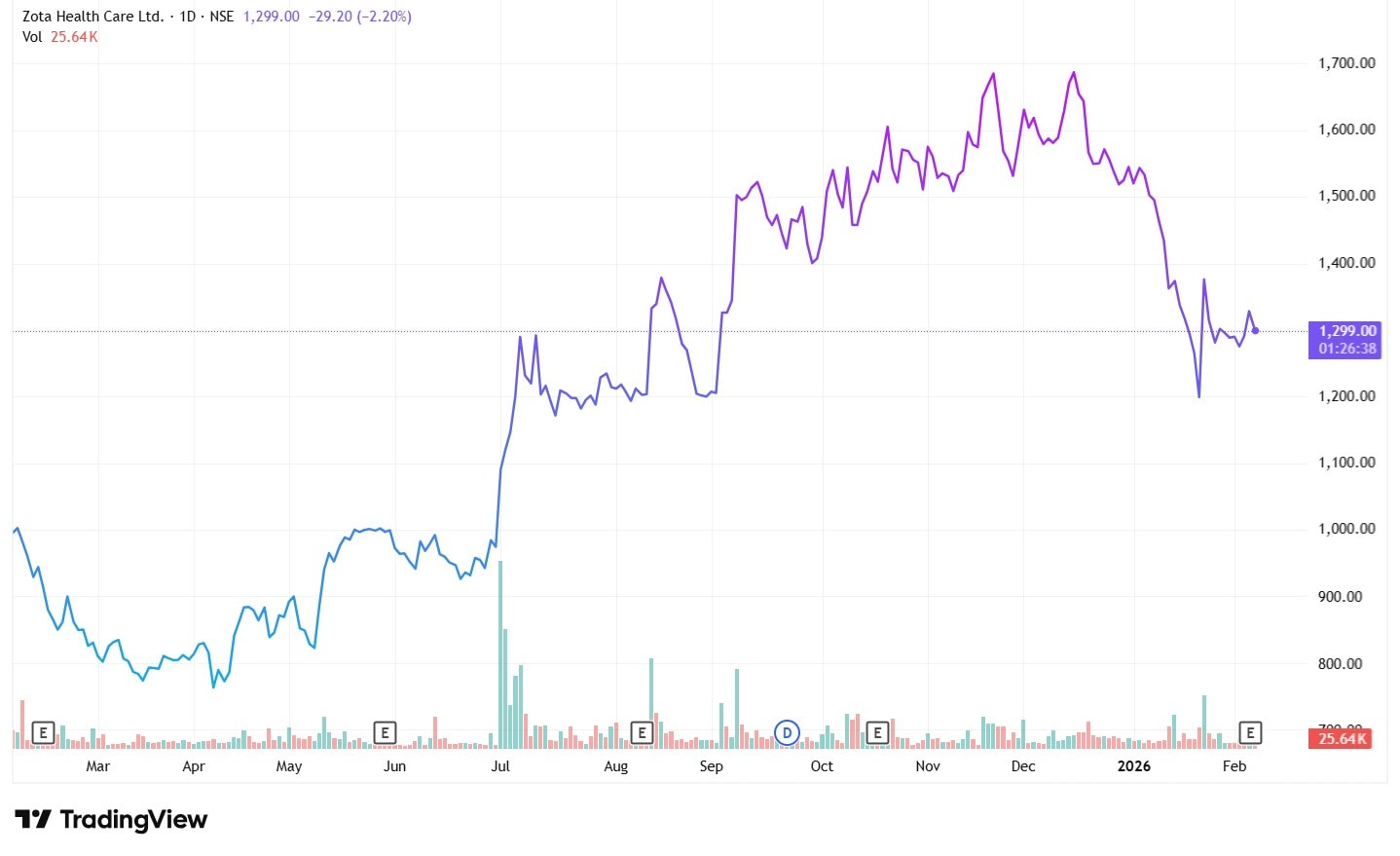
1-Year Share Price Chart of Zota Health Care Ltd.
Final Thoughts
Zota Health Care stands at an interesting inflection point. Its revenues are surging due to rapid expansion but that’s not getting converted into profits. While an aggressive expansion plan is helping the company penetrate the retail pharmacy sector more, it is also stressing the working capital of the company. So, it will be interesting to see whether the company can breakeven and make profits, thus underscoring the trust shown by the institutions in increasing their stake in the company.
Disclaimer:
We have relied on data from www.Screener.in throughout this article. Only in cases where the data was not available have we used an alternate, but widely used and accepted source of information.
The purpose of this article is only to share interesting charts, data points, and thought-provoking opinions. It is NOT a recommendation. If you wish to consider an investment, you are strongly advised to consult your advisor. This article is strictly for educational purposes only.
Maumita Mitra is a seasoned writer specializing in demystifying the world of investment for a broad audience. She has a keen eye for detail and a knack for explaining complex financial concepts in the simplest manner possible.
Disclosure: The writer and her dependents do not hold the stocks discussed in this article.
The website managers, their employees (s), and contributors/writers/authors of articles have or may have an outstanding buy or sell position or holding in the securities, options on securities, or other related investments of issuers and/or companies discussed therein. The content of the articles and the interpretation of data are solely the personal views of the contributors/ writers/authors. Investors must make their own investment decisions based on their specific objectives, resources, and only after consulting such independent advisors as may be necessary.