




At the start of the year, it seemed the Indian stock market would scale new highs.
After all, the Nifty had achieved a new all-time high and there was speculation of a trade deal being signed between India and the US.
But sentiment has changed significantly in just a few days and the Indian stock market is falling.
Nifty – 1 Month
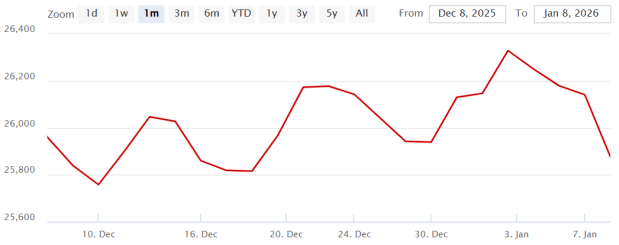
Source: Equitymaster
Is this a temporary phase before a bull run or is there cause for concern?
In this editorial, we dive into the two main reasons for the recent correction.
Read on…
#1 Tariff Concerns
US President Donald Trump has backed a bipartisan bill that could escalate India’s challenges related to tariffs.
If enacted, the legislation may impose tariffs of up to 500% on nations maintaining trade relations with Russia and buying its petroleum products.
If this tariff is imposed many companies are likely to be hit. In fact, the day reports surfaced several prominent exporters to the US saw their stock prices falling.
India and US have been working on a trade deal for many months but some issues have become key roadblocks. The imports of Russian oil has been one such point of contention.
#2 Uncertain Earnings Recovery
The Indian stock market is poised for good returns over the long term but only if earnings growth picks up.
The last few quarters have not seen a good performance from corporate India on this front. The market expects the ongoing earnings season to signal a clear recovery in sales and profit growth.
However, this is an expectation. The reality will become clear over the next few weeks.
If there is a disappointment on either sales growth or margins, Dalal Street is likely to react negatively. Some investors would rather wait for the results to come in amid the ongoing uncertainty instead of buying in anticipation of good results.
This hesitation on the part of investors makes it easier for stock prices to fall.
Conclusion
Equitymaster, has been in the market for over 30 years and there is one thing we know for certain:
No one can predict the future and more importantly, no one should attempt to do so. We strongly believe that time in the market is far more important than timing the market.
In the long term, the Indian stock market will go up along with the Indian economy. We have even made a Sensex 100,000 by 2027 prediction.
But that’s based on earnings growth, not sentiment.
Instead of trying to anticipate or react to every small move in the market, a better thing to do would be to make a watchlist of high-quality stocks and act on them when valuations become reasonable.
Do your due diligence. Consider factors such as valuation, industry trends, corporate governance, and market risks before making any investment decisions.
In this uncertain environment, if you are concerned about the stocks in your portfolio, then ask the following questions…
- Are the company’s fundamentals weak?
- Has there been any recent negative changes in the company’s fundamentals?
- Did the PE ratio shoot up without an improvement in the company’s earnings?
- Did you make a mistake in your original analysis at the time of buying?
These are all good reasons to sell or at least reduce your holdings.
But as is the case with any stock, you must allocate sufficient time to do the necessary due diligence.
If the answers to the questions above is a clear ‘NO’, then you can consider holding on, especially if the valuations are not too expensive.
And if the fundamentally strong stocks on your watch become available at reasonable prices, i.e., a low valuations, then you can consider them.
The best stocks to invest in right now – as long as the fundamentals are strong – are the ones that have suffered a correction of some sort for sentimental reasons.
Happy investing.
Disclaimer: This article is for information purposes only. It is not a stock recommendation and should not be treated as such. Learn more about our recommendation services here…
The website managers, its employee(s), and contributors/writers/authors of articles have or may have an outstanding buy or sell position or holding in the securities, options on securities or other related investments of issuers and/or companies discussed therein. The content of the articles and the interpretation of data are solely the personal views of the contributors/ writers/authors. Investors must make their own investment decisions based on their specific objectives, resources and only after consulting such independent advisors as may be necessary