




Welcome to the latest edition of Hidden Gems Weekly. In recent weeks we examined a tech stock benefitting from the AI hardware crisis is a goldmine, a small-cap automating India’s railway future, a QSR stock that just hit 570 stores and a debt-free gem front-running the data centre cycle spending and consumer expansion. This week we turn to a specialised coatings manufacturer benefiting from evolving housing preferences. Sirca Paints develops premium surface finishes used in modular kitchens, wardrobes and interior applications.
Every few years, Indian homes undergo a quiet transformation.
Walls get repainted. Kitchens are redesigned. Wardrobes are rebuilt.
Furniture changes. But something else changes along with it.
The finish.
Homeowners are no longer satisfied with functional furniture.
They want glossy wardrobes, matte kitchens and designer textures that resemble luxury showrooms.
Interior design has shifted from utility to aesthetics.
This shift is creating a new kind of demand.
Demand not just for paint, but for specialised surface finishes.
Welcome to the evolving world of coatings industry economics.
For decades, the decorative paint business was dominated by wall paints.
Companies such as Asian Paints built strong distribution networks and powerful brands around repaint cycles.
But inside homes, another consumption cycle was quietly emerging.
Furniture premiumization.
As modular kitchens, engineered wood and organised furniture manufacturing expand, surface finishing is becoming increasingly technical.
Traditional melamine coatings are gradually giving way to polyurethane and acrylic finishes that offer better durability, aesthetics and performance.
This is the economic backdrop in which Sirca Paints operates.
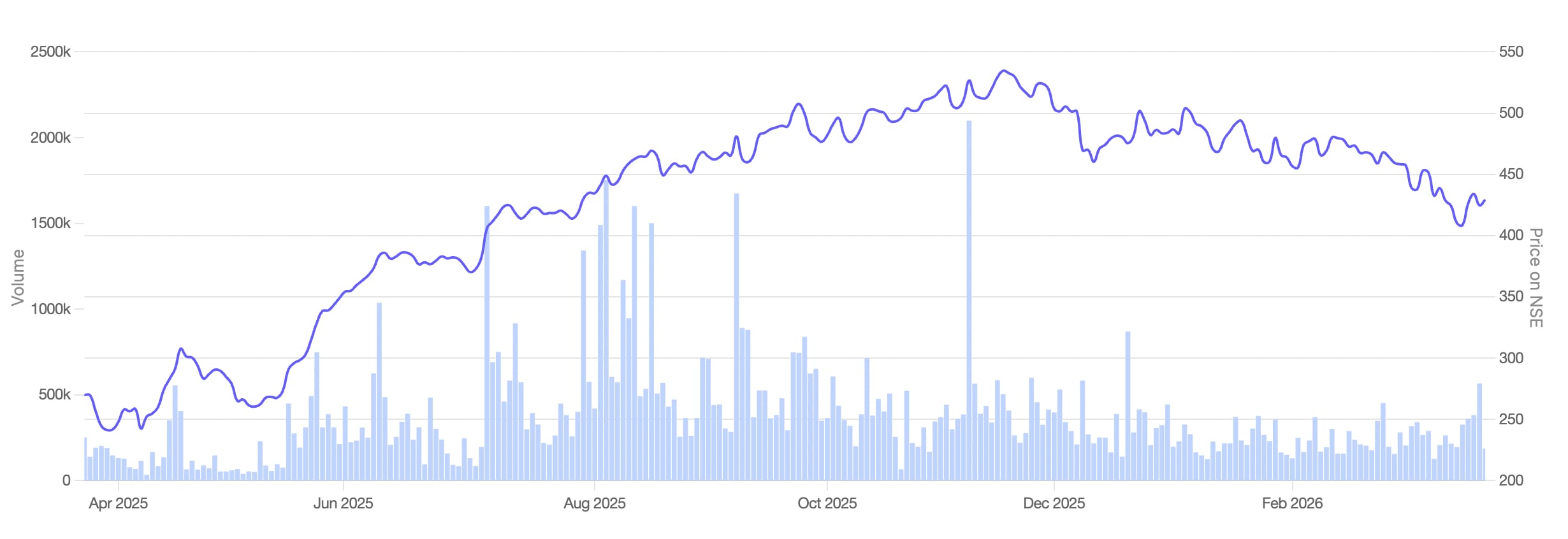
Before we dive into the business, here’s a look at how the company has performed on the bourses.
Sirca Paints 1-Year Share Price Chart
A business built on specialised finishes
Sirca Paints does not compete directly in mass decorative wall paints.
Instead, it focuses on wood coatings and high-end surface finishes used in furniture and interiors.
Its business model is relatively straightforward.
First, the company develops and sources specialized coatings, including polyurethane, acrylic and UV finishes.
These are technical products typically specified by architects, contractors and furniture manufacturers.
Second, the company sells these products through a combination of dealer networks and OEM relationships with organised furniture players.
Retail contributes roughly 70% of revenue, while institutional OEM clients provide stability to volumes.
Third, the company expands its portfolio through acquisitions and brand partnerships, allowing it to serve multiple price segments across the coatings value chain.
The result is a coatings business positioned not around repaint cycles, but around interior upgrades.
When interior demand becomes structural
India’s premium wood coatings market is estimated at around Rs 95–100 billion and is expected to grow steadily over the next several years.
This opportunity is supported by a few structural shifts in consumption.
First, rising urban incomes are increasing discretionary spending on home aesthetics and interior upgrades.
Second, organised furniture manufacturing is scaling up, making demand for specialised coatings more steady and predictable.
Third, growing health and environmental awareness is gradually shifting preference from formaldehyde-heavy finishes towards safer polyurethane products.
Companies focused on premium PU coatings are therefore aligned with changing consumer behaviour rather than just construction cycles. Sirca Paints appears positioned to benefit from this transition.
Numbers that reflect changing economics
Financial performance already reflects this shift.
The company has reported strong revenue growth supported by distribution expansion and product mix improvement.
Brokerage estimates suggest revenue, Earnings before interest, tax, depreciation and amortisation (EBITDA) and profit could grow at annual rates of roughly 27–30% over the medium term if demand trends sustain.
Margins have also benefited from lower input costs and a higher share of premium coatings in the product mix.
Unlike mass paint companies, profitability here depends less on advertising scale and more on technical differentiation and specification-led demand.
The balance sheet reveals the real strategy
To understand Sirca Paints, it helps to look beyond the income statement.
In coatings, growth is not only about selling more product. It depends on how deep the distribution network runs and how wide the product basket becomes.
The acquisition of Wembley has allowed the company to move beyond premium wood finishes into related categories such as thinners, enamels and sealers. This expands the addressable market and increases the ability to cross-sell within the same contractor or dealer ecosystem.
Producing more coatings locally should help Sirca retain a larger share of value over time.
But the path to scale is rarely margin friendly, especially in the early years.
Distribution expansion and brand-building come with upfront costs that tend to keep profitability in check. In effect, today’s earnings are being partly reinvested to create tomorrow’s growth engine.
As a result, operating margins may stay within the guided range of around 19 to 21% in the near term. In effect, part of today’s profitability is being reinvested to create a larger coatings platform for the future.
Strong returns, but driven by niche positioning
Return ratios in specialized coatings businesses can appear attractive.
But they do not necessarily indicate monopoly power.
In Sirca’s case, returns are supported by:
- Premium pricing relative to mass coatings
- Technical product differentiation
- Faster growth in high-margin polyurethane and acrylic finishes
The company estimates its market share in high-quality PU coatings could reach around 15%, even though its share in the broader wood coatings market remains much smaller.
This reflects a classic niche-to-scale growth trajectory.
Boardroom Mix
Promoters continue to hold a dominant stake of about 65.19%. This ensures tight control over the business direction and capital allocation.
At the board level, four out of eight directors are independent. Now this implies that independent directors form roughly 50% of the total board strength. This is broadly in line with listed company governance norms.
The market already prices future growth
Valuation remains an important consideration.
The stock trades at 40 times earnings. These valuations rely on a specific set of assumptions.
Investors are willing to pay for continued revenue growth, improving margins and successful integration of acquisitions.
Now, if interior premiumization continues to grow, these expectations may pan out well. On the offhand, if housing demand weakens or competition intensifies, valuation compression cannot be ruled out.
Where things could go wrong
Despite favourable industry trends, risks remain.
Demand for wood coatings is indirectly linked to real estate cycles and discretionary consumption.
Large paint companies could increase focus on premium finishes, thereby intensifying competition.
Expansion into new regions requires continuous marketing investment.
Finally, integration of the acquired brands by Sirca must eventually generate scale benefits, which is not an easy feat to accomplish.
A business built on aesthetics
Most paint companies sell colour.
Specialised coating companies sell finish.
As Indian homes become more design-oriented, the economics of surface finishing are quietly evolving.
Furniture may still be replaced over time, but expectations around finish quality, durability and safety are clearly rising. Interiors are becoming more personalised
Premium coatings are turning into a recurring consumption category.
Sirca Paints operates at the intersection of these trends.
Its future depends not only on repaint cycles or construction activity, but on how Indian consumers redefine what a finished home should look like.
In that sense, the company is not merely selling coatings.
It is participating in the premiumization of living spaces.
And as long as that aspiration continues to deepen, specialised finish companies may find room to grow — quietly, but steadily.
Disclaimer:
Note: We have relied on data from www.Screener.in throughout this article. Only in cases where the data was not available, have we used an alternate, but widely used and accepted source of information.
The purpose of this article is only to share interesting charts, data points and thought-provoking opinions. It is NOT a recommendation. If you wish to consider an investment, you are strongly advised to consult your advisor. This article is strictly for educative purposes only.
Manvi Aggarwal has been tracking the stock markets for nearly two decades. She spent about eight years as a financial analyst at a value-style fund, managing money for international investors. That’s where she honed her expertise in deep-dive research, looking beyond the obvious to spot value where others didn’t. Now, she brings that same sharp eye to uncovering overlooked and misunderstood investment opportunities in Indian equities. As a columnist for LiveMint and Equitymaster, she breaks down complex financial trends into actionable insights for investors.
Disclosure: The writer and her dependents do not hold the stocks discussed in this article. The website managers, its employee(s) and contributors/writers/authors of articles have or may have an outstanding buy or sell position or holding in the securities, options on securities or other related investments of issuers and/or companies discussed therein. The content of the articles and the interpretation of data are solely the personal views of the contributors/ writers/authors. Investors must make their own investment decisions based on their specific objectives, resources and only after consulting such independent advisors as may be necessary.