




Welcome to the latest edition of Hidden Gems Weekly. In recent weeks we examined a tech stock benefitting from the AI hardware crisis is a goldmine, a small-cap automating India’s railway future, a QSR stock that just hit 570 stores and a debt-free gem front-running the data centre cycle spending and consumer expansion. This week we look at a niche manufacturing exporter benefiting from changing housing preferences and global sourcing shifts.
Export manufacturing stories rarely look exciting in their early years. Companies invest in capacity, build distribution networks and expand product portfolios long before meaningful profitability shows up. For long periods, growth appears steady but unremarkable.
Then utilisation improves. Margins expand. Markets begin to reassess the business.
Carysil may be approaching such a phase.
Over the past decade, the company has quietly transitioned from being a small domestic sink manufacturer into a global kitchen solutions exporter.
Today, its products are sold across more than 60 countries, supported by relationships with distributors, retail chains and OEM partners. This expansion has been gradual rather than dramatic. But the foundations for scale now appear stronger than before.
Carysil 1-Year Share Price Chart
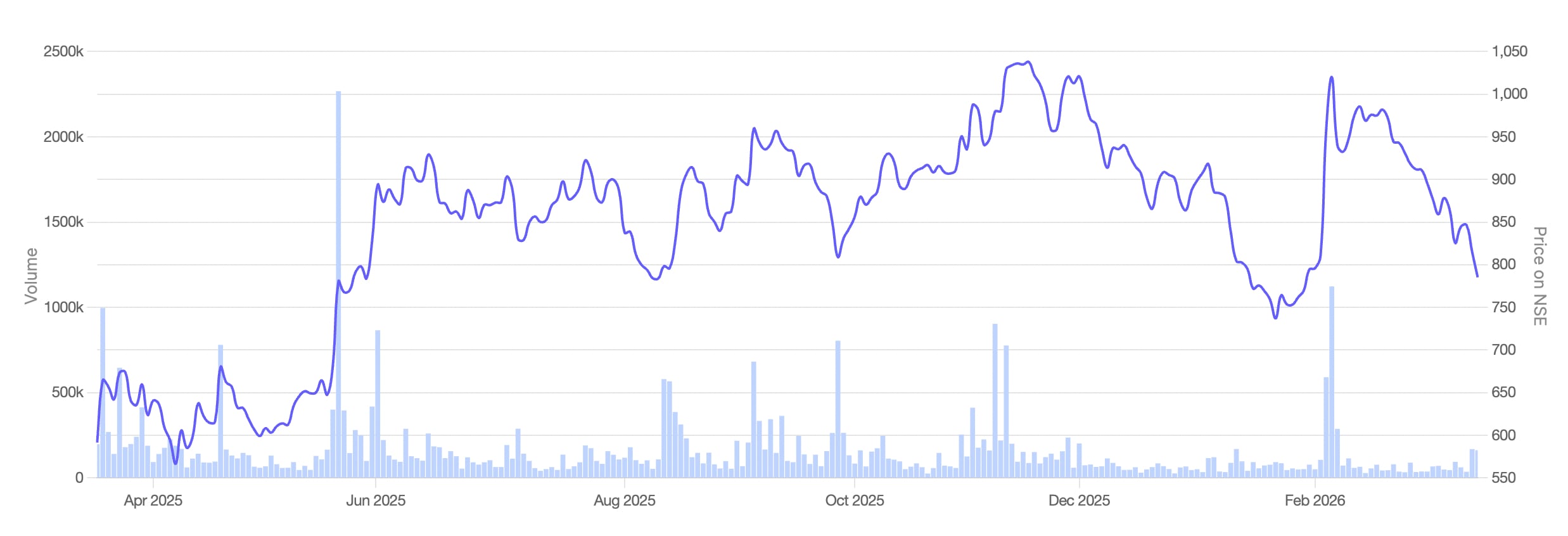
A niche player building global presence
Kitchen sinks and built-in appliances rarely feature in conversations about high-growth sectors. Yet globally, the category remains fragmented and heavily dependent on distributor relationships, product reliability and supply consistency. In such markets, scale is often built quietly rather than through dramatic innovation.
Carysil has tried to use this structure to its advantage.
Over time, it has moved beyond quartz sinks into stainless steel products, faucets and kitchen appliances. This wider portfolio allows the company to sell more products to existing customers while gradually entering new markets. For manufacturers, increasing wallet share is often a more predictable growth strategy than constantly chasing new clients.
Recent numbers suggest incremental progress.
December 2025 (Q3FY26) consolidated revenue stood at about Rs 223 crore, up from roughly Rs 203 crore a year earlier. Operating margins improved to around 19% from about 14% in the corresponding period. Such expansion typically reflects better capacity utilisation and improved product mix.
In manufacturing businesses, operating leverage tends to appear only after years of investment. When it does, earnings growth can begin to outpace revenue growth.
Exports dominate, but domestic opportunity is emerging
Exports contribute a lion’s share of Carysil’s revenue, roughly 80%. The company’s key markets include the United States, the United Kingdom, Europe, Australia and parts of the Middle East. These regions are closely linked to housing cycles and renovation demand.
Moreover, Carysil has been strengthening its domestic presence. A large of the growth here will be driven by premiumization in urban housing, rising modular kitchen adoption and increased consumer preference for branded products.
While India currently contributes a smaller share of revenue, faster domestic growth could help reduce dependence on global housing cycles. For export-oriented manufacturers, such diversification can provide earnings stability over time.
Investment phase visible on the balance sheet
The balance sheet perhaps tells the most honest story about Carysil’s expansion.
Total assets have more than doubled in the past three years, reflecting real investments in manufacturing capacity, distribution reach and inventory required to service global customers.
Borrowings have risen alongside this expansion. The debt-to-equity ratio now stands at around 0.42. Interest coverage, however, remains comfortable at over six times.
In other words, leverage exists but has not yet become a constraint.
For export manufacturers attempting to build scale, such balance sheet transitions are often unavoidable. Capital is deployed first. Returns usually follow later.
Utilization & Working Capital: The Path to Earnings Inflection
Working capital trends underline the same shift.
Inventory days have moved closer to 290 and the cash conversion cycle has stretched to roughly 250 days. This means money remains locked inside the business for longer periods before it turns into cash.
Companies often do this deliberately. They build stock to improve delivery timelines or to prepare for an eventual pickup in demand. The risk, of course, is that if demand recovery takes time, returns remain subdued.
That is visible in return ratios.
Return on capital employed is currently in the mid-teens, lower than what mature manufacturing businesses typically deliver at peak utilisation. But such moderation is not unusual during expansion phases. Mainly because once capacity gets absorbed, operating leverage will begin to work. This will improve profitability faster than revenue.
Future growth tied to housing cycle and sourcing shifts
The future path for Carysil is closely linked to housing cycles. Especially in developed markets.
Simply put, demand for sinks, fittings and kitchen solutions tends to follow residential construction and renovation activity. When housing slows, orders soften. When sentiment improves, discretionary upgrades often return.
However, it is to be noted that the recent geopolitical disruptions have added uncertainty. This is mainly via freight cost volatility and supply chain adjustments. Simultaneously, they are nudging global buyers to diversify sourcing away from traditional manufacturing hubs.
Indian exporters may gradually benefit from this shift and Carysil’s presence across various export markets gives it a strong platform to participate, provided demand conditions stabilise.
Meanwhile, the company’s product diversification into appliances and higher-value kitchen solutions could also support margin improvement over time.
Valuation reflects expectations of gradual improvement
At present, Carysil trades at roughly 24 times earnings. These numbers indicate that investors are beginning to factor in the possibility of earnings improvement rather than pricing only current performance.
Return ratios like the ROCE of around 15% and ROE near 14–15% remain moderate. If capacity utilisation improves and working capital intensity reduces, profitability could strengthen meaningfully. In manufacturing businesses, such operating leverage phases often lead to market rerating.
The investment perspective
Carysil represents a familiar but potentially interesting manufacturing transition story.
The key question for investors is whether the next phase will see improved demand, hopefully translating into stronger earnings growth.
Manufacturing businesses move through cycles of investment. This is usually followed by periods of profitability expansion. Identifying the shift between these phases often defines investment outcomes.
If global housing demand stabilises and domestic growth accelerates, Carysil’s earnings trajectory could improve faster than current expectations. If demand remains uneven, the payoff from recent investments may take longer to materialise.
In markets, some companies attract attention only after years of quiet preparation. Carysil may be closer to that turning point than it appears.
Disclaimer:
Note: We have relied on data from www.Screener.in throughout this article. Only in cases where the data was not available, have we used an alternate, but widely used and accepted source of information.
The purpose of this article is only to share interesting charts, data points and thought-provoking opinions. It is NOT a recommendation. If you wish to consider an investment, you are strongly advised to consult your advisor. This article is strictly for educative purposes only.
Manvi Aggarwal has been tracking the stock markets for nearly two decades. She spent about eight years as a financial analyst at a value-style fund, managing money for international investors. That’s where she honed her expertise in deep-dive research, looking beyond the obvious to spot value where others didn’t. Now, she brings that same sharp eye to uncovering overlooked and misunderstood investment opportunities in Indian equities. As a columnist for LiveMint and Equitymaster, she breaks down complex financial trends into actionable insights for investors.
Disclosure: The writer and her dependents do not hold the stocks discussed in this article. The website managers, its employee(s) and contributors/writers/authors of articles have or may have an outstanding buy or sell position or holding in the securities, options on securities or other related investments of issuers and/or companies discussed therein. The content of the articles and the interpretation of data are solely the personal views of the contributors/ writers/authors. Investors must make their own investment decisions based on their specific objectives, resources and only after consulting such independent advisors as may be necessary.