




Rekha Jhunjhunwala is not a name that needs introduction. The wife of the Warren Buffett of India, Late Rakesh Jhunjhunwala and the heir to his fortunes, she is one of the most followed super investors of India. With 27 stocks in her portfolio as on 11th March 2026, worth over Rs 45,860 cr, she is sometimes also called the Woman Warren Buffett of India.
Two of her favourite stocks, that she refuses to sell despite a significant correction, have caught the eye of many investors. The fact that she holds them steadily even after the correction, means she sees potential in these stocks over the long term or a possible turnaround in the near future.
Let us take a look at these stocks to see if they are worthy of the FY27 Watchlist.
Metro Brands Analysis: Why Rekha Jhunjhunwala Holds 14.4% Stake
Incorporated in 1977, Metro Brands Ltd is one of the largest Indian footwear & accessories specialty retailers and is among the aspirational Indian brands in the footwear category.
With a market cap of Rs 25,870 as on 11th March 2026, the company is a one-stop shop for of branded products for the entire family, including men, women, unisex, and children, and for every occasion, including casual and formal events.
Rekha Jhunjhunwala holds a stake in the company at least since the filings for the quarter ending December 2021 (when the stock was listed) per Trendlyne.com. Currently, she holds close to 10% stake in the company worth over Rs 2,473 cr.
What has been off late catching the eye of smart investors looking for the next pick for their FY27 watchlist, is the fact that Jhunjhunwala has shown solid trust in the stock despite the decay in prices in the recent months.
The share price of Metro Brands Ltd was about Rs 470 when listed in December 2021 and as on 11th March 2026 it was Rs 949. While this is over a 100% jump in 4 years, the stock price has seen big correction the last 6 months.
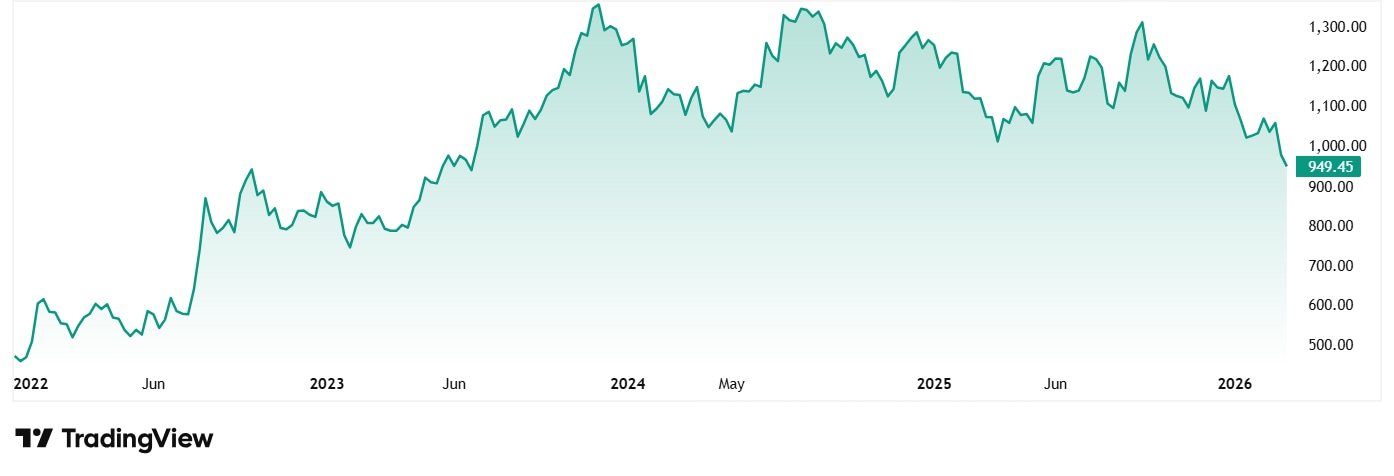
Just in the last 6 months, the price has declined from Rs 1,321 to its current price of Rs 949 which is close to its 52-week low of Rs 890.
Let us look at the financials to see if we can find a reason for this fall in prices.
The Cost of “Priced to Perfection”
The sales recorded a compounded growth of 16% in the last 5 years, but not without its share of peaks and falls.
| FY | FY20 | FY21 | FY22 | FY23 | FY24 | FY25 |
| Sales/Rs Cr | 1,285 | 800 | 1,343 | 2,127 | 2,357 | 2,507 |
And for the 3 quarters of FY26 ending in December 2025, sales of Rs 2,090 cr were recorded.
The EBITDA (earnings before interest, taxes, depreciation, and amortization) logged an upward trend after the fall of FY21.
| FY | FY20 | FY21 | FY22 | FY23 | FY24 | FY25 |
| EBITDA/Rs Cr | 355 | 175 | 412 | 680 | 704 | 759 |
For the 3 quarters of FY26 ending in December 2025, EBITDA logged by the company was Rs 630 cr.
The net profits also moved in a similar pattern for Metro Brands, with the only difference being that it saw a fall in FY25 as well, despite the sales and EBITDA growing over the last year.
| FY | FY20 | FY21 | FY22 | FY23 | FY24 | FY25 |
| Profits/Rs Cr | 161 | 65 | 214 | 365 | 415 | 354 |
Between April and December 2025, the company has recorded profits of Rs 298 cr, which makes it interesting to look out for the Q4 figures.
The Valuation Hurdle: Growth at What Price?
Regarding the valuations, the share is trading at a PE of 66x, which is more than double the current industry median of 32x.
While the big fall in FY21 could be attributed to Covid19, which bought even the biggest of the retail brands to its knees, the most recent fall could be due to the decline in profits in FY25.
This decline comes as a reality check for a company that had become very expensive to own. Even though they are selling more shoes, investors got nervous because the stock’s price was priced for perfection, meaning it was so high that even minor problems caused a sell-off.
Currently, the company is spending a lot of cash to open dozens of new stores, which is great for the future but temporarily eats into their current profits through higher rent and staff costs. Furthermore, new government quality rules (called BIS) have made it harder to import popular global brands, causing a temporary supply shortage.
Essentially, the market and Jhunjhunwala are hitting the pause button on the hype while it waits for the new investments and imports to finally pay off.
While the current valuation suggests that the market is still demanding a high premium for Metro’s growth story, the real question for investors isn’t about the price today, but the payoff tomorrow. We are seeing a classic tug-of-war between short-term margin pressures driven by aggressive store rollouts and regulatory hurdles and the long-term compounding potential of a house of brands strategy that has clearly kept one of India’s most prominent super-investors at the table.
As we look toward the Q4 results and the start of FY27, the answer may lie in how quickly Metro can navigate the BIS transition and turn those new storefronts into profit engines.
Jubilant Pharmova: Decoding the Radiopharmaceutical Pivot for FY27
Established in 1978, Jubilant Pharmova Ltd is an integrated global pharmaceuticals company having three business segments i.e. pharmaceuticals, contract research and development services and proprietary novel drugs.
With a market cap of Rs 13,039 cr as on 11th March 2026, the company is engaged in radiopharma, allergy immunotherapy, contract development and manufacturing of sterile injectable, generics, contract research development and manufacturing and proprietary novel drugs businesses. The radiopharma business is engaged in manufacturing and supply of radiopharmaceutical products and services.
Rekha Jhunjhunwala bought a stake in the company as per the exchange filings for the quarter ending September 2021 and as per the filings for the quarter ending December 2025, she held 6.4% stake worth over Rs 832 cr.
Just like Metro Brands above, Jubilant Pharmova has also caught the eye of the smart investors, due to the stock prices.
The share price of Jubilant Pharmova Ltd was about Rs 780 in March 2021 and as on 11th March 2026 it was Rs 818.
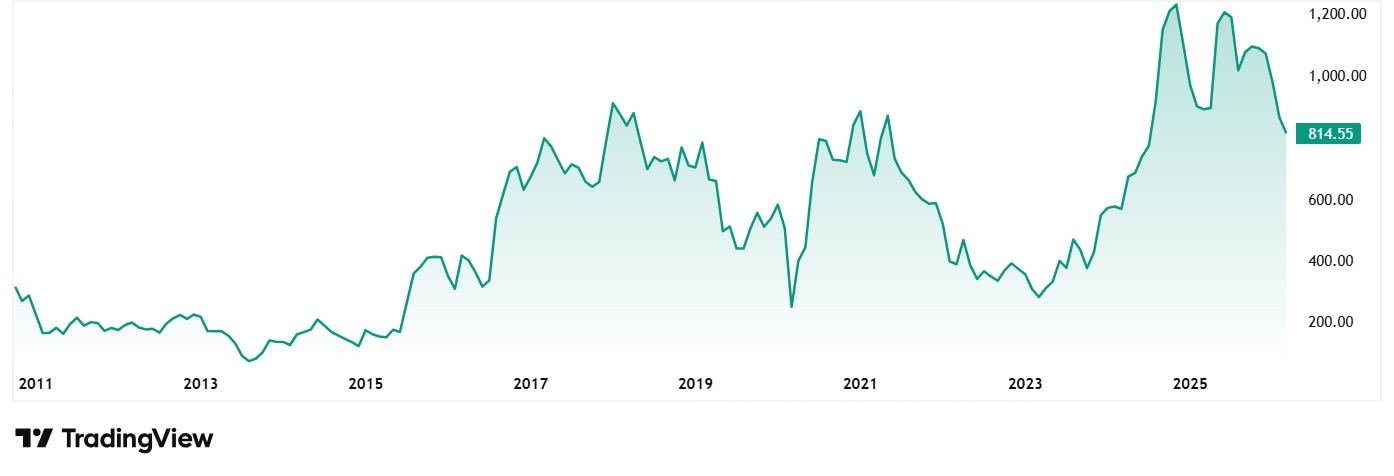
As we can see, in the last 6 months, the price has declined from Rs 1,125 to its current price of Rs 818, which is closer to the stock’s 52-week low of Rs 784.
Let’s dive into the financials to get a perspective of how the company stands right now.
The Classic Case of Growth Gap
The sales recorded a compounded growth of just 4% in the last 5 years from Rs 5,976 cr in FY20 to Rs 7,234 cr in FY25. And for the 3 quarters of FY26 ending in December 2025, sales of Rs 5,989 cr were recorded.
The EBITDA is where the company got battered…
| FY | FY20 | FY21 | FY22 | FY23 | FY24 | FY25 |
| EBITDA/Rs Cr | 1,548 | 1,403 | 1,150 | 779 | 901 | 1,173 |
For the 3 quarters of FY26 ending in December 2025, EBITDA logged by the company was Rs 920 cr, which hints at a turnaround which Jhunjhunwala is probably betting on.
The net profits also saw its share of ups and downs before recording a complete turnaround in FY25.
| FY | FY20 | FY21 | FY22 | FY23 | FY24 | FY25 |
| Profits/Rs Cr | 898 | 836 | 413 | -65 | 73 | 836 |
And between April and December 2025, the company recorded profits of Rs 278 cr, which is much lower than the figure of Rs 685 cr for the same 3 quarters in the previous year.
However, it is important to note that the prior period was supported by one-time exceptional gains of Rs 382 cr from selling its stake in Sofie Biosciences. On a normalized basis, the company’s operational profit actually grew by 13%, indicating that the headline decline is a mathematical base effect rather than a loss of business momentum.
Radiopharma Pivot or Value Trap?
As for the valuations, the share is trading at a PE of 28x, which is same as the current industry median.
The decline in Jubilant Pharmova’s share prices over the last six months reflects a strategic growth gap where the high costs of transitioning toward specialized niches like Radiopharmaceuticals are currently overshadowing immediate earnings. While the company is pivoting away from high-pressure generics, this shift has been met with significant operational friction, including elevated R&D spending, higher interest burdens from capital expansion, and the persistent overhang of USFDA regulatory hurdles at key facilities.
Essentially, the market is discounting the stock as it moves through a heavy investment phase, trading immediate margin stability for the long-term potential of a more complex, high-entry-barrier portfolio.
All said and done, Jubilant Pharmova finds itself in a form of strategic limbo. It has moved beyond the commoditised margins of legacy generics but has yet to fully harvest the riches of its specialized bets. The current share-price decline reflects a tension between the high capital cost of corporate reinvention and the market’s mounting impatience for immediate yield.
But Jhunjhunwala remains put. Whether this period of underperformance is the painful birth of a high-moat pharmaceutical powerhouse or a symptom of a pivot too ambitious for its balance sheet remains the defining question that only the next several quarters of operational execution can answer.
The Price of Patience in a Growth-Hungry Market
As we get closer to FY27, the presence of Metro Brands and Jubilant Pharmova near their annual lows presents a classic study in contrarian conviction. For Rekha Jhunjhunwala, these are not merely tickers in a portfolio but strategic bets on long-term structural shifts, one in the premiumization of Indian retail and the other in the complex pivot toward high-moat radiopharmaceuticals.
The market’s recent cooling toward these names reflects a broader impatience with investment phases. In the case of Metro Brands, the friction of rapid store expansion and regulatory hurdles like the BIS norms has temporarily masked the company’s compounding power. Similarly, Jubilant Pharmova is navigating the valley of death that often accompanies a shift from commoditized generics to specialized medicine, where R&D costs precede revenue by years.
Whether these stocks will turn out to be value traps or emerge as the turnaround stories of FY27 depends on operational execution. Metro must prove it can turn its new storefronts into high-yielding assets, while Jubilant needs to clear regulatory overhangs to monetize its specialized bets. Add these stocks to your watchlist for FY27 and follow them closely to not miss out on any big movements.
Disclaimer:
Note: We have relied on data from www.Screener.in and www.trendlyne.com throughout this article. Only in cases where the data was not available, have we used an alternate, but widely used and accepted source of information.
The purpose of this article is only to share interesting charts, data points and thought-provoking opinions. It is NOT a recommendation. If you wish to consider an investment, you are strongly advised to consult your advisor. This article is strictly for educative purposes only.
Suhel Khan has been a passionate follower of the markets for over a decade. During this period, He was an integral part of a leading Equity Research organisation based in Mumbai as the Head of Sales & Marketing. Presently, he is spending most of his time dissecting the investments and strategies of the Super Investors of India.
Disclosure: The writer and his dependents do not hold the stocks discussed in this article.
The website managers, its employee(s), and contributors/writers/authors of articles have or may have an outstanding buy or sell position or holding in the securities, options on securities or other related investments of issuers and/or companies discussed therein. The content of the articles and the interpretation of data are solely the personal views of the contributors/ writers/authors. Investors must make their own investment decisions based on their specific objectives, resources and only after consulting such independent advisors as may be necessary.