



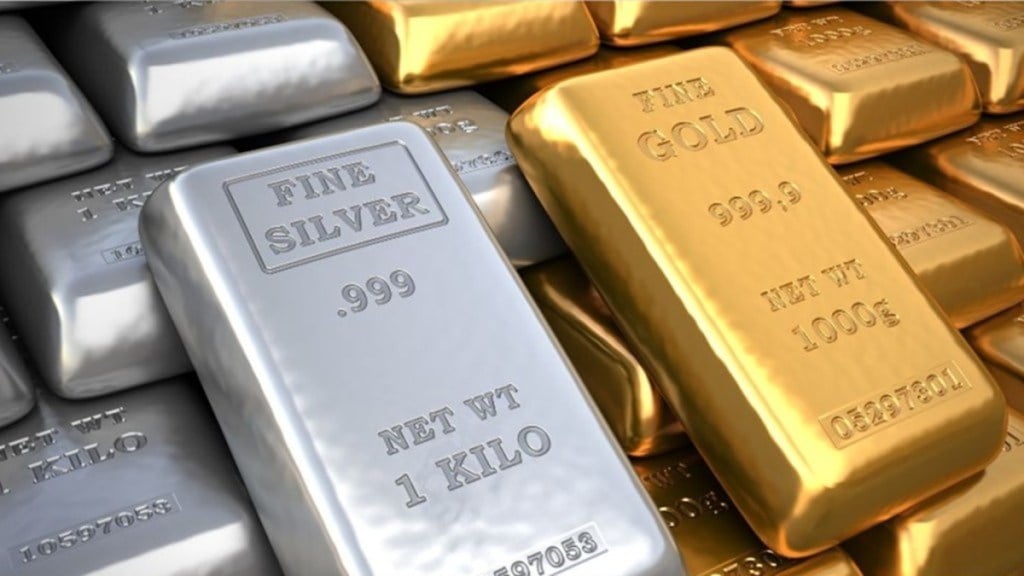
Is silver the new gold in the commodity market? The key precious and industrial metal has been grabbing headlines due to the sharp surge in recent times. In fact, Silver Futures extended their sharp rally on the Multi Commodity Exchange of India (MCX) and surged another 4% on December 17. Market veteran Ajay Bagga called the ourperformance by silver ‘‘Gold on steroids.”
“Silver has overtaken Microsoft to become the 5th most valuable asset in the world, behind only Gold, Nvidia, Apple, Alphabet(Google), at $ 3.6 trillion of value,” Bagga added.
Silver rally rooted in valuation catch-up
Bagga described silver’s strong performance in 2025 as a catch-up after a prolonged period of underperformance relative to gold.
“The Silver outperformance in CY25 has been a ‘catch up’ trade, as the Gold to Silver ratio had shot up to 105 and is back to a reasonable 70 now,” he said.
Historically, silver has tended to outperform gold during major precious metals bull markets, Bagga noted.
“In the previous two great precious metals bull markets, Silver has performed as ‘Gold on steroids. In 1979-80, Gold went up 3x, Silver went up 7x. In 2007-2012, Gold was up 2x, Silver went up 4x,” he explained.
Even after the sharp move this year, relative valuation indicators continue to favour silver, according to Bagga. “In terms of Silver to the S&P 500 ratio, there is still a lot of runway for Silver to go even higher.”
Ajay Bagga on why silver prices surged in 2025
According to Bagga, the interaction of rising industrial demand, investment flows and supply inelasticity explains the scale of silver’s move this year.
“Add the hi-tech/industrial demand and the surge in investment demand, and you have the recipe for the 110% plus rise in Silver prices this year,” he said.
Macro forces supporting precious metals
The broader context for silver’s rise mirrors that of gold. According to a Silver Outlook and Trends note prepared by Axis MF Research, many of the same macro drivers are at play.
These include a weaker US dollar, uncertainty around US Federal Reserve policy, global economic uncertainty, geopolitical tensions and turbulence in Japan’s bond market. The report notes that Japan’s exit from yield curve control and the unwinding of the yen carry trade have added to global risk aversion, supporting demand for precious metals.
Bagga links silver’s appeal directly to this macro environment. “Gold and Silver are being preferred as investments in a world marked by the debasement trade, by rising debt-GDP ratios for major countries which is a precursor to further fall in value of fiat currencies, by the de-dollarisation move post the seizure of the Russian FX reserves by the US and Europe, by enhanced geopolitical risks, by the 324 interest rate cuts that have happened across the world in the last two years, by Central bank buying and finally by higher demand than supply of these precious metals,” he said.
Industrial demand forms the backbone
Where silver diverges from gold is in its industrial role. According to The Silver Institute and Metals Focus, industrial applications account for more than half of total global silver consumption.
Bagga says this dual identity is central to the metal’s current cycle. “The factors for Silver’s rise are the Gold-related factors of investment plus the high-tech demand surge market,” he said.
The Axis MF Research note identifies solar energy, electric vehicles and semiconductors as key sources of industrial demand, all linked to the global green transition.
Bagga elaborates on each of these drivers.
“Silver, in addition to these, has a huge and increasing demand from renewables, from EVs and from the AI boom leading to data centre rollouts,” he said.
Solar, EVs and AI drive silver consumption
On solar energy, Bagga points to rapid capacity expansion. “In Solar, the PV cell capacity has gone up 10x in the last 10 years, Silver demand has risen 3x in a sector which is forecasted to grow at 17% CAGR through 2030.”
The silver outlook report echoes this assessment, noting that solar remains one of the fastest-growing end-use segments for silver, according to The Silver Institute.
Electric vehicles represent another growing source of demand. “In EVs, nearly 69%-80% more Silver is required in an Electric Vehicle vs an ICE vehicle. With EVs growing at 13% CAGR through 2030, we expect elevated demand for Silver,” Bagga said.
The report also highlights semiconductors as a steady source of silver consumption, given the metal’s conductive properties.
Artificial intelligence-led infrastructure spending adds a third layer.
“The third big demand source is the massive roll-outs of data centres to support the AI investments. Data centre AI capacity has gone up 53x from 2000 to 2025, and we expect this to go up some 10x over the next 10 years. There is no readily available Silver supply to meet these three key demand areas,” Bagga said.
Supply remains structurally tight
On the supply side, silver faces persistent constraints. According to The Silver Institute and Metals Focus, global silver supply has lagged demand for five consecutive years, resulting in a sustained market deficit.
Bagga says the structure of silver mining limits the industry’s ability to respond quickly to higher prices. “In terms of supply, nearly 80% of mined Silver comes from lead, zinc and copper mines, which obviously face their own constraints,” he said.
He added, “The world has been short of physical supplies of silver versus the demand for the last 5 years, and this will continue into the next decade as well.”
Silver outlook in 2026: Key risks to watch
The silver outlook report cautions that as prices move higher, investors need to be mindful of potential risks. These include the possibility of overvaluation affecting physical demand, ETF outflows, profit-taking, a stronger US dollar, rising real yields, easing geopolitical tensions, a downturn in copper prices and rotation into energy or agricultural commodities. The report also notes that central banks continue to prefer gold over silver for official reserves, limiting institutional support.
Silver: The big call for 2026
Despite these risks, the report describes the outlook for silver as constructive, with multiple tailwinds still in place, even as volatility may increase in 2026.
Bagga strikes a similar note and says, “We expect this to continue into 2026 because all the conditions are continuing to be supportive. There won’t be 100% returns in 2026, but mid double-digit returns are expected,” he said.