




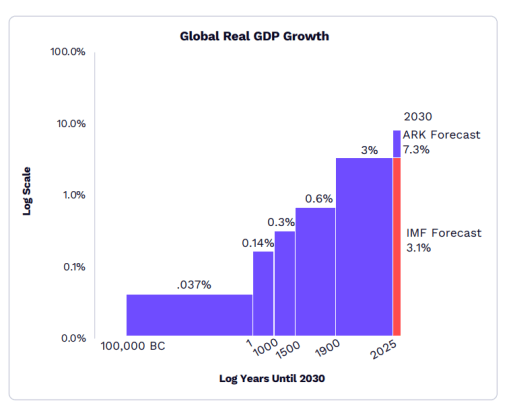
Cathie Wood’s ARK Invest just released their annual “Big Ideas” report for 2026, and if you thought last year was crazy, buckle up. This time, they’re predicting GDP growth could hit 7.3% annually (versus the IMF’s measly 3.1% forecast), robotaxis will be everywhere, and—wait for it—your household robot could add $62,000 to GDP per year. Yes, you read that right.
The details
Let’s start with the headline number that’ll make your economics professor spit out their coffee: ARK believes real GDP growth could accelerate from the current 3% to 7.3% annually by 2030. That’s not a typo. They’re saying the world economy could more than double the IMF’s projections, driven entirely by disruptive technologies.
But here’s where it gets interesting—and slightly bonkers.
Your future robot butler is worth $6 trillion
ARK has done the math on household humanoid robots, and the numbers are eye-watering. Right now, Americans spend about $2,600 annually on paid household maintenance and care. But the actual value of all home upkeep work (including what you do yourself) is around $68,000 per year.
Enter the humanoid robot.
According to ARK, if you put one of these metal helpers in each of the 90 million US owner-occupied homes, it could increase GDP by nearly $6 trillion—that’s 20% of the entire US economy. If these robots penetrate 80% of households over five years, annual GDP growth could jump from 2-3% to 5-6%.
Think about that for a second. We’re talking about robots that do your laundry, mow your lawn, and cook your meals, all while freeing you up to do more productive (read: profitable) work.
Space data centers (Because earth wasn’t big enough)
Now here’s where ARK’s predictions venture into science fiction territory: they believe space-based AI data centers could become cheaper than terrestrial ones.
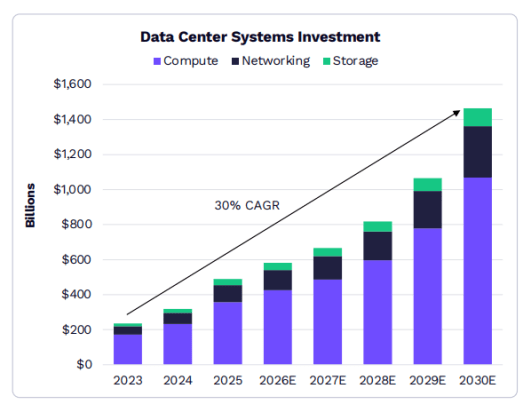
The logic? AI is running into earthly constraints—power, cooling, real estate. But in space, you’ve got unlimited solar power and the vacuum of space for cooling. At prospective launch costs (thanks to SpaceX’s reusable rockets), space-based compute could be 25% less expensive than Earth-based alternatives.
If this happens, demand for reusable rockets could increase 60-fold. We’re talking about sending enough hardware into orbit to support 100 gigawatt of AI compute. That’s roughly 11 times more mass than everything SpaceX plans to launch for their Starlink constellation through 2030.
The $28 trillion blockchain bet
While everyone’s fighting about Bitcoin on Twitter, ARK is calmly projecting that the entire digital asset market (cryptocurrencies plus smart contract networks) could reach $28 trillion by 2030. That’s a 61% annual growth rate from today’s ~$2 trillion.
Bitcoin alone could account for $16 trillion of this, growing at 63% annually. The rest would come from smart contract platforms like Ethereum and Solana, which are basically becoming the new financial infrastructure of the internet.
And stablecoins? They’ve already hit $3.5 trillion in monthly transaction volume—2.3 times larger than Visa, PayPal, and global remittances combined. That’s not a future prediction; that’s happening right now.
AI is getting ridiculously cheap
Remember when AI was expensive? Well, not anymore. The cost of software development using AI fell 91% in just eight months—from $3.50 per million tokens in April 2025 to $0.32 in December. At this rate, by 2030, augmenting knowledge workers with AI could boost global software spend from the current $1.4 trillion to potentially $13 trillion.
But here’s the kicker: even in ARK’s most conservative scenario, they expect employment to keep growing, not shrinking. Historically, automation hasn’t killed jobs—it’s made existing jobs more productive and created entirely new categories of work we couldn’t have imagined before.
Robotaxis will dominate cities
ARK believes that by 2030, autonomous vehicles could generate $34 trillion in enterprise value. Not revenue—enterprise value. They’re predicting that robotaxis will cost just $0.25 per mile by 2035, compared to $2.80 for human-driven ride-hail today.
Here’s the math that should terrify Uber and Lyft: just 140,000 robotaxis could handle all current US ride-hail volume. And only 24 million robotaxis—less than 10% of today’s US vehicle fleet—could accommodate the majority of all US urban miles traveled.
Tesla, with its current production capacity, could theoretically build enough vehicles to handle all urban transportation in America’s top cities. That’s not speculation—that’s just looking at their current manufacturing capabilities.
The multiomics revolution nobody’s talking about
While everyone obsesses over ChatGPT, ARK is watching a quieter revolution in biology. The cost to sequence a whole human genome has dropped to around $100, and by 2030, it could hit $10. That’s a 90% decline.
Here’s why that matters: cheaper data means better AI models, which means better diagnostics and treatments, which eventually means cures instead of lifetime medications. ARK calculates that a cure for a rare disease could be worth 20 times more than a typical prescription drug because it captures lifetime value upfront and avoids competition.
They’ve even sized up the longevity market opportunity at $1.2 quadrillion. Yes, quadrillion with a Q. That’s the theoretical value of eliminating age-related decline and disease-related deaths in the US alone.
The bottom line
ARK’s predictions sound insane until you remember they’ve been right about some pretty wild stuff before. They called the EV revolution when Tesla was trading at $50. They predicted Bitcoin when it was a joke. They saw the AI boom coming years early.
Are they right this time? Who knows. But if even half of these predictions come true, we’re looking at a decade of economic growth and technological transformation unlike anything we’ve seen since the Industrial Revolution.
The real question isn’t whether these technologies will arrive—it’s whether you’re positioned to benefit when they do.
Because according to Cathie Wood, the future isn’t just coming. It’s already here, being built by robots, running on AI, and launching into space.
And honestly? That’s either the most exciting investment opportunity of our lifetime or the setup for the world’s most expensive lesson in humility.
Time will tell which one it is.
Sonia Boolchandani is a seasoned financial writer She has written for prominent firms like Vested Finance, and Finology, where she has crafted content that simplifies complex financial concepts for diverse audiences.
Disclosure: The writer and her his dependents do not hold the stocks discussed in this article.
The website managers, its employee(s), and contributors/writers/authors of articles have or may have an outstanding buy or sell position or holding in the securities, options on securities or other related investments of issuers and/or companies discussed therein. The content of the articles and the interpretation of data are solely the personal views of the contributors/ writers/authors. Investors must make their own investment decisions based on their specific objectives, resources and only after consulting such independent advisors as may be necessary.