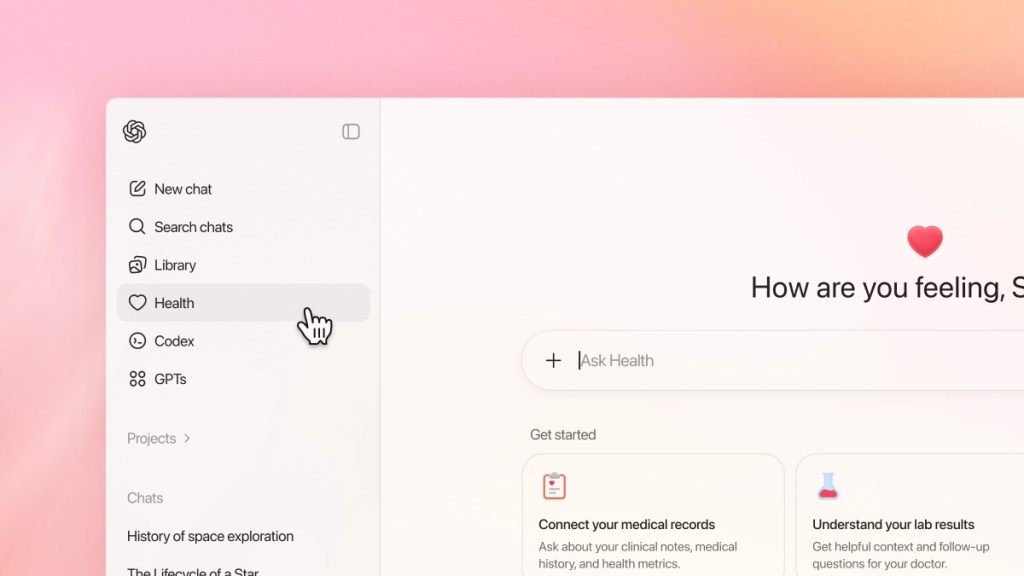
OpenAI has stepped into the digital health arena with a new flavour of its trusty ChatGPT chatbot. It is called the ChatGPT Health has been revealed as a dedicated feature within its popular chatbot. OpenAI says that ChatGPT Health is designed to help users better understand and manage their health by securely connecting the bot with personal medical records and wellness apps. The idea is to help individuals with more relevant, context-aware responses to everyday health questions, unlike existing health monitoring and fitness tracking apps.
Since OpenAI has already treaded on troubled water in the past, the AI company has explicitly stated that ChatGPT Health is meant to support – not replace – professional medical care. Developed in collaboration with over 260 physicians from 60 countries, ChatGPT Health wants to address the surging demand for health-related queries on the platform. OpenAI reports that more than 230 million people worldwide ask health and wellness questions on ChatGPT each week.
ChatGPT Health: What does it offer
ChatGPT Health operates as a separate, sandboxed space in the ChatGPT interface, accessible via a dedicated ‘Health’ tab in the sidebar.
Users can optionally connect:
– Medical records (U.S. only, powered by a partnership with b.well Connected Health, which connects to millions of providers).
– Wellness apps such as Apple Health (iOS required), MyFitnessPal, Function Health, Peloton, Weight Watchers, AllTrails, and others.
Once the data is connected to ChatGPT Health, the AI can provide personalised assistance, including:
– Decoding lab results and test reports in an accessible language.
– Preparing questions or summaries for doctor appointments.
– Offering tailored advice on diet, exercise routines, and fitness goals based on activity, sleep, and nutrition data.
– Analysing healthcare patterns to explain insurance options and tradeoffs.
– Tracking long-term patterns for better-informed discussions with clinicians.
OpenAI clarifies that the feature is not for diagnosis or treatment. It focuses on everyday wellness, pattern recognition, and preparation for professional care. It is sort of like the Apple Watch, where you get insights based on the data provided. For medical attention, you will need to visit a professional healthcare service.
Is ChatGPT Health private and secure
Since this feature deals with the sensitivity of health data, ChatGPT Health includes enhanced protections:
– Purpose-built encryption and compartmentalisation to isolate health conversations.
– Data and memories do not flow into or out of the Health space (except limited non-health context for relevance).
– Conversations are not used to train OpenAI’s foundation models.
– Users can view, delete, or disconnect data at any time. Health Chats can be removed within 30 days.
– Multi-factor authentication recommended for added security.
OpenAI states that medical record connections require explicit user authorisation, and integrations comply with US healthcare standards via b.well.
ChatGPT Health: When can you use it
– It will be initially available to a limited group of early users via a waitlist.
– Those eligible for ChatGPT Free, Go, Plus, and Pro subscribers outside the European Economic Area, Switzerland, and the UK (due to stricter data regulations) will get access it.
– A full rollout of ChatGPT Health is planned in the coming weeks for all users on web and iOS platforms.
However, note that the medical records and certain app integrations are currently limited to the US version only.