



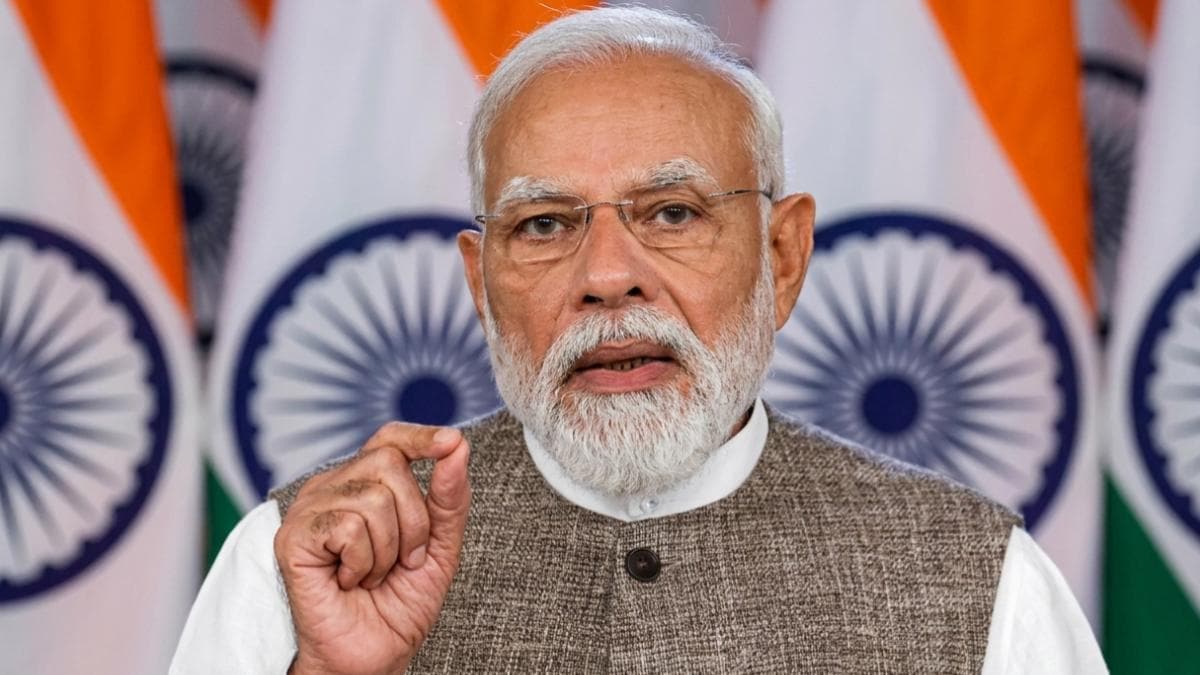
Prime Minister Narendra Modi sought an apology for the Lok Sabha setback for the women’s reservation bill from “mothers and sisters” in an emotional address to the nation on Saturday. “Women will make the opposition pay for the disrespect,” he said, accusing the Congress and its INDIA bloc partners of “betraying” women and celebrating the defeat of their political aspirations, despite decades of demand by women leaders across parties.
“Parties like Congress, DMK, TMC and Samajwadi Party have committed foeticide by defeating bill on women’s reservation,” he said.
Accusing the Congress of spreading falsehoods about necessary reforms, he said that “every single challenge our country faces today is due to the negative approach of the party over the years”, he added”.
“Every citizen of this country is witnessing how women’s progress has stalled… Despite our best efforts, we haven’t succeeded. Amendments could not be made in the Nari Shakti Adhiniyam. And I apologise to all the mothers and sisters in the nation for this,” PM Modi said.
This insult by Congress and its allies will always remain in every woman’s heart, he said, adding that a woman “forgets everything, but not her insult”. “Congress has always believed in the politics of dividing people, so they spread falsehood about North-South divide,” he said.
‘Woman forgets everything, but never forgets her insult’
“For us, the nation’s interest is paramount. But when for some people party interest becomes everything, when party interest overshadows the nation’s interest, then women’s power, the nation’s interest… has to bear the consequences. This is exactly what has happened this time too,” he added.
He alleged that the “self-serving politics of parties like Congress, DMK, TMC, and the Samajwadi Party” has come at the expense of the nation’s women.
“Yesterday, crores of women across the country had their eyes on Parliament. It was deeply painful to see that when this proposal in the interest of women was defeated, parties like Congress, DMK, SP, and TMC were applauding. By taking away women’s rights, they were thumping their desks. Those were not just thumps on the desk, they were blows to the dignity and self-respect of women,” he said, adding that “a woman forgets everything, but never forgets her insult”.
Opposition parties in Lok Sabha voted against the Constitution Amendment Bill on Friday.
The Lok Sabha took up Constitution (One Hundred and Thirty-first Amendment) Bill, Delimitation Bill, and Union Territories Laws (Amendment) Bill together for passing. In the division that took place on the Constitution Amendment Bill following the debate on the three bills, 298 members voted in favour and 230 against.
With Constitution Amendment Bill defeated, the government later said it did not want to pursue the two other linked bills.
The bills aimed to increase the strength of the Lok Sabha from 543 to 816, with 33 per cent reservation for women. The delimitation was to be carried out based on the 2011 census. The government said there will be a proportionate increase in seats for all states.
Opposition parties said that they are strongly in favour of women’s reservation but were against the Delimitation Bill. They called upon the government to implement the women’s reservation in the existing strength of Lok Sabha.
What was the delimitation bill all about?
PM Modi’s national address was based around the recent defeat of the delimitation exercise has become a central focus of Indian political debate. In simple terms, delimitation is like redrawing the electoral map of India to make sure every Member of Parliament (MP) represents a fair and roughly equal number of people. Since India’s population has grown significantly over the decades, the government introduced the Delimitation Bill, 2026 to increase the total number of seats in the Lok Sabha from 543 to 850.
The bill was specifically linked to the Women’s Reservation Bill; the government argued that by adding more seats, they could guarantee a 33% quota for women without taking away seats from current male representatives. However, the plan faced a “North-South” divide.
Southern states feared that because they successfully controlled their population growth, redrawing the map based on the 2011 Census would give more seats (and more power) to Northern states with higher populations. When the opposition blocked the bill in Parliament, it effectively also stalled the increase in women’s quota.