



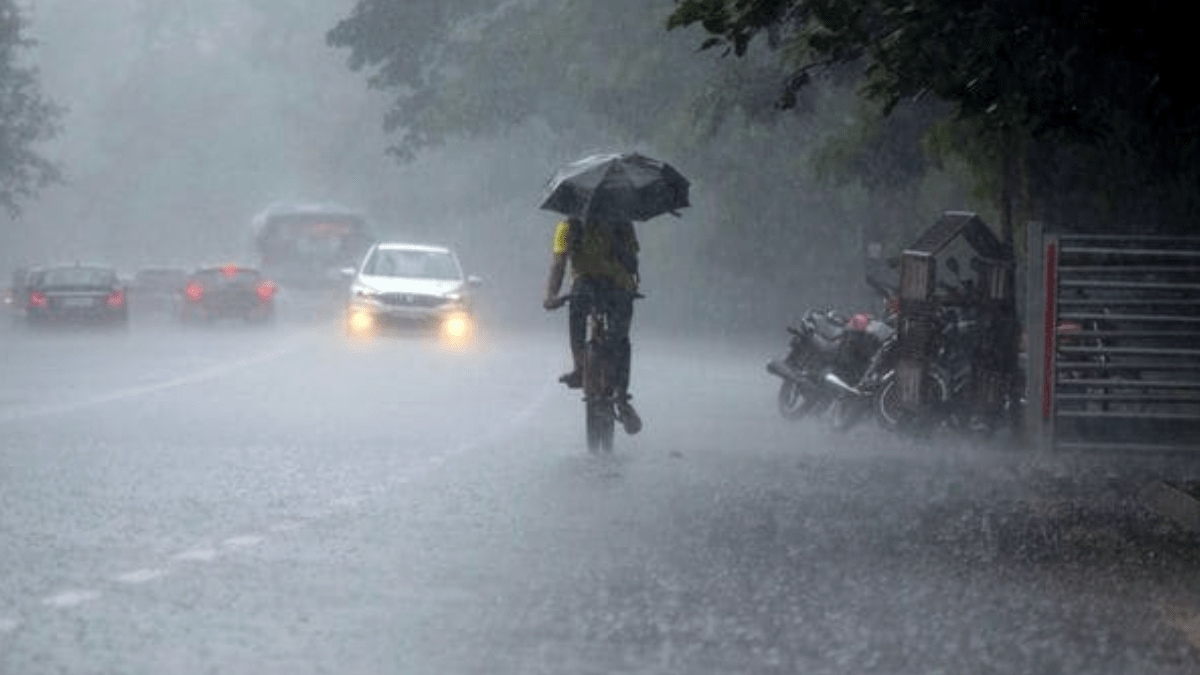
Lack of clarity persisted on Sunday regarding when the southwest monsoon would hit the Kerala coast, where it usually enters the subcontinent. The weather department refrained from announcing a new date for the start of seasonal rains in peninsular India, after its prediction of an “early onset” on May 26 proved incorrect.
The India Meteorological Department (IMD) said on Monday that “conditions are favourable for further advance” of the southwest monsoon in the next 3-4 days, but weather scientists attributing the delayed onset of the rains to weak wind conditions said the onset could be delayed to “after June 3.”
In the last decade, in 2023 and 2016, the monsoon onset was on June 8, whereas it had an early entry into the mainland both in 2024 (May 30) and 2025 (May 24), according to IMD data.
Revised Forecasts
On Friday, the IMD revised its forecast for the June-September southwest monsoon rainfall from 92% of the long period average (LPA) last month to 90% of LPA, indicating “below-normal” rainfall. There is an 84% chance the rains will fall in the “deficient to below normal” range.
Weather models indicate the possibility of a weak monsoon onset in Kerala “after June 3,” followed by its northward progression across parts of Tamil Nadu and coastal Karnataka in the subsequent few days,” Akshay Deoras, senior research scientist, Department of Meteorology, University of Reading, UK, told FE. Deoras said northeast India is expected to witness the monsoon onset between June 5-10, whereas the onset over east India and central regions such as most of Maharashtra appears unlikely before June 10.
The monsoon winds are currently much weaker, but winds could become better organised over the next week in response to Typhoon Jangmi over the western Pacific.
Several global models indicate below-average rainfall over many regions of the country during the first half of June. The delay in onset into the mainland occurred despite the monsoon’s arrival over the Andaman Sea and neighbouring areas on May 16, a week ahead of the normal schedule.
On Sunday, IMD said “conditions are favourable for further advance of southwest monsoon into some more parts of southwest & southeast Arabian sea, Lakshadweep islands, some parts of Kerala and Tamil Nadu, some more parts of southwest, west-central, east-central and northeast Bay of Bengal, and remaining parts of southeast Bay of Bengal during next 3-4 days.”
The earliest onset date recorded this century is May 18, 2004. According to the Met Department, its operational forecasts of monsoon onset over Kerala during 2005-2025, were proved to be correct except in 2015.
Agricultural Stagnation
Typically, the monsoon covers the entire country by July after its onset over the Kerala coast in early June. These southwest monsoon rains, which account for around 75% of the country’s annual precipitation, gradually begin to recede from north India by mid-September.
Adequate rainfall boosts hopes of a robust agriculture-sector output as Kharif crops—paddy, pulses, oilseed and coarse cereals—sowing starts with the onset of rains. The monsoon rains also provide soil moisture for the winter (rabi) crops — wheat, oilseeds and pulses.
However the met department lowered its forecast of “below-normal” southwest monsoon rainfall for June-September this year to 90% of the benchmark- long-period average -, implying that the coming monsoon could be the weakest since 2015.