



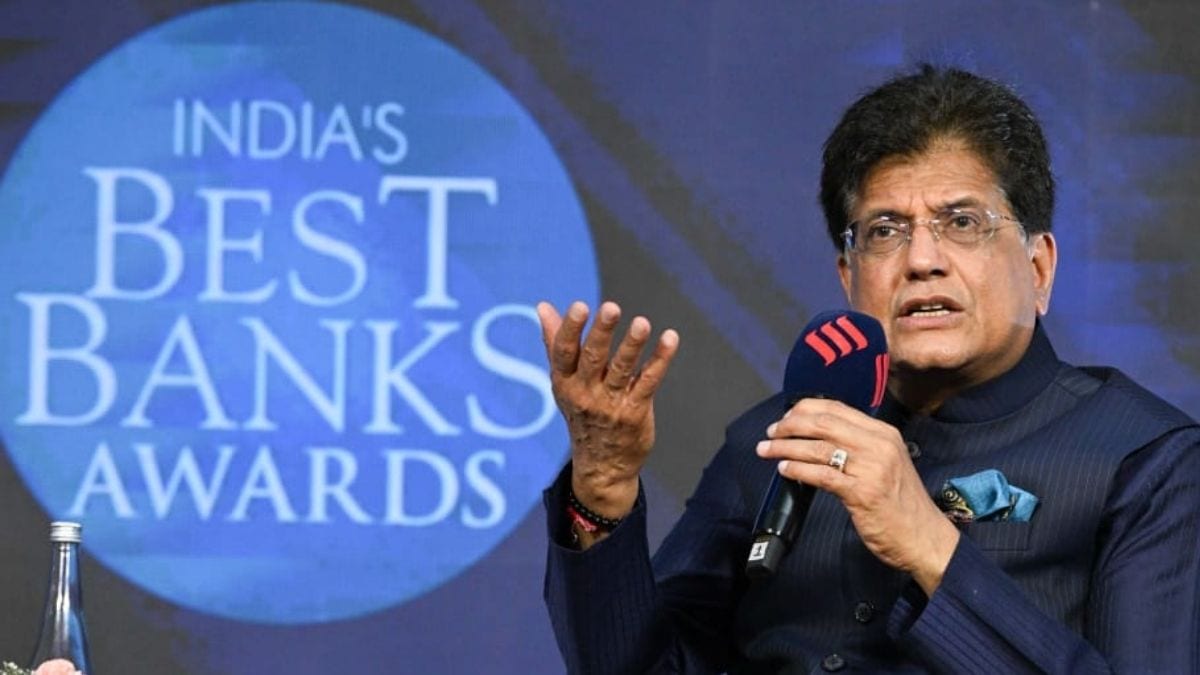
Union Commerce and Industry Minister Piyush Goyal said on Sunday that India remains open to investments from China and other neighbouring countries in desirable sectors, but there is “absolutely no chance” that the Narendra Modi government will join the Regional Comprehensive Economic Partnership (RCEP). Speaking at the Financial Express Best Banks Awards 2026 in Mumbai, Goyal defended India’s investment screening framework and launched a sharp attack on the previous Congress-led government for taking India into RCEP negotiations.
Responding to a question on whether India should review its approach towards Chinese investments as the trade deficit with China continues to rise, Goyal said India does not oppose investments from China as long as they do not pose risks to the economy or lead to opportunistic acquisitions of strategic assets.
“We encourage investments from all over the world. We have no problem also on Chinese investments as long as they are in desirable segments, as long as they are not coming in as an opportunistic takeover of an asset which may at some point of time be underpriced,” Goyal said.
He said the restrictions introduced through Press Note 3 of 2020 were not targeted at China alone but applied to all countries sharing a land border with India. The policy was designed to prevent opportunistic takeovers during periods of economic stress.
“China is one of them and it applies to all the land-border countries. It is not a country-specific problem. It is just a mechanism to protect our own economy from opportunistic takeover,” he said.
Goyal also referred to recent changes in the investment framework. “We have just amended Press Note 3 of 2020 with Press Note 2 recently of 2026 so that up to 10 per cent beneficial ownership is not automatically covered. We are not against investments from any land-border countries except Pakistan,” he said.
Turning to India’s growing trade deficit with China, Goyal said policymakers must first examine the composition of imports before drawing conclusions. “As regards the trade deficit, circle back to the issue I said first. You have to study the import profile from China and what are the products we import,” he said.
What Piyush Goyal said about RCEP
Goyal reserved his strongest remarks for RCEP, the 15-country Asia-Pacific trade bloc that India chose not to join in 2019. “As regards RCEP, there were basic difficulties in the founding principles of RCEP that I am against. I can place on record that there is absolutely no chance that the Narendra Modi government is going to sign RCEP,” he said.
The minister added that he does not see India joining the grouping for many years. “To the best of my knowledge and what I can see around, for many more years now, the Modi government is there and I don’t see the RCEP happening,” he said.
Goyal questioned why India entered the negotiations in the first place. He argued that India already had trade agreements with most RCEP members and therefore did not need to become part of a larger arrangement that included China.
“I actually have a suspicion and a big question mark which some journalists should investigate. Why in the first place did India even enter the negotiations of RCEP? What was the compelling reason at that point of time?” he said.
According to Goyal, India already had free trade agreements with the 10 ASEAN countries and was at an advanced stage of negotiations with Australia. “RCEP was a discussion among 15 countries. India was not in the scene at all. Out of those 15 countries, India already had an FTA with 10 nations. We were at an advanced stage of negotiations with Australia and it could have been wrapped up quickly,” he said.
The minister directly blamed the Congress party for pursuing what he described as an “irresponsible” trade strategy involving China. “The Congress party, I frankly hold them responsible for this irresponsible act of trying to do an FTA between China and India,” Goyal said.
He said that joining RCEP could have severely damaged India’s manufacturing sector by exposing domestic industry to a surge of imports. “The outcome could have been devastating for Indian manufacturing. There would have been no Bajaj Auto. There would have been no manufacturing in India,” he said.
Goyal also questioned the decision-making process under the previous government, saying there was little public consultation before India joined the negotiations. “I still don’t know what was the compulsion of the then government to have a meeting at the level of the then Prime Minister Dr Manmohan Singh and decide to plunge into the RCEP negotiation. The actions did not involve public consultation at all,” he said.
Industry opposed joining the trade bloc, says Piyush Goyal
The minister recalled that when he took charge of the commerce portfolio in June 2019, India was only months away from a crucial RCEP decision. “I got into my job on June 1, seven years ago and the final RCEP meeting was on November 4. I had only five months to study what was on the files and interact with all of you,” he said.
Goyal said the government conducted extensive consultations with stakeholders across the country before making its decision. “We did 200 stakeholder consultations across India. Out of 200, only three interactions said we should join RCEP. That was the kind of fear that industries had for RCEP,” he said.
He said Indian industry, farmers and several other stakeholders feared that joining the trade bloc would expose domestic producers to unfair competition and widen trade imbalances. “I wish and pray that nobody looks at entering RCEP, particularly given that we get a raw deal even from the RCEP,” Goyal said.
Financial Express Best Banks Awards 2026
Goyal’s remarks came at the Financial Express Best Banks Awards 2026, one of India’s leading recognitions for excellence in the financial sector. Held in Mumbai on June 7, the event brought together senior bankers, financiers, fintech executives and corporate leaders.
The awards recognise outstanding performance across banks, non-banking financial companies (NBFCs), small finance banks and fintech firms. Winners are selected by an independent jury with support from EY India based on growth, profitability, financial strength, governance standards and other operational parameters drawn from Reserve Bank of India data over a three-year period.
Apart from honouring top-performing institutions across public sector, private sector and foreign banking categories, the awards also recognise digital lenders, innovative banking products and industry leaders who have built institutions of lasting significance.