



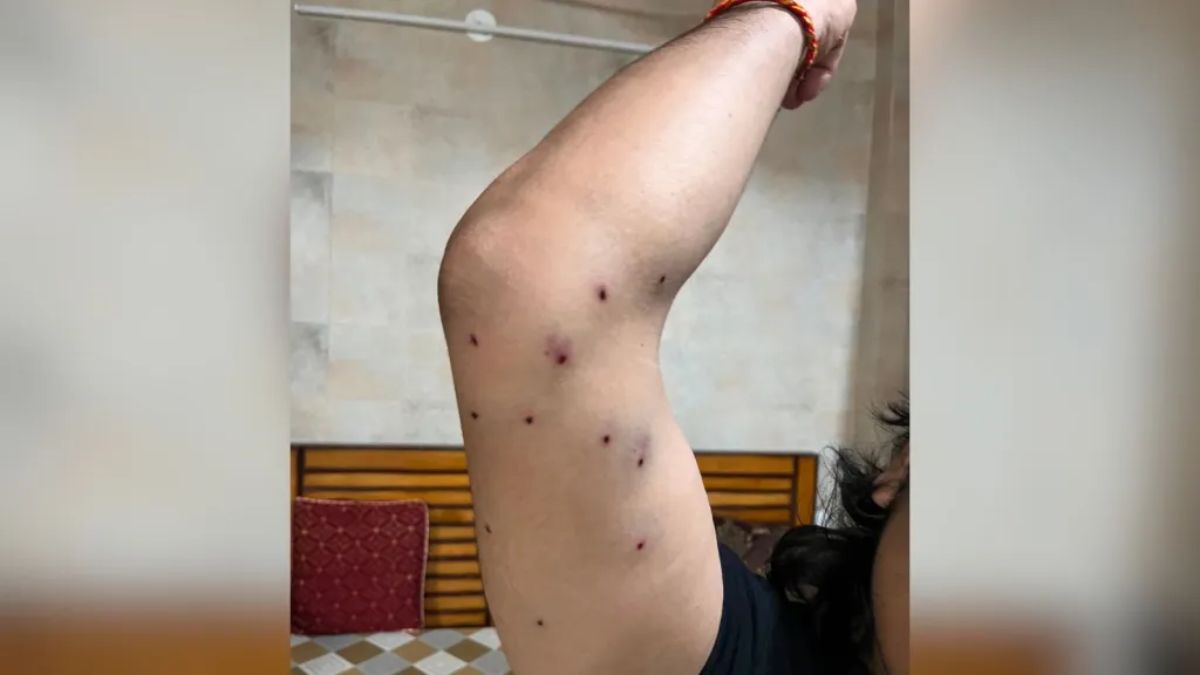
In another story that documents police excess at the Jantar Mantar protests, a 28-year-old sports journalist working with Outlook has sought compensation from the government after being struck by pellets during the ‘Chalo Sansad’ march in Delhi, leaving more than 30 pellets lodged in his body.
The journalist was caught in the clashes near Jantar Mantar on July 20, when thousands of protesters attempted to march towards Parliament to demand accountability over examination paper leaks and the resignation of Union Education Minister Dharmendra Pradhan, according to The Indian Express report.
A medical report issued by Safdarjung Hospital on July 22 and reviewed by The Indian Express records that the journalist sustained injuries from “physical assault at Jantar Mantar by pellet gun”.
Doctors found small, punched-out wounds across his right arm, chest and back, describing the injuries as consistent with pellets, the report said.
Despite the injuries, the journalist has resumed working from home. “The FIFA tournament got over on the 19th, and today (July 23) is the India-Zimbabwe cricket match, so I’ve been following that,” he says, adding that he is eager to return to covering sports, the publication said.
Speaking about what drove him to the protest, the journalists revealed that the government officials had taken Wangchuk from the protest side to a hospital in the ‘interests of his safety.’
“After they took away Sonam Wangchuk, that was the turning point for me,” he told the Indian Express.
What happened during the march
The journalist had parked his motorcycle in Connaught Place before joining the ‘Chalo Sansad’ march on July 20. The protesters were demanding accountability from the Centre over examination paper leaks and the resignation of Union Education Minister Dharmendra Pradhan.
He said he stayed with the gathering as it moved from Jantar Mantar towards Connaught Place. At around 4 pm, clashes broke out and people began running from the area.
According to his account, tear-gas shells were initially fired upwards but were later directed towards the crowd. He said he saw one person ahead of him being struck close to the eye.
Amid the confusion, he spotted uniformed personnel and saw an officer pointing a weapon in his direction. He turned and began running, but felt something strike him in the back. The first sensation was a mild tingling, he recalled. Within moments, it developed into an intense burning pain across his back.
He managed to walk some distance before sitting down. When he later checked himself, he found several wounds with blood beginning to clot around them.
With movement around Connaught Place restricted, he remained in the area for nearly an hour before riding to a friend’s home. Once there, he found that his vest was soaked in blood.
His friend photographed the injuries and asked ChatGPT about the wounds following which they started suspecting that the wounds may have been caused by pellets. The journalist received a tetanus injection later that evening but said the pain became severe while he tried to sleep.
Doctors advise against removing pellets
The following evening, he went to Safdarjung Hospital, where he remained from around 7 pm until nearly 4 am.
Doctors cleaned the wounds and administered medicines through an intravenous drip, which helped reduce the pain. He was then examined by several doctors and underwent a CT scan, MRI and X-ray.
The examinations revealed that more than 30 pellets were lodged inside his body.
Doctors, however, advised against attempting to remove them. According to the journalist, they explained that extracting such a large number of pellets would require several incisions and could cause more damage than leaving them in place.
He said he could identify around 25 to 30 pellets himself. The doctors also told him that he was fortunate none had settled close to the bones, as that could have affected movement in his arm.
For now, he has been advised to take medication whenever the pain intensifies. While the external wounds are expected to heal, the pellets may remain inside his body.
He is scheduled to consult an orthopaedic specialist at Safdarjung Hospital and also plans to seek another medical opinion. He has demanded compensation from the government for the injuries he sustained.
Nearly 180 injured in July 20 clashes says Delhi Police
The July 20 confrontation left nearly 180 people injured, according to figures released by Delhi Police.
Police said more than 118 security and police personnel, including senior officers and women personnel, suffered injuries. Around 60 protesters were also reported injured.
The police additionally said that 70 protesters were detained and 15 to 20 government vehicles were vandalised.
The CJP, however, has accused security personnel of using excessive force against peaceful protesters and releasing a suppressed count/ estimate of protestors that were injured by the violence on July 20.
Police have maintained that force became necessary after sections of the gathering allegedly attempted to breach barricades and threw stones and other objects at personnel.
Fresh clashes were reported on Wednesday after the crowd at Jantar Mantar swelled to nearly 12,000 people, against the venue’s stated capacity of around 4,000. Six police personnel, including two Assistant Commissioners of Police, were injured in that separate confrontation, according to officials.
The Delhi Police’s Crime Branch and Special Cell are examining CCTV footage, drone recordings, body-camera videos and other forensic material as part of the investigation into the violence. Security around Jantar Mantar has also been reinforced with multiple layers of barricades and a five-tier deployment.
Fast ends, protest continues
The journalist’s account emerged as the movement entered a fresh phase on Friday. Activist Sonam Wangchuk ended his 26-day hunger strike after receiving written assurances from the Centre.
Wangchuk said the assurances included no cases being filed against protesting students, a discussion in Parliament on examination paper leaks and suitable compensation for the families of students who died by suicide. He also urged demonstrators to remain peaceful and prevent attempts to provoke further violence.
The CJP has, however, refused to withdraw its principal demand for Pradhan’s resignation. Following talks with Union Ministers J P Nadda and Jitendra Singh at the Constitution Club on Friday, the organisation gave the government until Saturday afternoon to respond and threatened larger nationwide demonstrations if its demands were not accepted.