



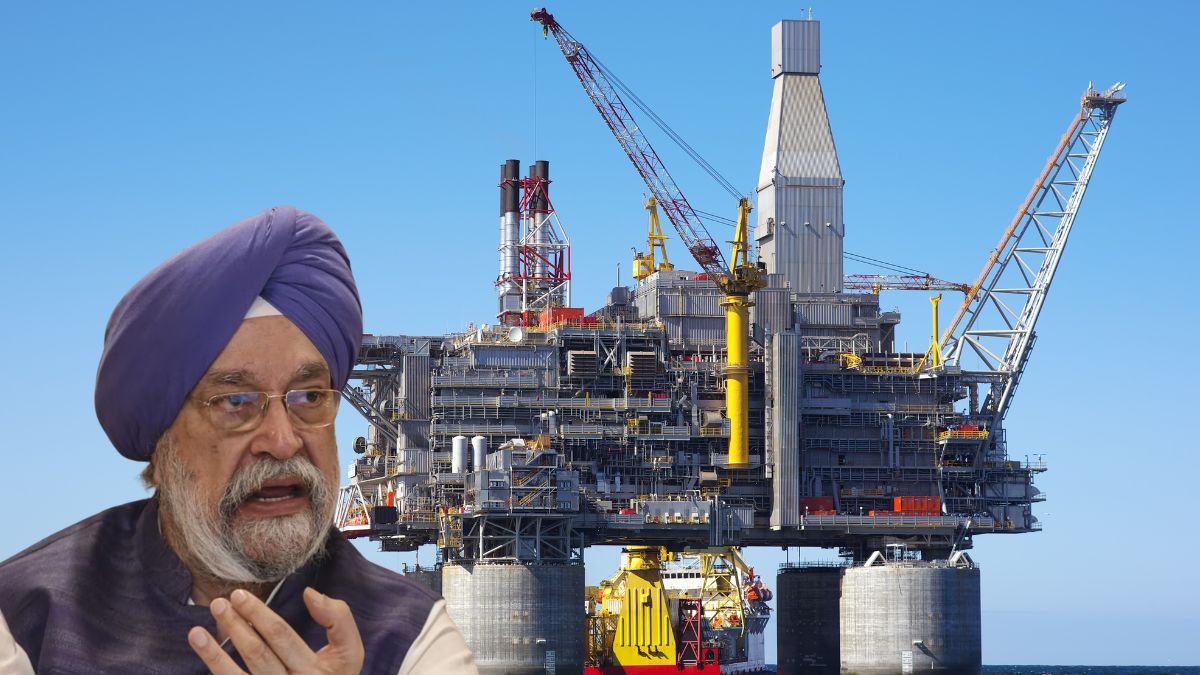
Amid mounting pressure for retail fuel price hikes after the recently concluded assembly elections, Union Petroleum and Natural Gas Minister Hardeep Singh Puri on Tuesday said fuel price revisions were “unrelated” to elections, while acknowledging that the government would eventually have to assess how long state-run oil companies can continue absorbing massive losses caused by elevated crude prices and stagnant retail fuel rates.
The remarks come at a time when state-run oil marketing companies (OMCs) are estimated to be incurring under-recoveries of nearly ₹1.98 lakh crore in the current quarter, while actual losses are projected at around ₹1 lakh crore as petrol, diesel and LPG prices remain largely unchanged despite the sharp rise in global energy prices following the West Asia conflict.
“My oil companies are losing ₹1,000 crore a day,” Puri said at the CII Annual Business Summit 2026. “How long will the oil companies be able to take it… frankly, that’s something that worries me,” he said.
The minister, however, ruled out any immediate supply concerns and said India currently holds around 60 days of crude oil stocks, 60 days of LNG inventories and 45 days of LPG reserves despite disruptions to global energy flows and concerns around the Strait of Hormuz.
“We have no supply-side problems,” Puri said, adding that India started the crisis with “more than enough” inventories and subsequently increased domestic LPG production to 54,000 tonnes per day from around 35,000-36,000 tonnes earlier.
The comments come as the West Asia conflict entered its third month, increasing volatility in global oil markets and disrupting shipping routes through the Strait of Hormuz, which handles nearly 20% of global oil and gas flows.
Data from the Petroleum Planning and Analysis Cell (PPAC) showed the average crude import price for Indian refiners rose sharply to $104.68 per barrel in May from $69.01 per barrel before the conflict began.
Despite the rise in crude prices, petrol and diesel prices have remained unchanged for nearly four years at around ₹94.77 per litre and ₹87.67 per litre, respectively.
Domestic LPG prices were increased by ₹60 per cylinder in March, but remain significantly below import parity levels.
According to the minister, OMCs are currently losing around ₹14 per litre on petrol, ₹42 per litre on diesel and ₹674 per cylinder on domestic LPG sales.
The losses incurred during one quarter alone are now enough to wipe out the annual profits earned by the three state-run fuel retailers — Indian Oil Corporation (IOC), Bharat Petroleum Corporation Ltd (BPCL) and Hindustan Petroleum Corporation Ltd (HPCL), he said.
“We haven’t raised prices for the last four years. I’m not saying prices will not go up. I’m saying prices and elections are unrelated,” Puri said.
The minister said India had managed the crisis better than many countries by ensuring uninterrupted supplies without rationing or large retail price increases.
“There are no shortages anywhere,” he said. “Every petrol pump in the country has had petrol and diesel. LPG supply is more than enough.”
Puri said the government and OMCs had conducted continuous “war-room” reviews of refining operations and supply chains over the past two months to prevent disruptions.
The minister also indicated that India would need to increase strategic reserves of crude oil, LNG and LPG following the lessons from the current crisis.
“I think the time has come that we will need to stock up even more,” he said.
The International Energy Agency (IEA) recommends strategic reserves equivalent to 90 days of consumption. Puri said India currently has around 76 days of crude holding capacity.
The minister said the government was also accelerating domestic oil and gas exploration under the proposed “Samudra Manthan” programme aimed at expanding offshore exploration.
“Exploration is a highly capital-intensive process which requires perseverance,” Puri said.
“Now we have Samudra Manthan scheme. We are in final stages of getting money,” he added.
India plans to expand refining capacity to 320 million metric tonnes annually by 2030 from around 260 million tonnes currently, positioning itself as a major global refining hub.
Puri also backed Prime Minister Narendra Modi’s recent call for moderation in fuel consumption, describing it as a “visionary” long-term measure to reduce fiscal stress and import dependence if geopolitical disruptions persist.
“If this continues, we have to start thinking about measures to lessen the fiscal strain,” he said.