



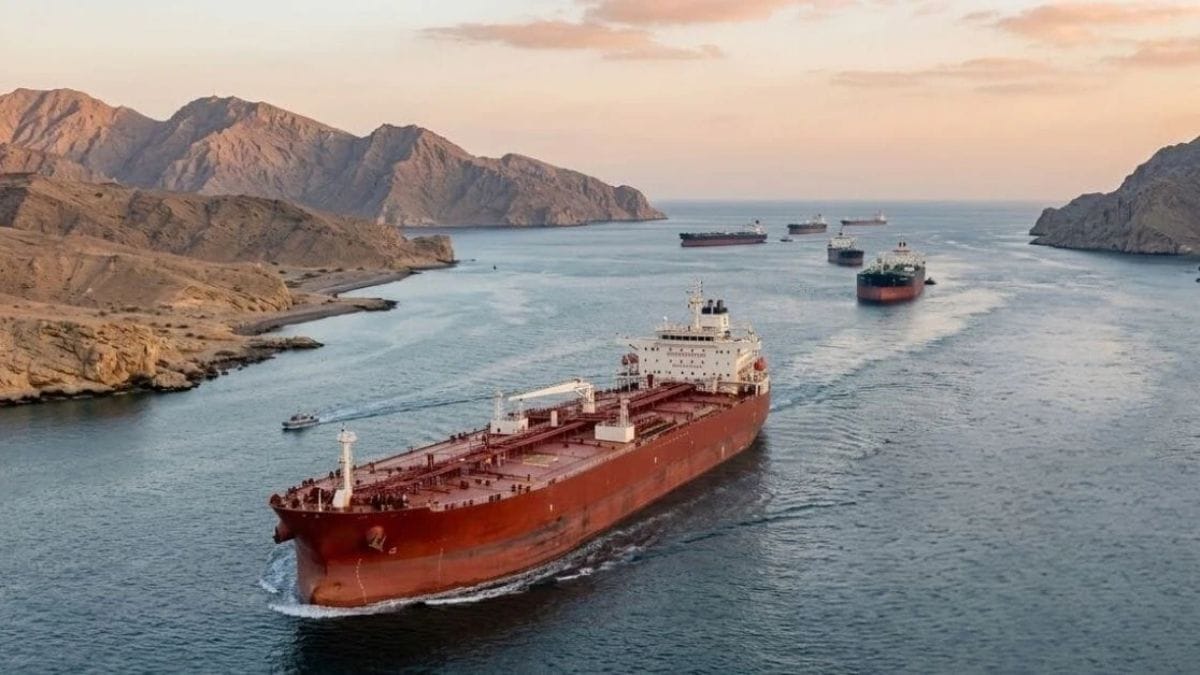
India is in talks with Iran to secure safe passage for more than 20 tankers through the Strait of Hormuz — including around 10 vessels carrying LPG and five transporting crude oil contracted by Indian refiners — as New Delhi intensifies diplomatic and supply-side efforts to safeguard energy availability amid escalating tensions in West Asia.
The diplomatic outreach comes as disruptions in Gulf shipping routes threaten flows of crude oil and LPG through the Strait of Hormuz, one of the world’s most critical maritime energy corridors.
The urgency of the talks is closely linked to India’s dependence on imported LPG, which is widely used as household cooking fuel across the country.
What did the Morgan Stanley report suggest?
“India is also ramping up purchases of Russian crude (particularly Urals) after the US waived sanctions on Russian oil imports for 30 days. It is also in talks with Iran to secure safe passage for more than 20 tankers,” the Morgan Stanley report said.
Two Indian-flag LPG carriers — Shivalik and Nanda Devi — carrying about 92,712 metric tonnes of LPG have recently crossed the Strait of Hormuz and are currently sailing toward India, with the cargo expected to reach Mundra and Kandla ports in the coming days.
However, the shipping situation in the region remains fragile. The country still has 22 India-flagged vessels stuck in the Persian Gulf, Rajesh Kumar Sinha, special secretary at the shipping ministry, said during an inter-ministerial briefing on Saturday. These include six LPG ships, four crude oil tankers and one LNG carrier, he said.
With about 90% of India’s LPG imports coming from the Middle East, any disruption in the Strait of Hormuz poses a direct risk to households, restaurants and petrochemical producers that depend on LPG as a key fuel and feedstock for plastics production.
At the same time, the government has begun scouting additional LPG cargoes from international suppliers to cushion against potential disruptions to Gulf shipments.
What are Indian refineries and OMCs doing?
Indian refiners and oil marketing companies are exploring cargoes from global energy traders and producers, including companies linked to the United States, Algeria and other non-Gulf suppliers, as New Delhi seeks to diversify sourcing during the ongoing crisis.
India is among the world’s largest LPG consumers, and around 60–65% of domestic demand is met through imports, most of which traditionally originate from West Asian producers such as Saudi Arabia, Qatar and the UAE.
According to data from the Petroleum Planning and Analysis Cell (PPAC), India produced 12.8 million tonnes of LPG in FY25, while consumption stood at 31.3 million tonnes. In the current financial year, LPG consumption had already reached 30.85 million tonnes by January, with two months still remaining in the fiscal year.
Officials said India is also securing LPG cargoes from multiple sources, including the United States, Canada, Norway, Algeria and Russia, in an effort to stabilise supplies and reduce reliance on Gulf shipments during the current crisis.
To manage supply pressures, the government has rolled out several operational measures. Refineries have been directed to maximise LPG production by diverting hydrocarbon streams such as propane and butane toward domestic cooking gas supply, while oil marketing companies have been asked to prioritise household consumers.
Authorities are also encouraging urban consumers to shift to piped natural gas (PNG) wherever connectivity is available to conserve LPG cylinders and ease pressure on supplies.
In parallel, the government has issued a Natural Gas Control Order under the Essential Commodities Act, ensuring 100% gas supply to priority segments such as domestic PNG and CNG, while supplies to industrial and commercial users are being regulated.
In a media report, External Affairs Minister S. Jaishankar said discussions with Tehran are underway to facilitate tanker movement through the Strait of Hormuz.
“I am at the moment engaged in talking to them, and my talking has yielded some results,” Jaishankar said in an interview with the Financial Times.
The discussions have already helped facilitate the passage of two Indian-flag LPG carriers through the Strait of Hormuz, even as broader shipping movements remain uncertain.
However, Jaishankar stressed that there is no general arrangement in place for Indian vessels transiting the strait, suggesting negotiations are taking place on a ship-by-ship basis.
“From India’s perspective, it is better that we reason and we coordinate and we get a solution than we don’t,” he said. “If it is yielding results for me, I would naturally continue to look at it. Every ship movement is an individual happening.”
The report warned that disruptions around the Strait of Hormuz could ripple across Asian energy markets.
“Asia has not seen an energy access shock in 50 years. Stresses are emerging in multiple Asian economies and industries as the shock wave travels,” it said.
It added that the disruption of the Strait of Hormuz is testing the resilience of Asia’s energy, chemicals and fertiliser value chains.
For India, whose crude and LPG imports depend heavily on Gulf shipping routes, ensuring tanker movement through the Strait of Hormuz while diversifying cargo sources has emerged as a key strategic priority as geopolitical tensions reshape global energy flows.