



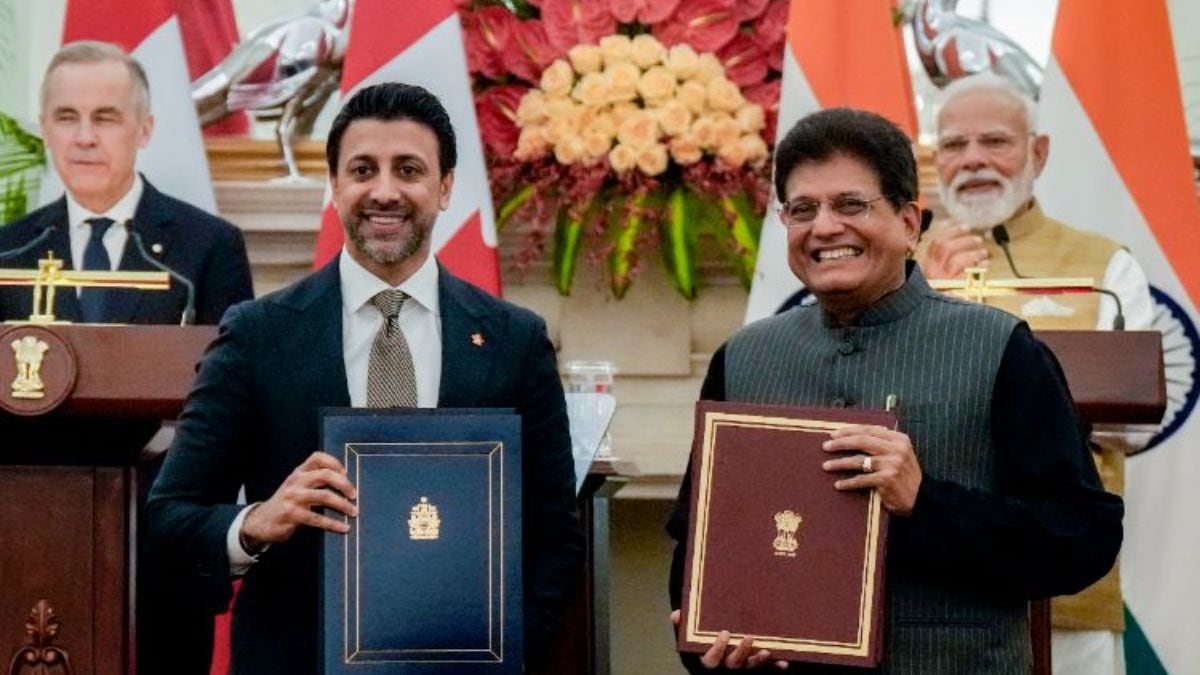
India and Canada on Monday signed Terms of Reference of the Comprehensive Economic Partnership Agreement (CEPA) which they aim to conclude by the end of this year. Other than the proposed trade pact, the visit of Canadian Prime Minister Mark Carney to India resulted in a 2.6 billion Canadian dollar deal to supply Uranium for power generation over the next nine years.
The documents of the ToR that provides the framework, frequency, and modalities that will guide the discussions was signed by Commerce and Industry Minister Piyush Goyal and Minister of International Trade of Canada Maninder Sidhu.
What did MEA secretary say?
“Signing of ToR for CEPA provides a clear roadmap to conclude a balanced, ambitious, mutually beneficial agreement by the end 2026,” Secretary (East) in the Ministry of External Affairs P Kumaran said.
The agreement on supply of 22 million pounds of uranium ore concentrates was signed between the Department of Atomic Energy with Cameco of Canada for nuclear energy generation from 2027 to 2035.
At the meeting between Prime Minister Narendra Modi and Carney both sides also announced a new Strategic Energy Partnership. Under this two Memorandum of Understanding (MoUs) were signed to intensify cooperation on critical minerals and energy sources, supporting technical and commercial engagement, and diversifying supply chains.
Canada to join India-France led ISA
Canada announced its intention to join the International Solar Alliance and is upgrading to full membership status in the Global Biofuels Alliance.
Indian public sector oil and gas companies and Canadian energy firms are also negotiating India’s first long-term LPG supply arrangement.
Through CEPA both sides aim to double their bilateral trade to $ 50 billion by 2030. Goods and services between the two countries stood at $23.66 billion in 2024, with merchandise trade valued at nearly $8.98 billion, and the rest coming from services. In 2024-25 India’s goods exports to Canada were up 9.80% to $ 4.22 billion while imports from Canada fell 2.3% to $ 4.44 billion.
During the visit the Finance Ministers’ Economic and Financial Dialogue was launched that will bring together finance officials on issues such as payments modernization, financial stability, fintech innovation and capital markets development. “As an early priority, this will include collaboration on the future of instant payments and explore opportunities on cross-border remittances and merchant payments,” a joint statement after the leaders’ meeting said.
Canadian pension funds and others have so far invested $ 80 billion in India and Carney asked India that they be treated at par with Sovereign Wealth Funds (SWF) in terms of benefits which will make India a competitive investment market compared to other financial centres in the region.
Kumaran said the Prime Minister assured that he would look into it and see what can be done. India provides significant tax breaks to attract capital from major sovereign wealth funds (SWFs), particularly those from Saudi Arabia and the UAE.
This is the most critical tax break for SWFs. Introduced to boost infrastructure, it provides a 100% tax exemption on income from dividends, interest, and long-term capital gains.