



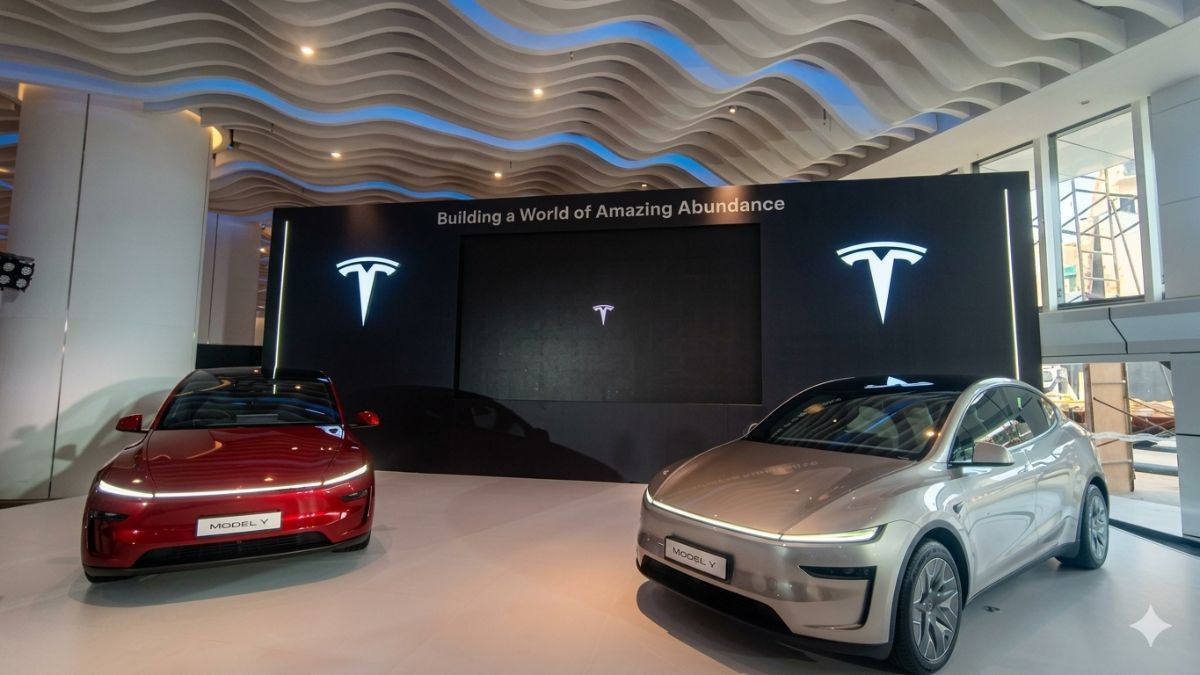
For Tesla enthusiasts in India, the menu just expanded. The American electric carmaker on Wednesday introduced its second model – the three-row, six-seater Model YL – priced at Rs 61.99 lakh, while outlining an aggressive expansion of charging and service infrastructure.
The move comes less than a year after its entry with the Model Y, and signals a shift from a single-product debut to a more ecosystem-led strategy in a market where premium electric mobility is still finding scale. The Model YL, positioned as a family-oriented premium SUV, will compete with offerings such as the EQS and EQB from Mercedes-Benz and models from MG Motor India in the Rs 70 lakh to Rs 1.4 crore bracket.
Tesla claims a 0–100 kph acceleration time of 5.0 seconds and a WLTP-certified range of up to 681 km, metrics that place it firmly in the upper tier of the segment. But the company’s pitch extends beyond specifications, leaning on its integrated approach to ownership and infrastructure.
“We are building block by block the very strong foundation for the business and the brand in the future, focusing on building the entire ecosystem in India,” Tesla India General Manager Sharad Agarwal, said at the launch. Tesla began deliveries in September 2025 and has already reached customers across 21 states, a footprint it plans to widen in the coming months.
Expansion of experience centres
The company currently operates three experience centres in Delhi, Mumbai and Gurugram, and is preparing to expand its service and body shop network to cities including Kolkata, Hyderabad, Chennai and Ahmedabad.
Charging infrastructure is central to Tesla’s India strategy. The company has set up five supercharger stations so far and plans to link key urban corridors like Delhi, Chandigarh, Jaipur, Ahmedabad, Pune, Bengaluru and Chennai, through a highway-based charging network. “We want to build the charging around the lifestyle of our customers,” Agarwal said, adding that India’s scale offers parallels with China, where Tesla operates over 2,500 superchargers.
Alongside public infrastructure, Tesla is pushing home and destination charging as part of its ecosystem. The company has already installed home charging solutions across 28 states and claims it can now enable such setups in any city. “Service for us is more of peace of mind to our customers. Charging is a very important part of the ecosystem that we are building here in India,” Agarwal said.
Taken together, the launch of a second model and a parallel build-out of charging and service networks indicate Tesla’s intent to deepen its presence rather than test the waters.