



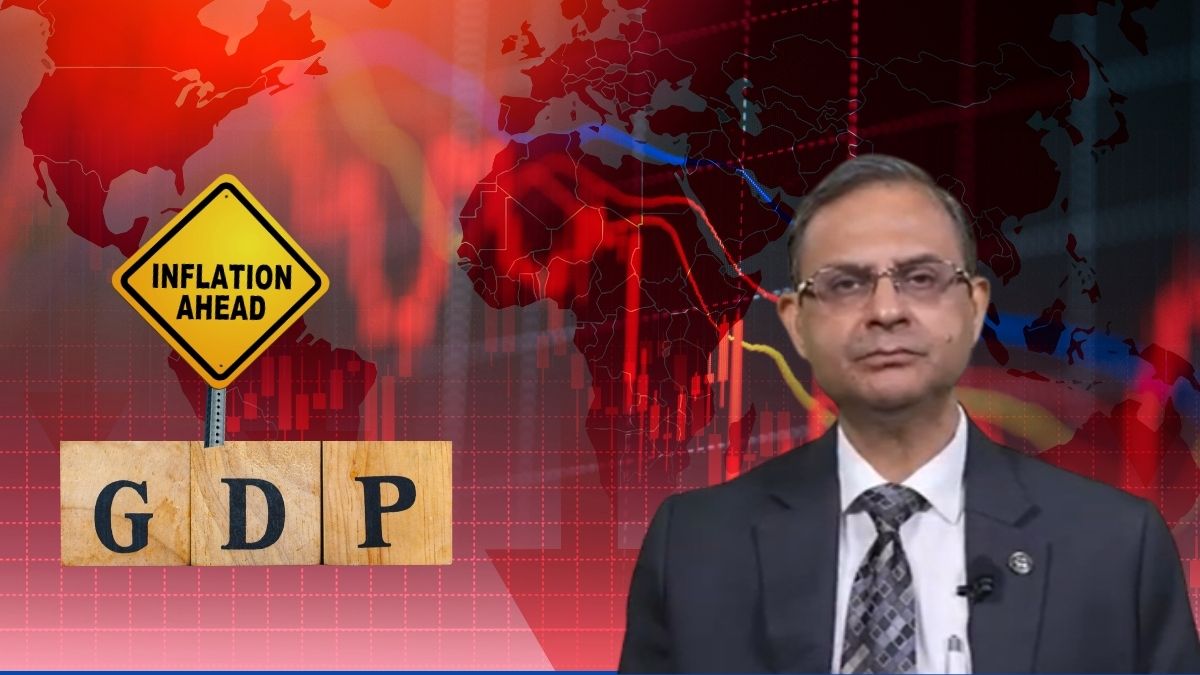
Reserve Bank of India Governor Sanjay Malhotra revised India’s GDP growth forecast for FY27 to 6.6 percent from the 6.9 percent projected in the April monetary policy review.
Further, the Reserve Bank projected retail inflation for 2026-27 at 5.1 percent, higher than its earlier estimate of 4.6 percent, largely due to mounting input costs, driven by the pass-through of higher global energy prices into retail petrol and diesel prices.
Key factors affecting GDP
Announcing the outcome of the Monetary Policy Committee (MPC) meeting, the Governor said the evolving geopolitical situation, disruptions in global supply chains, volatility in financial markets, and weather-related risks have increased downside risks to the domestic growth outlook.
“Real GDP growth for this year is now projected at 6.6 percent. You know we projected 6.9 percent. Of course, there is huge uncertainty and downside risk. The Q1 is now projected at 6.6 percent, Q2 at 6.3 percent, Q3 at 6.5 percent, and Q4 at 6.8 percent. Prolonged global supply chain disruptions, volatility in global financial markets, and weather-related shocks continue to pose downside risks to the domestic growth outlook,” the Governor said.
He noted that rising energy prices and disruptions in the supply of key commodities are likely to weigh on economic activity going forward.
He added that the overall impact on the economy will depend on the duration of the conflict, the pace of normalization in global supply chains, and the burden-sharing approach adopted by stakeholders.
“The rise in prices of energy and other inputs, coupled with supply disruption, is likely to weigh on economic activity. While import diversification into affected commodities is likely to improve supply, it will still come at a higher cost,” he said.
Inflation forecast implications
On the inflation forecast, the RBI Governor said the increase implies a direct impact of about 36 basis points on headline inflation, which, along with second-order effects, would be reflected in consumer price index (CPI) inflation in the coming months.
Malhotra also said the inflation forecast is subject to upside risks due to global supply chain disruptions, commodity price shocks, uncertainty about the distribution of the monsoon and El Nino conditions.
Despite the challenges, the RBI Governor expressed confidence that the government’s measures would help the economy cope with external shocks. He said several initiatives undertaken by the government, including support to MSMEs and export sectors, efforts to ramp up domestic gas and food production, encouraging the use of domestically produced alternatives to imported inputs, and diversification of critical imports, are expected to provide support to the economy