



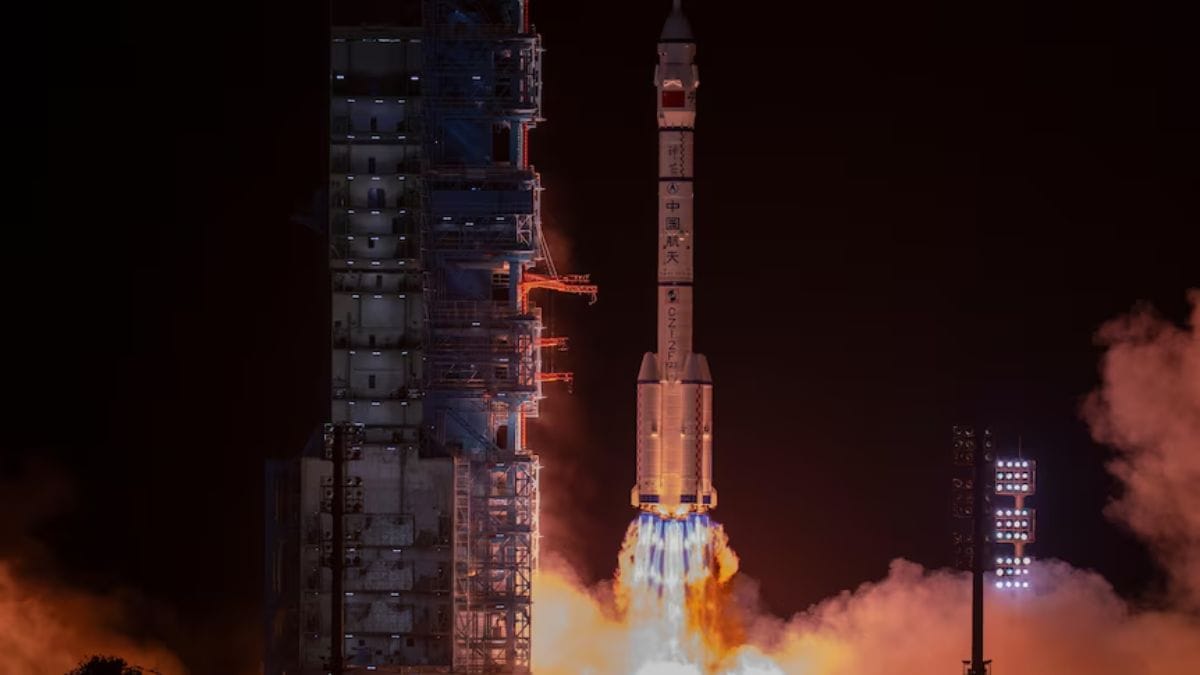
China has launched its Shenzhou-23 crewed mission to the Tiangong space station, marking a major step in Beijing’s plan to send astronauts to the Moon by 2030 and build a long-term lunar presence by the next decade.
The spacecraft lifted off from the Jiuquan Satellite Launch Center in northwest China at 11.08 pm local time on Sunday, carried by a Long March-2F Y23 rocket, Reuters reported.
The three-member crew includes commander Zhu Yangzhu, pilot Zhang Yuanzhi and payload specialist Li Jiaying, a former Hong Kong police inspector who has become the first astronaut from the city to join a Chinese space mission.
The most important part of the mission is the planned year-long stay of one astronaut aboard Tiangong. This will be China’s longest human spaceflight mission so far and is aimed at studying how the human body responds to extended exposure to space.
According to Reuters, scientists will study radiation exposure, bone density loss and psychological stress during the mission. These areas are critical for any future Moon mission, where astronauts will have to operate farther from Earth and in more difficult conditions than those aboard a low-Earth-orbit station.
Why the mission matters
Until now, China’s Shenzhou missions have largely sent three-member crews to Tiangong for six-month stays. The one-year stay changes that pattern. It gives China more data on long-duration human spaceflight and helps it test whether its space station systems, crew routines and medical protocols can support deeper and longer missions.
The Shenzhou-23 flight will also carry out China’s first autonomous rapid rendezvous and docking procedure with Tiangong’s core module, Reuters reported. This is significant because China’s 2030 lunar plan depends on automated rendezvous in lunar orbit between the Mengzhou crew capsule and the Lanyue lunar lander.
Beijing has been preparing the hardware needed for that Moon mission, including the Long March-10 heavy-lift rocket, the Mengzhou spacecraft and the Lanyue lander. According to Reuters, a successful crewed landing before 2030 would strengthen China’s larger plan to build a permanent lunar base with Russia by 2035.
The money behind China’s space push
China does not publish a fully transparent, itemised annual space budget, especially because parts of its programme overlap with defence and strategic technology. However, estimates cited by space analyst Girish Linganna in The Week put China’s annual space spending between $12 billion and $18 billion, averaging around $14.5 billion.
That is far higher than India’s annual space allocation. In the Union Budget 2026-27, India’s Department of Space received Rs 13,705.63 crore, or roughly $1.64 billion at broad exchange-rate terms, according to Budget documents. On that basis, China’s estimated annual spending is about 7 to 11 times India’s allocation, depending on the estimate used.
This budget vacuum explains the difference in scale. China is operating an independent space station, sending regular crew rotations, planning a crewed Moon landing and developing the supporting launch and lunar infrastructure at the same time.
India, despite a much smaller budget, has focused on cost-efficient missions such as Chandrayaan-3, Aditya-L1 and the upcoming Gaganyaan human spaceflight programme.
Tiangong and the cost question
Tiangong is central to China’s ambitions. It is currently the only space station independently run by a single country, The Week noted. The station allows Beijing to conduct uninterrupted human spaceflight operations, test long-duration stays and train astronauts for future lunar missions.
The full official cost of Tiangong has not been publicly disclosed. Older official data cited by the Washington-based Centre for Strategic and International Studies (CSIS) showed that China had spent over RMB 20 billion (around $2.4 billion) between 1992 and 2005 and another RMB 15 billion (around $2.2 billion) between 2005 and 2011 on its manned space programme, before the full Tiangong station was assembled.
More recent public estimates often place Tiangong’s construction cost in the multi-billion-dollar range, though these are not official Chinese disclosures.
China’s larger space ambition
The Shenzhou-23 mission comes at a time when the global space race is again centred on the Moon. NASA is targeting a crewed Moon landing under the Artemis programme, while China is aiming for its own crewed lunar landing by 2030.
Beijing has also set its sights on a permanent lunar base around 2035, with Russia as a partner. Reuters has reported that the China-led lunar base plan could include a nuclear energy power plant on the Moon’s surface to support long-term operations.
For China, the year-long Tiangong stay is therefore not just a record-setting mission. It is a rehearsal for the next phase of its space programme: keeping humans alive and functional for longer periods, testing docking and station systems, and building an operational pipeline suited for larger moon missions in the future.