



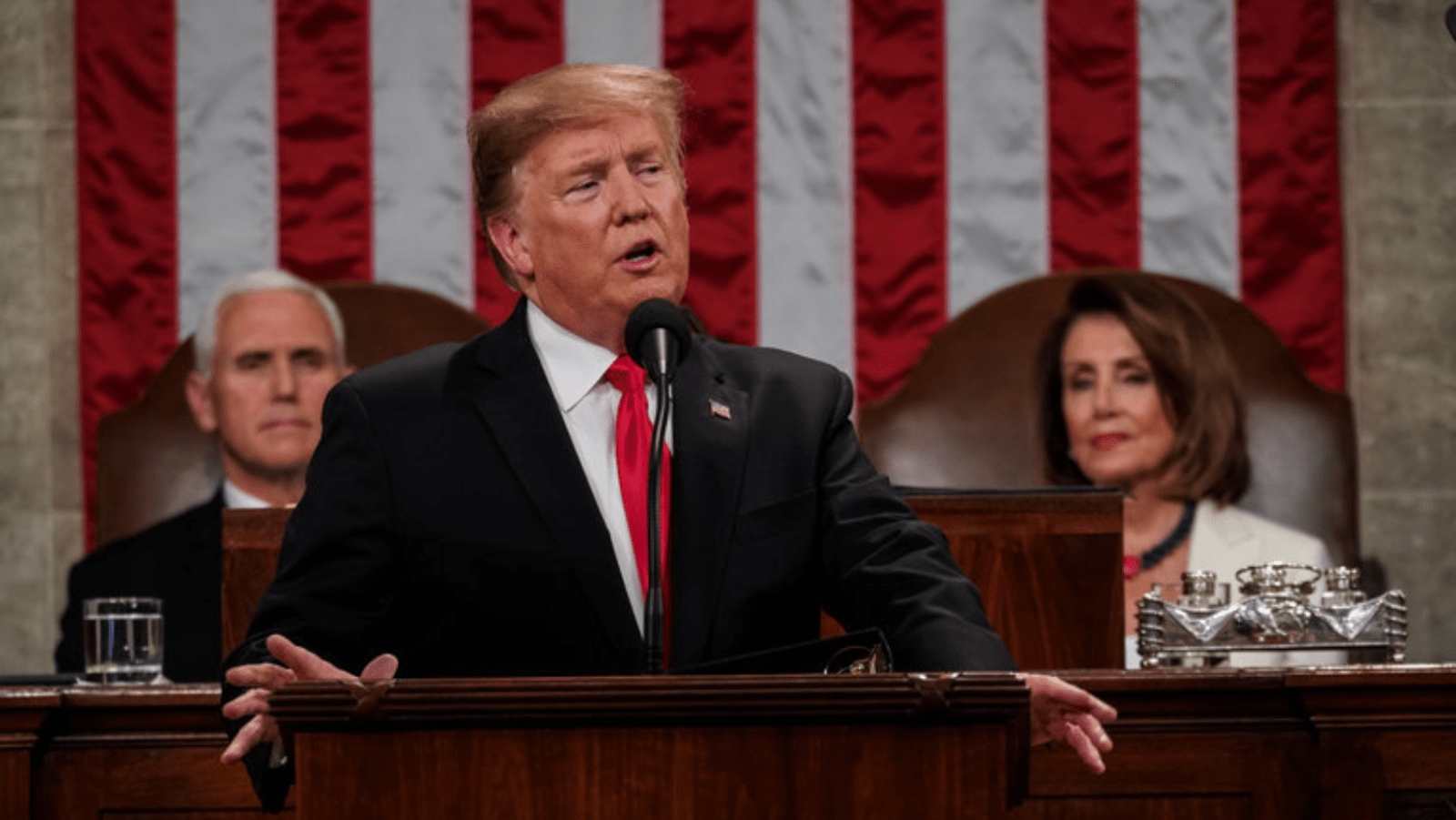
US President Donald Trump will address a joint session of Congress tonight for his first formal State of the Union since returning to the White House just over a year ago. The primetime speech will be president’s high-stakes platform to frame his second-term agenda and sharpen Republican messaging ahead of the midterm elections. But it is also happening at a time when there are mounting legal, political and diplomatic turbulence.
One year into his renewed presidency, Trump has positioned himself once again as a leader willing to challenge traditional norms. His administration has pursued rapid changes in domestic priorities, recalibrated longstanding international alliances and tested the boundaries of executive power.
What is the relevance of the address?
The State of the Union is not merely ceremonial. The US Constitution requires that the president periodically inform Congress about the nation’s status and recommend legislative measures. Traditionally, it serves as both a recap of the past year and a blueprint for the one ahead.
Politically, the stakes are especially high. With Republicans defending narrow majorities in Congress and historical trends suggesting that the President’s party often loses ground in midterm elections, Trump faces pressure to consolidate support. Public opinion remains fractured. Recent polling shows that six in 10 Americans believe the country is worse off than a year ago, and a majority say the state of the union is not strong.
When will it happen?
President Trump is scheduled to begin speaking at 9 p.m. ET (7:30 AM IST) on Tuesday, February 24. If recent history is any guide, viewers should expect a lengthy address. During his first term, each of Trump’s State of the Union speeches exceeded one hour, averaging roughly 80 minutes.
Last year’s joint address to Congress, though not formally designated a State of the Union, stretched close to 100 minutes, making it one of the longest such speeches in decades.
What can be expected from his speech?
Immigration is likely to dominate the address. The administration has dramatically escalated enforcement operations, with federal agents conducting large-scale raids across the country. Officials say the focus is on removing individuals with criminal records, but a broad “dragnet” approach has swept up long-term undocumented residents without convictions. Protests have erupted in several cities, particularly after two US citizens were killed in separate encounters with immigration agents in Minneapolis earlier this year. Those incidents continue to create discussions.
Trade policy will also loom large. Last week, the Supreme Court of the United States dealt a significant setback to Trump’s tariff strategy, rejecting the administration’s claim that trade deficits constitute a national security emergency. Though the president has vowed to continue imposing tariffs under existing laws, the ruling complicates one of his central economic arguments. Data from the US Bureau of Economic Analysis show that the trade deficit has continued to widen regardless of the new policies, adding to the economic messaging challenge facing the White House.
On domestic legislation, Trump is expected to tout the Republican Party’s sweeping tax cut package, which includes new savings accounts for infants, exemptions on tips, targeted deductions and deep reductions to Medicaid and SNAP benefits. The bill also allocates more than $170 billion to Homeland Security, reinforcing the administration’s deportation and border security agenda.
Foreign policy tensions may provide some of the sharpest lines in the speech. The president has intensified pressure on Iran over its nuclear program and recently expanded the US military footprint in the Middle East. Trump has indicated he will soon decide whether to authorise further military action, a posture that contrasts with his earlier campaign rhetoric opposing prolonged foreign entanglements. Lawmakers have indicated plans to introduce a War Powers resolution aimed at limiting unilateral military strikes.
The Pentagon has also expanded operations in Yemen, Somalia, Nigeria and Syria, while launching high-profile actions in Venezuela and the Caribbean. At the same time, Trump has committed billions of dollars to a reconstruction initiative in Gaza and continued staunch support for Israel’s government moves that have generated friction with some Arab states.
Legislative muscle and executive power
Over the past year, Trump has demonstrated a dual strategy in advancing his agenda. At times, he has leaned heavily on direct pressure to secure key votes in Congress. In other instances, he has bypassed protracted negotiations, relying instead on executive authority to push forward controversial policies. That approach has prompted renewed debates over checks and balances and the limits of presidential power.
The Supreme Court’s tariff ruling represents one of the clearest institutional rebukes yet. Even some Republican lawmakers have expressed concern over the scope of executive authority invoked in the administration’s trade policies.
Democratic response and political contrast
Democrats have chosen Abigail Spanberger, the governor of Virginia and a former CIA officer, to deliver the official rebuttal. Her selection signals a strategic emphasis on pragmatism and economic affordability rather than progressive activism. Spanberger is expected to focus on rising costs, community instability and anxieties about government shutdowns and federal workforce reductions.
California Senator Alex Padilla will deliver the Spanish-language response, indicating the party’s continued focus on immigration policy and outreach to Latino voters. Meanwhile, a group of Democratic lawmakers plans to boycott the speech and participate in a counter-event on the National Mall, showing internal party debates over how forcefully to confront the president.