



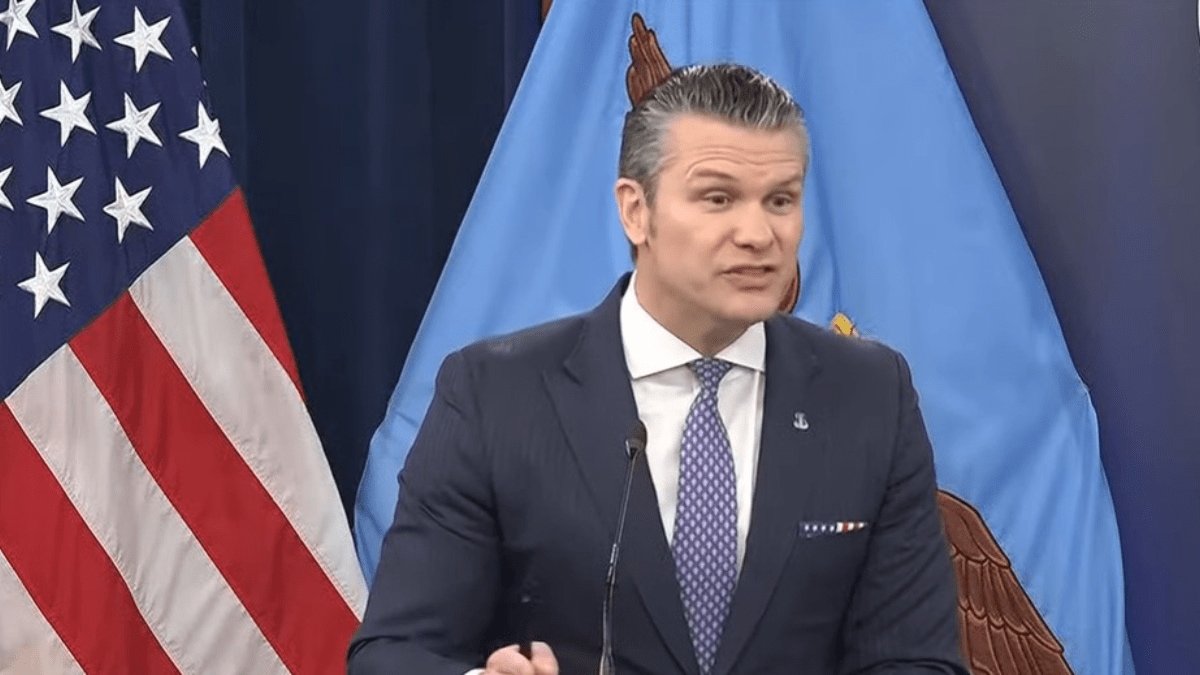
US Defence Secretary Pete Hegseth defended the Trump administration’s military spending plans on Tuesday as lawmakers from both parties pressed him over the growing cost of the Iran war, America’s weapons stockpiles and the administration’s long-term strategy in the conflict.
Hegseth appeared before House lawmakers to support President Donald Trump’s proposed $1.5 trillion defence budget for fiscal year 2027, reported Associated Press. During the hearing, he said the administration’s spending plans would strengthen America’s military and rebuild domestic manufacturing.
“The $1.5 trillion budget request put forward by the President will build upon the previous one trillion dollar FY26 topline and continue to reverse four years of underinvestment and mismanagement by the Biden Administration,” Hegseth said.
The Pentagon chief spoke about the major private sector investments linked to defence programs. He said the Department of Defence helped generate more than 250 private investment deals across 39 states, 180 cities and 150 companies. “This has resulted in 280 new and expanded facilities, more than 18 million square feet of new American manufacturing space, and more than 70,000 new American jobs,” Hegseth told lawmakers.
Members of Congress from both parties questioned whether the Trump administration had a clear plan for ending the conflict and whether the United States could sustain the military and economic costs. Pentagon comptroller Jay Hurst told lawmakers the cost of the Iran war has now reached about $29 billion, reported AP. He said around $24 billion of that amount went toward replacing and repairing munitions, while the remaining funds covered military operations and deployments across the region.
Just two weeks ago, Pentagon officials estimated the war cost at roughly $25 billion.
What Hegseth said about Iran war
Democratic Representative Rosa DeLauro criticized the Trump administration’s handling of the conflict. She questioned what the United States had achieved after months of fighting. “The question must be answered at the end of this crisis: What have we accomplished and at what cost?” DeLauro said.
She accused the administration of failing to provide a stable strategy for the war. “This administration has not presented Congress with any kind of clear or coherent strategy week to week, day to day, hour to hour,” she said. “The rationale shifts, the objectives change. The end game is ill-defined when it is defined at all,” she asked.
Republican Representative Ken Calvert also raised concerns about whether the United States has enough weapons and military capacity for a long conflict. “Questions persist about whether we are building the depth and reliance required for a high-end conflict,” Calvert said.
Democratic Representative Betty McCollum asked whether the Pentagon had a plan to reduce troop levels in the Middle East if Congress moved to end the war. Hegseth said the military has multiple operational plans prepared. “We have a plan to escalate if necessary. We have a plan to retrograde if necessary. We have a plan to shift assets,” he said.
He refused to publicly discuss future military operations but strongly rejected claims that the US military is running low on weapons. “I take issue with the characterization that munitions are depleted in a public forum,” Hegseth said. “That’s not true.” He added, “We have plenty of what we need,” he said.
Hegseth also blamed weaknesses in America’s military industrial base on previous administrations and on years of military aid sent to Ukraine during its war with Russia, reported AP. He said defence companies have now received orders to increase production rapidly. “We told them to build more and build faster,” he said.
US-Iran tensions
The war has created growing political and economic pressure for President Trump. Iran’s closure of the Strait of Hormuz disrupted one of the world’s most important oil shipping routes. Nearly 20 percent of global oil trade normally passes through the narrow waterway, reported AP.
The United States military responded by blockading Iranian ports while both sides exchanged attacks in the region. American forces intercepted strikes aimed at US warships and targeted oil tankers linked to Tehran.
Rising fuel prices inside the United States have become a major political problem for Republicans ahead of the midterm elections.
Trump said on Monday that the ceasefire between the two sides remains fragile. “I would call it the weakest right now after reading that piece of garbage they sent us,” Trump said while criticizing Iran’s latest proposal during negotiations.
The president has also pushed for a temporary suspension of the federal gas tax to reduce pressure on American consumers facing higher fuel prices. Trump said that preventing Iran from obtaining a nuclear weapon remains a top priority for his administration.