



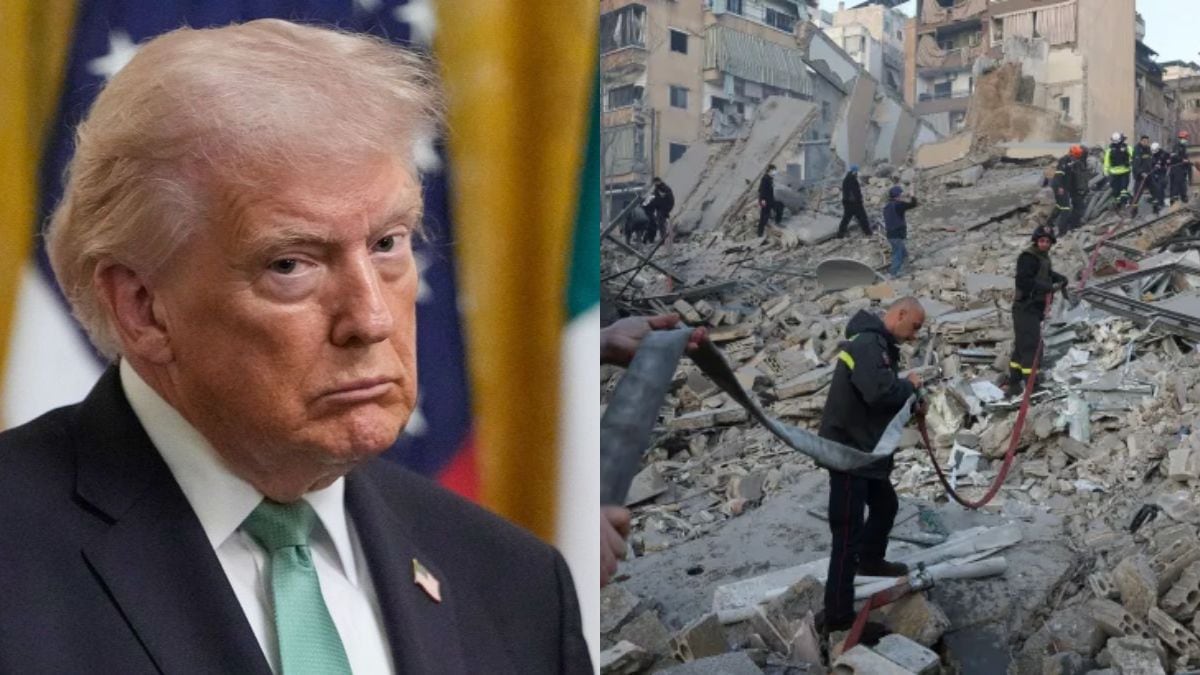
The US-Israel war on Iran has entered its 26th day with the conflict hurtling towards its most dangerous inflection point yet. Here are the key highlights on March 25, 2026.
- The United States has sent Iran a 15-point plan aimed at ending the ongoing war in the Middle East. According to Reuters, the plan was sent through Pakistan.
- Oil prices, which had dipped on Monday, started rising again on Tuesday. Analysts say oil is now the main force moving markets.
- Trump said negotiations were happening and claimed that the Iranians “would like to make a deal.” Iran has publicly said no negotiations are taking place. But Trump insisted that talks were underway, involving VP JD Vance, Marco Rubio, Jared Kushner, and Steve Witkoff.
- Israeli authorities reported a direct hit in Tel Aviv that severely damaged at least three residential buildings. Six people were treated for injuries there.
- Trump also addressed a New York Times report that Saudi Crown Prince Mohammed bin Salman was urging him to pursue the war. Trump said, “He’s a warrior. He’s fighting with us.”
- Secretary of State Rubio is scheduled to travel to France on Friday to discuss the war and other issues with diplomats from the Group of 7 nations.
- Iran’s effective closure of the Strait of Hormuz, through which a fifth of the world’s oil passes, combined with attacks on oil and gas infrastructure in the Persian Gulf, has pushed crude oil prices above $100.
- In Iran, former Islamic Revolutionary Guards Corps general Mohammad Bagher Zolghadr was appointed as the country’s top security official, replacing Ali Larijani, who was killed in an Israeli attack.
- US stock futures moved higher on Tuesday night after a report said Washington has shared a plan with Iran that could help end the ongoing conflict.
- Futures linked to the S&P 500 rose 0.7%, while Nasdaq 100 futures climbed 0.9%. Futures for the Dow Jones Industrial Average were also up, gaining 320 points, or 0.7%.
| Crude Oil | Brent | Natural gas | Gasoline | Gold | Silver |
| Dips to $88.82 | Dips to $100.22 | Down $2.90 | Surges to $3.04 | Up $4,480.70 | Up $71.62 |
READ ALL THE LATEST UPDATES ON IRAN WAR
US-Israel-Iran War Live Updates
This blog is closed. The Iran war coverage has moved here: https://www.financialexpress.com/world-news/us-israel-iran-war-live-news-brent-crude-down-to-97-65-in-early-asian-trade-iraqi-group-claims-23-attack-on-us-sites/4183313/
Nuclear watchdog calls for 'maximum restraint' after Iranian nuclear power plant is targeted
The International Atomic Energy Agency (IAEA) said Iran had told it about a projectile hitting the premises of the country's only operation nuclear plant - Bushehr Nuclear Power Plant.
"According to Iran, there was no damage to the NPP itself nor injuries to staff, and the condition of the plant is normal," it says.
IAEA chief Rafael Grossi called for "maximum restraint to avoid nuclear safety risks during conflict."
Oil prices drop in Asia
During early trade in Asia on Wednesday, oil prices fell sharply after Trump asserted that talks to end the Iran war are happening "now."
Brent crude is down by 6.5% to $97.65 a barrel, a day after it had crossed $100.
US-traded oil dipped by 6% to $86.77.
Despite the dropping figures, the prices remain significantly higher than the pre-war numbers.
New warnings of missiles from Iran
According to Iran's Channel 12 broadcaster, the military detected missiles launched from Iran towards central parts of the country. Subsequently, air raid alarms were set off across central Israel.
Iran wants JD Vance for negotiations - Report
According to two regional sources quoted by CNN, Iranian officials have reached out to the Trump administration to inform them that they would prefer to engage in talks with Vice President JD Vance instead of special envoy Steve Witkoff and President Donald Trump’s son-in-law Jared Kushner.
The message was reportedly passed through back channels to the US. CNN cited the sources saying that Vance was more sympathetic to concluding the war.
“The perception is that Vance would be intent on wrapping up the conflict,” one of the sources said.
“Who the administration decides to send, the Iranians will have to deal with, but it doesn’t mean they don’t have a preference,” the second source said.
State of emergency in Philippines amid 'imminent danger' to energy supply
Philippines President Ferdinand Marcos Jr declared a state of national emergency, highlighting the "imminent danger" to the “availability and stability of the country’s energy supply. The declaration will be in place for a year amid the closure of the Strait of Hormuz, which has severely impacted global oil supply.
Fire breaks out at Kuwait Airport after drone strike
In Kuwait, drones struck a fuel tank at Kuwait International Airport, sparking a fire.
Authorities said the attack caused damage, but there were no reports of injuries. Emergency teams rushed to the scene and worked to bring the fire under control.
Officials added that drones linked to Iran have hit the airport several times during the war, damaging parts of the passenger terminal and injuring people in earlier incidents.
Senate blocks move to limit Trump on Iran war
The US Senate has once again refused to back a move that would limit President Donald Trump’s powers in the Iran war.
Lawmakers voted 47 to 53 against a resolution that would have required Trump to get approval from Congress before taking any further military action against Iran.
Republican Senator Rand Paul broke ranks and voted with Democrats to support the measure. On the other side, Democratic Senator John Fetterman sided with Republicans to block it.
This is now the third time Democrats have pushed for a vote on war powers linked to Iran since the conflict began. Each time, the effort has failed.
Democrats say they will keep forcing votes until Secretary of State Marco Rubio and Defense Secretary Pete Hegseth testify in public about the war. So far, there have been no open hearings in Congress, only closed-door briefings.
Even if the resolution had passed, it would have faced a tough road ahead. It would need to clear more steps in the Senate, pass the House, and then survive a likely veto from Trump — which would require a two-thirds vote to override.
Oil remains the big driver
Oil prices, which had dipped on Monday, started rising again on Tuesday. Analysts say oil is now the main force moving markets.
Speaking to CNBC, Michael Kantrowitz, chief investment strategist at Piper Sandler said, “We continue to see this as just an oil-driven, one-variable market."
He added, “Oil and interest rates are driving the equity market. And for now, I think markets are priced appropriately for where conditions are, and we’ll continue to move and react as conditions evolve.”
Kantrowitz said he isn’t too worried about the broader economy. “I’m less concerned about the economy. I think the US economy can certainly handle $90, $100 oil,” he said. But he did flag one concern: “I’m a little more concerned about interest rates and the fear of persistent inflation weighing on equity multiples.”
Energy crisis worsens
Iran’s effective closure of the Strait of Hormuz, through which a fifth of the world’s oil passes, combined with attacks on oil and gas infrastructure in the Persian Gulf, has pushed crude oil prices above $100. The Philippines declared a state of national energy emergency, while South Korea advised citizens to take shorter showers and avoid charging phones and electric vehicles at night.
Developments in Lebanon and G7 Diplomacy
Israel’s defense minister announced plans to expand military control in southern Lebanon, keeping territory south of the Litani River. This river has long been a dividing line in conflicts with Hezbollah, the Lebanese militant group.
Secretary of State Rubio is scheduled to travel to France on Friday to discuss the war and other issues with diplomats from the Group of 7 nations.
Contrasting claims on negotiations
Iran has publicly said no negotiations are taking place. But Trump told reporters in the Oval Office that talks were underway, involving Vice President JD Vance, Secretary of State Marco Rubio, his son-in-law Jared Kushner, and senior adviser Steve Witkoff.
Trump portrayed Iran as a country close to military defeat, suggesting it had little choice but to negotiate. Yet Iran’s missile strikes on Israel and Iraq showed it could still strike across the region. Despite claims by US and Israeli officials that Iran’s missile program had been heavily damaged, attacks continued.
US sends 15-point plan to Iran to end Middle East War
The United States has sent Iran a 15-point plan aimed at ending the ongoing war in the Middle East, according to two officials familiar with the diplomacy. The plan was sent through Pakistan, highlighting the Trump administration’s push to find a way out of a conflict that has rattled the global economy.
It is not clear whether Iran will accept the plan as a starting point for talks, or whether Israel, which has been conducting airstrikes alongside the US for nearly four weeks, agrees with it.
President Trump spoke about the situation on Tuesday, the same day Iran launched waves of missiles across the region. He said negotiations were happening and claimed that the Iranians “would like to make a deal.”
Türkiye says no disruption in gas flow from Iran, storage at 71%
Türkiye’s Energy Minister Alparslan Bayraktar on Tuesday said natural gas supplies from Iran remain uninterrupted, dismissing earlier reports of a halt in flows.
Speaking to reporters after a cabinet meeting, Bayraktar said the country’s gas storage facilities are currently 71% full, indicating a stable supply position.
“There are no problems with the gas flow from Iran,” he said, according to Turkish media, pushing back against claims that deliveries had been disrupted.
China urges swift peace talks in Middle East, tells Iran 'dialogue over force'
In a diplomatic push wrapped in calm but pointed messaging, China’s Foreign Minister Wang Yi has urged all sides in the Middle East conflict to move swiftly towards peace talks, telling his Iranian counterpart Abbas Araghchi that “talking is always better than fighting”.
The appeal came during a phone call held at Tehran’s request, according to China’s Foreign Ministry. Wang stressed that even the most volatile crises should be steered through dialogue, not force, adding that “all hotspot issues should be resolved through dialogue and negotiation.”
Araghchi, in response, signalled that Iran is not looking for a pause button but a full stop. He said Tehran is committed to a “comprehensive end” to the conflict rather than a temporary ceasefire, while also expressing gratitude for China’s humanitarian support.
The conversation reflects Beijing’s careful balancing act: standing by Iran as a strategic partner, yet drawing a line at escalation. China has made clear it does not support Tehran’s strikes on Gulf states hosting US bases and continues to call for restraint and a ceasefire.
Fresh Israel-Iran fighting pushes oil prices higher
Oil prices climbed on Tuesday after renewed overnight clashes between Israel and Iran dampened expectations of a near-term end to the nearly month-long Middle East conflict.
India supports de-escalation and restoration of peace at earliest, PM Modi tells Trump
Following the call from Donald Trump, Prime Minister Modi posted on X, “Received a call from President Trump and had a useful exchange of views on the situation in West Asia. India supports de-escalation and restoration of peace at the earliest. Ensuring that the Strait of Hormuz remains open, secure and accessible is essential for the whole world. We agreed to stay in touch regarding efforts towards peace and stability.”
MBS urges Donald Trump to keep pushing war on Iran, reports NYT
A report by the New York Times claims that Saudi Arabia crown prince Mohammed bin Salman has urged Donald Trump to press ahead with the ongoing war against Iran. According to sources cited by NYT, MBS described the joint US-Israeli military campaign as a “historic opportunity” to reshape the Middle East.
In a series of conversations over the past week, the Saudi’s de facto leader reportedly pushed for a more aggressive approach, advocating the dismantling of Iran’s hard-line government. He is said to have argued that Tehran represents a long-term strategic threat to Gulf stability that can only be neutralised through regime change.
Trump calls Modi to discuss West Asia crisis
Prime Minister Narendra Modi spoke with US President Donald Trump to discuss the escalating situation in the Middle East, with a key focus on ensuring stability in global energy routes, US Ambassador to India Sergio Gor said in a post on X. The two leaders underscored the importance of keeping the Strait of Hormuz open, a critical chokepoint for global oil supplies currently under strain due to the ongoing conflict.
“President Donald Trump just spoke with Prime Minister Modi. They discussed the ongoing situation in the Middle East, including the importance of keeping the Strait of Hormuz open,” he said.
Gulf states must find way to coexist with Iran, says Qatar
Qatar has called for coexistence and dialogue in the Gulf region amid ongoing tensions with Iran, stressing that geography and shared history make long-term peace unavoidable.
Speaking on future relations, Qatar’s Foreign Ministry spokesperson Majed al-Ansari said countries in the region have deep-rooted ties and must find ways to live alongside each other.
“Iran has been here for a millennia. The people in this region have been here for a millennia. Nobody’s going anywhere. Total annihilation is not an option,” he said.
Al-Ansari added that neighbouring nations will continue to share the region for generations to come.
- via Al Jazeera
Iran appoints Ali Larijani's replacement
Iran has appointed Mohammad Bagher Zolghadr as the new secretary of its Supreme National Security Council, state news agency IRNA reported, citing the president’s office.
He replaces Ali Larijani, who was killed in an airstrike last week.
Islamabad willing to facilitate dialogue if US and Iran agree, says Pak Foreign Ministry
Pakistan has offered to host talks between the United States and Iran as tensions continue in the region, signalling a potential diplomatic opening amid the ongoing conflict.
In a statement to Al Jazeera, Foreign Ministry spokesperson Tahir Andrabi said Islamabad is willing to facilitate dialogue if both sides agree. “If the parties desire, Islamabad is always willing to host talks,” he said, adding that Pakistan has consistently advocated diplomacy to ensure regional peace and stability.
The offer comes a day after US President Donald Trump announced a five-day pause on potential strikes against Iranian energy infrastructure, while claiming that “very good” negotiations were underway. Tehran, however, has publicly denied engaging in any talks with Washington.
Despite the denial, reports suggest that countries including Pakistan, Egypt and Turkiye have been acting as intermediaries, relaying messages between the two sides to ease tensions. Some reports have also indicated the possibility of US-Iran talks being held in Islamabad, though this remains unconfirmed.
The diplomatic push follows a series of high-level contacts, with Pakistan’s army chief Field Marshal Asim Munir speaking to Trump, Prime Minister Shehbaz Sharif holding talks with Iranian President Masoud Pezeshkian, and Foreign Minister Ishaq Dar engaging with counterparts from Iran and Turkiye.
Sirens in Kiryat Shmona after rocket fire
Sirens sounded in northern Israel’s Kiryat Shmona and nearby areas following incoming rocket fire, according to Israeli media reports. The alerts were triggered by projectiles launched from Lebanon, with Hezbollah suspected to be behind the attack.
Washington keeps talking about negotiations, but Tehran is swatting those claims away, exposing a widening gap between rhetoric and reality.
This is diplomacy on brittle ground. For Iran, opening the door to talks with the US is complicated by a deep reservoir of mistrust—one that has only grown darker over time.
Over the past year, Iranian officials have entered negotiations twice, only to see those efforts disrupted by air strikes mid-process. Each such episode has made the prospect of future dialogue feel less like diplomacy and more like a gamble.
Tehran has drawn a hard line: as long as air strikes continue, talk of ceasefire or negotiations is meaningless.
Yet, in the shifting fog of conflict, even a slight easing of strikes could reopen a narrow, uncertain window for talks—fragile, but not entirely out of reach.
Israel to control Litani River crossings
Israel’s defence minister has said the Israeli army will control the remaining bridges over Lebanon’s Litani River and the area south of it.
He added that Israel had destroyed all bridges over the Litani River that it claims Hezbollah used to transport weapons and fighters, and that the military would “control the remaining bridges and the security zone up to the Litani”.
Israel will establish a “security zone” in southern Lebanon stretching to the Litani River, indefinitely displacing hundreds of thousands of Lebanese residents, he said. He added that those who evacuated northward will not be allowed to return south of the Litani River until security for residents in northern Israel is ensured.
Israeli strikes destroy Bekaa bridge
Israeli air strikes have destroyed the al-Dallafa bridge in the western Bekaa Valley in eastern Lebanon, according to a correspondent on the ground.
Earlier, Lebanon’s National News Agency reported that several Israeli strikes targeted the bridge, which links parts of the south and the Bekaa region.
Iran strikes kill six in Kurdistan
Iraq’s autonomous Kurdish region has accused Iran of launching an attack on its Peshmerga forces, following the deaths of six fighters.
“Six Iranian ballistic missiles targeted them” in two attacks, the region’s armed forces ministry said in a statement, adding that the strikes killed six people and wounded 30 others.
It marks the first deadly attack on the regional security forces since the Middle East conflict began on February 28 with Israeli and US strikes on Iran.
Iran internet blackout hits day 25
A nationwide internet blackout imposed by Iranian authorities has entered its 25th day, according to monitoring group NetBlocks, crossing the 576-hour mark.
The outage has left “the public isolated from the world as whitelisted accounts seek to take control of the narrative,” the group said. “The measure leaves civilians without vital updates and without a voice on the global stage.”
Indian Govt to convene for an all-party meeting tomorrow
In addition to Indian Prime Minister Narendra Modi addressing the Lok Sabha on the West Asia conflict on Tuesday, the Indian Government has also called for an all-party meeting tomorrow, March 25, at 5 pm on the same issue.
While stressing the need to focus on domestic production, PM Narendra Modi noted that currently 90% of India's trade is done by foreign ships. As a result, the Indian Government has allocated Rs 70 crore for building ships, as per PM Narendra Modi's Lok Sabha address.