



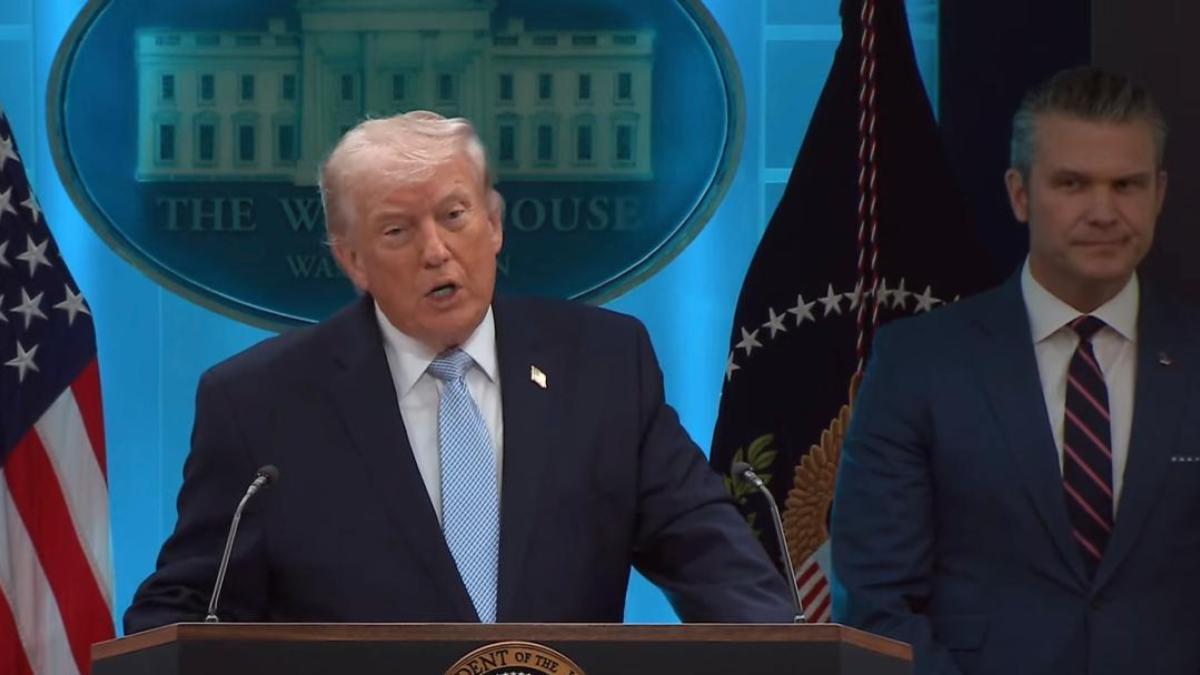
Any country supplying military weapons to Iran will face immediate 50% tariffs, warned US President Donald Trump on Truth Social, as the fragile two-week truce remained in force amid reports of new attacks on Iran and Gulf Arab countries Wednesday. The 11th-hour deal allowed Trump to pull back from his threat to unleash a bombing campaign that would destroy Iranian civilization.
“A Country supplying Military Weapons to Iran will be immediately tariffed, on any and all goods sold to the United States of America, 50%, effective immediately. There will be no exclusions or exemptions,” Trump warned on Truth Social.
Though Trump did not name any country, the warning was largely seen as directed at Russia, which, according to a Ukrainian intelligence assessment, has shared detailed imagery surveys of military facilities across the Middle East to help Iran strike US forces and other targets during the month-long war.
Per Reuters, Russian and Iranian hackers were also collaborating in the cyber domain. These assessments represent the most detailed account yet of how Russia has provided secret support to Iran.
Russian satellites surveyed 46 “objects,” including US military bases, says report
Russian satellites made at least 24 surveys of critical areas in 11 Middle Eastern countries from March 21 to 31, news agency Reuters reported, quoting a Ukrainian intelligence assessment and a source quoted in Israeli media. These surveys covered 46 “objects,” including US and other military bases and sites, including airports and oil fields.
Within days of being surveyed, these military bases and headquarters were targeted by Iranian ballistic missiles and drones, the assessment said, in what it described as a clear pattern.
Key military areas of Turkey, Jordan, Kuwait and the United Arab Emirates were put under satellite surveillance twice, while places in Israel, Qatar, Iraq, Bahrain and Naval Support Facility Diego Garcia did once, it said.
The assessment added that Russian satellites were actively surveying the Strait of Hormuz, a vital waterway through which a fifth of global oil and LNG flows. This information proved critical for Iran during its de facto blockade to all but “non-hostile vessels.”
Iran provided Shahed attack drones to Russia to attack Ukraine
Russia and Iran have deepened military ties since Russia’s full-scale invasion of Ukraine in February 2022.
According to Kyiv, Russia has been using long-range Shahed attack drones provided by Iran to bomb Ukraine. Iran denies supplying weapons used against Ukraine.
Russian President Vladimir Putin and Iranian President Masoud Pezeshkian then signed a Treaty on Comprehensive Strategic Partnership in January last year.
Cyber help
The Ukrainian intelligence assessment also highlighted Russia’s assistance to Iran in the cyber domain.
Hacking groups controlled by Iran were working with Russian hackers via Telegram since late February, targeting mainly critical infrastructure and telecommunications companies in the Gulf, they said.
These collaborations were between the Russian groups “Z-Pentest Alliance,” “NoName057(16)” and “DDoSia Project” and Iran’s “Handala Hack”, it said.
A recent incident included the said groups, including Handala Hack, publishing a warning on Telegram about attacks on the information and communication systems of Israeli energy companies.
What we know about ceasefire deal
Much about the deal remains unclear as the sides presented vastly different visions of the terms.
Iran said the deal would allow it to formalise its new practice of charging ships passing through the Strait of Hormuz, but the terms were not clear, nor was whether ships would feel safe using the crucial transit lane for oil.
Pakistan, which helped to mediate the deal, has said fighting would pause in Lebanon, but Israel has refused the deal mentions a halt on its operation against the Iran-backed Hezbollah militant group.
The fate of Iran’s missile and nuclear programs — the elimination of which were major objective for the US and Israel in going to war — also remained unclear. Also, Trump’s claim that the US would work with Iran to remove buried enriched uranium has not been confirmed by the regime in Iran.
On Tuesday, Russia along with China vetoed a watered-down United Nations Security Council (UNSC) resolution aimed at protecting commercial shipping in the Strait of Hormuz.
The draft text, proposed by Bahrain, found favour among 11 of the 15 members of the UNSC, while two abstained. However, Russia and China said that the measure was biased against Iran.