



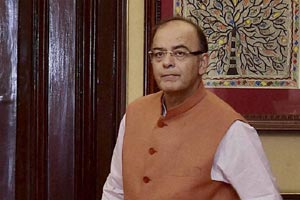
The next few months would see “a far bigger increase” in public expenditure and the “recovery trend” in the economy was going to continue, finance minister Arun Jaitley said on Thursday, even as he sought to downplay adverse impact of a likely deficient monsoon on the grain production and inflation. Addressing a brief press conference that followed Tuesday’s India Meteorological Department prediction of a 12% shortfall in normal monsoon showers and the Reserve Bank of India’s bi-monthly policy announcement,which included a quarter-point cut in the key rates and a revision of the its inflation forecast for January 2016 to 6% from 5.8%, the minister said even assuming the IMD proves spot on, a distress situation in the farm sector or in the rural areas was highly unlikely.
The minister also said the aggressive PSU disinvestment plan for the current fiscal would not be altered despite the recent steep fall in equity markets. The BSE Sensex has fallen by 1,036 points in last three trading sessions.
RBI governor Raghuram Rajan had said that the future trajectory of the monetary policy would depend on the monsoon, the way the government managed shocks, if any, emanating from it, and the price of crude oil. “Going forward, room (for any further policy easing) may absolutely open up if the monsoon is better than currently expected, or if government actions mitigate any potential rise in food prices and if energy prices stay contained,” he was quoted as saying.
Arguing that the timing and geographical spread of rains were as significant was the extent of rainfall for farm-sector performance, Jaitley said any slight inadequacy was to be felt, if at all, in the northwest region that comprises Punjab, Haryana and western Uttar Pradesh, whereas the south, central and northeastern regions would witness rainfall closer to normal. Abundance of foodgrain stocks with the government and deft food management as was seen last year would prevent any form of inflationary trend, the minister said. “The kind of speculation that we have been seeing and the speculative analysis that we have been reading about (the monsoon) appears to be somewhat misplaced,” Jaitley who just received a detailed briefing from IMD officials, said.
A 12% deficit in normal monsoon showers dragged down growth in the farm and allied sectors to just 0.2% in 2014-15, compared with 3.6% a year earlier. This was even as grain production was down just 5.3% at 251.1 million tonnes last year from a year before.
Even though the RBI has just revised its GDP growth forecast for the current fiscal year to 7.6% from 7.8% projected in April and governor Rajan said in media interactions that the state of the economy appeared weaker than assumed earlier, Jaitley stuck to his optimistic view of the economy and said he “foresaw the recovery to continue”.
Allaying inflationary fears, he said the government was adequately prepared to deal with any eventuality, adding that the food ministry would increase supplies (by importing) to address the price rise in pulses.
As per the IMD prediction, there is now a 66% chance of deficient monsoon rains, which are defined as below 90% of the long-period average of 89 centimetres of showers recorded between 1951 and 2000. Even chances of an El Nino weather pattern, which had caused the worst drought in 37 years in 2009 and affected rainfall last year, are pegged at 90% now, while the El Nino situation was considered weak earlier. While only two out seven times in the past an El Nino has developed into a monsoon failure, the link between the monsoon and food production has also been rather complex. Rajan had said: “There has been El Nino incidents in the past with reasonable rainfalls, and poor rainfall which has not led to a fall in production, and a fall in production which has not led to inflation. So each path of this sequence is fraught with uncertainty.”
Stating that the FY16 disinvestment programme (to fetch Rs 69,500 crore) was firmly on track, Jaitley suggested that movements in a day or two hardly indicated a trend. Such transience should not be misconstrued to be a negative vote by global investors on the Indian economy. There was much greater stability in the market now than a few months ago, he said.
Bullish on the economy, Jaitley said several stalled projects had been resumed while some still needed to be pushed.
He also cited the downward movement in bank’s non-performing assets to drive home his point. Gross NPAs of public sector banks (as a percentage of their advances) had come down from a high of 5.64% as on December 31, 2014, to 5.2% as on the end of the March quarter.
The Modi government, which trimmed expenditure in the final months of last year to meet its deficit target, spent about 9% of the budget for FY16 in April, on the higher side going by historic pattern. The minister has now indicated that front-loading of government spending would be continued in the coming months too.
For Updates Check Economy News; follow us on Facebook and Twitter