



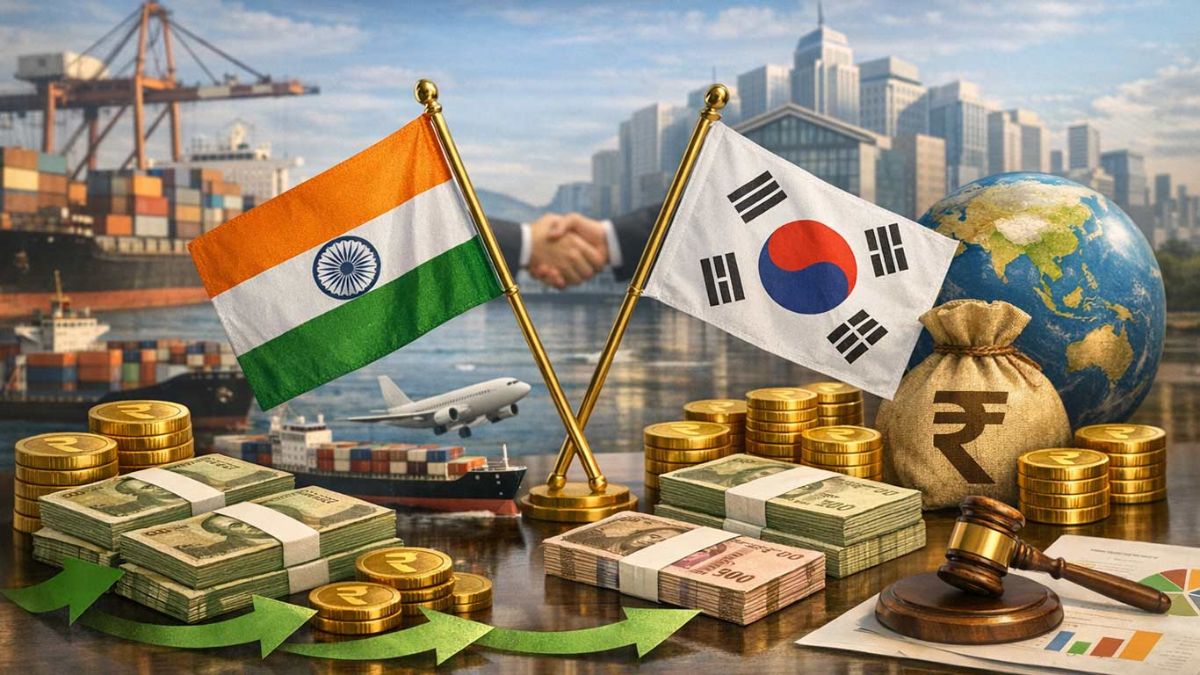
The West Asia conflict has no doubt provided impetus for a deeper engagement between India and South Korea. Among the many outcomes of South Korea’s President Lee Jae Myung’s visit to India, an important one was to upgrade the comprehensive economic partnership agreement (CEPA), which came into effect way back in 2010, on a fast-track, mission mode.
India has been deeply ambivalent regarding the benefits of this one-sided agreement and sought to review the deal for more than a decade. As this CEPA was our first trade agreement with a developed nation—South Korea is an export-led industrial power while India is at a much lower stage of development—it perhaps reflected our lack of experience in negotiating such deals.
India’s ruling dispensation now feels confident of upgrading this CEPA as it has the benefit of negotiating nine deals since it came to power in 2014. These include big-ticket deals with the UK and the European Union and a putative deal with the US which has taken India out of its comfort zone in lowering tariffs and other barriers while holding firm on its red lines.
This was the spirit of India’s commerce and industry minister, Piyush Goyal’s pitch to his South Korean counterpart for a new trade pact which is “more contemporary”. Noting that the CEPA has not worked for India—with our deficits doubling from $6.7 billion in FY11 to $14 billion in FY26 till February—Goyal even suggested rewriting a completely new free trade agreement.
What would upgrading the CEPA entail?
Upgrading the CEPA entails addressing non-tariff barriers, expanding market access, and simplifying business processes to bring greater balance to bilateral trade. As India appears more confident in advancing its interests, this effort should ensure that it moves up the value chain from mainly shipping primary goods, raw materials, intermediates, or metals at an early stage of processing.
We must be able to step up pharmaceutical and IT services exports, including movement of our professionals. Above all, the focus must be on “implementation mechanisms to deliver more equitable returns from existing provisions” as has been forcefully underscored in ambassador VS Seshadri’s report titled “India-Korea CEPA: An Appraisal of Progress” at the Research and Information System for Developing Countries and the ASEAN India Centre.
A more contemporary CEPA is feasible if South Korea and India exploit each other’s complementarities. South Korea is a “hard” power with manufacturing and technological prowess. India is a “soft” power in IT and services. Seoul is short of natural resources. New Delhi has raw materials including critical minerals.
This is synergistic as South Korea has the capability to manufacture these into rechargeable batteries, electric vehicles, and other advanced products. South Korea has capital. India has a skilled workforce with a strong engineering and scientific capability. South Korea seeks markets. India has a vast domestic market. Make in India, together with Korea, can truly undergird an upgraded trade and investment deal.
Looking ahead
Looking ahead, the challenge of an all-new CEPA is to double bilateral trade to $54 billion by 2030 from current levels of $27 billion, implying an ambitious growth of 18% per annum. This is possible only if there is greater two-way foreign direct investment (FDI). The numbers are modest in this regard with South Korean FDI into India of $6.6 billion from April 2000 to March 2025 while India’s investment was $796 million over this period.
Only 700 Korean companies are currently present in India. The earlier wave of South Korean investments was in consumer electronics and automobiles. Now there is the prospect of partnerships in steel—JSW and POSCO—and shipbuilding. The next wave is expected to be from their small and medium enterprises (SMEs).
The proposal for a Korea-specific industrial township, with plug and play infrastructure, is bound to make a big difference in facilitating the entry of SMEs and lift trade volumes as India and South Korea engage more closely due to West Asia conflict.
The writer is an economics and business commentator based in New Delhi
Disclaimer: The views expressed are the author’s own and do not reflect the official policy or position of Financial Express.