



The US-Israel war on Iran since February 28, which forced Tehran to blockade the Strait of Hormuz to raise costs to the global economy, has hastened efforts to evolve new trade routes. Shipping channels have been disrupted since the conflict began, forcing India to reroute its shipments not just to the Gulf but also affecting the global economy.
Our monthly exports to West Asia are $6 billion but in March only $2.5 billion went through. India successfully routed shipments of food and agricultural items but the absence of regular shipping channels halted those of engineering goods, electronics, and petroleum products. Our greatest vulnerability is on the energy front.
Before the war, 93% of our 3.1 million barrels of oil per day imported from the Gulf flowed through the Strait. These imports had shrunk by two-thirds in April.
For India’s energy security, considering options that bypass the Strait is imperative. Iran’s behaviour in firing on two India-flagged oil tankers even after providing clearance raises serious questions.
India’s foreign secretary conveyed deep concern over this incident to Iran’s envoy while noting the importance we attach to the safety of merchant shipping and mariners. He recalled that Iran had earlier facilitated the safe passage of several ships bound for India.
As if all of this weren’t serious enough, there is mention of tolls being charged to access the Strait, which is anathema to India that believes in unimpeded navigation through these waters. Options to bypass Hormuz are already in place by Saudi Arabia with its 1,200-km East-West pipeline and the United Arab Emirates’ (UAE) 360-km pipeline from Habshan to Fujairah.
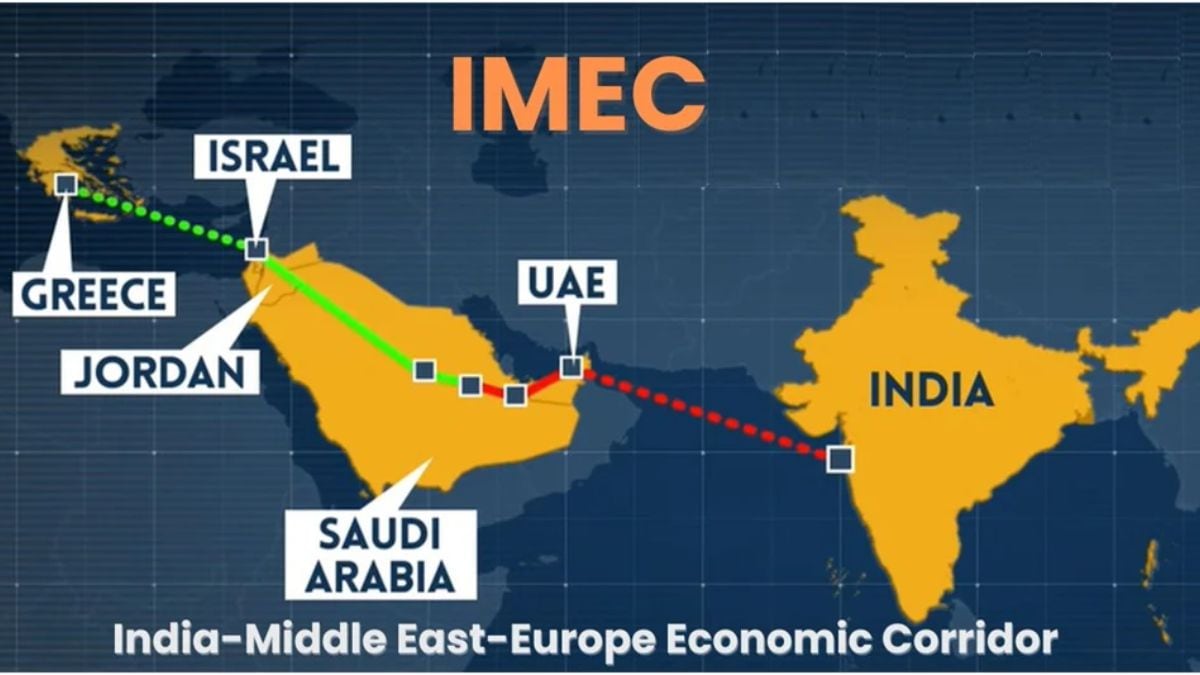
From India’s point of view, the most efficacious option bypassing Hormuz is through the game-changing India-Middle East-Europe Economic Corridor (IMEC). Once the Iran war ends, IMEC must move forward as it offers compelling geoeconomics, capable of delivering goods to Europe 40% faster than through the Suez Canal which is currently the quickest way for goods to transit between Asia and Europe.
First leg of the IMEC corridor
The first leg of the IMEC corridor is by ship from Indian ports to UAE’s Jebel Ali. The goods then go by rail through Saudi Arabia and Jordan to Haifa in Israel, which is admittedly vulnerable to regional geopolitical tensions. From there, they will again be shipped to Piraeus in Greece to reach European markets. It serves our objectives as shipments freely flow to the Gulf as well as the world market.
IMEC is an idea whose time has come given the disruption to regular shipping due to the blockaded Strait. India must gear up to leverage the corridor by aligning its nodal points on the western coast line with dedicated freight and logistics corridors that transport containers from metropolitan growth centres like New Delhi, Hyderabad, and Bengaluru.
The challenge is that these corridors do not extend to southern India. Their containers would thus have to head to Colombo in Sri Lanka via Chennai or Thoothukudi. Although Colombo is the largest transshipment terminal in the Indian Ocean, additional capacity is needed as its utilisation rate has exceeded 90% since 2021.
India’s port infrastructure will also have to be upgraded. India must engage Qatar which has not been included in the original proposal. Egypt also needs attention as its revenues from the Suez Canal would be impacted by IMEC.