



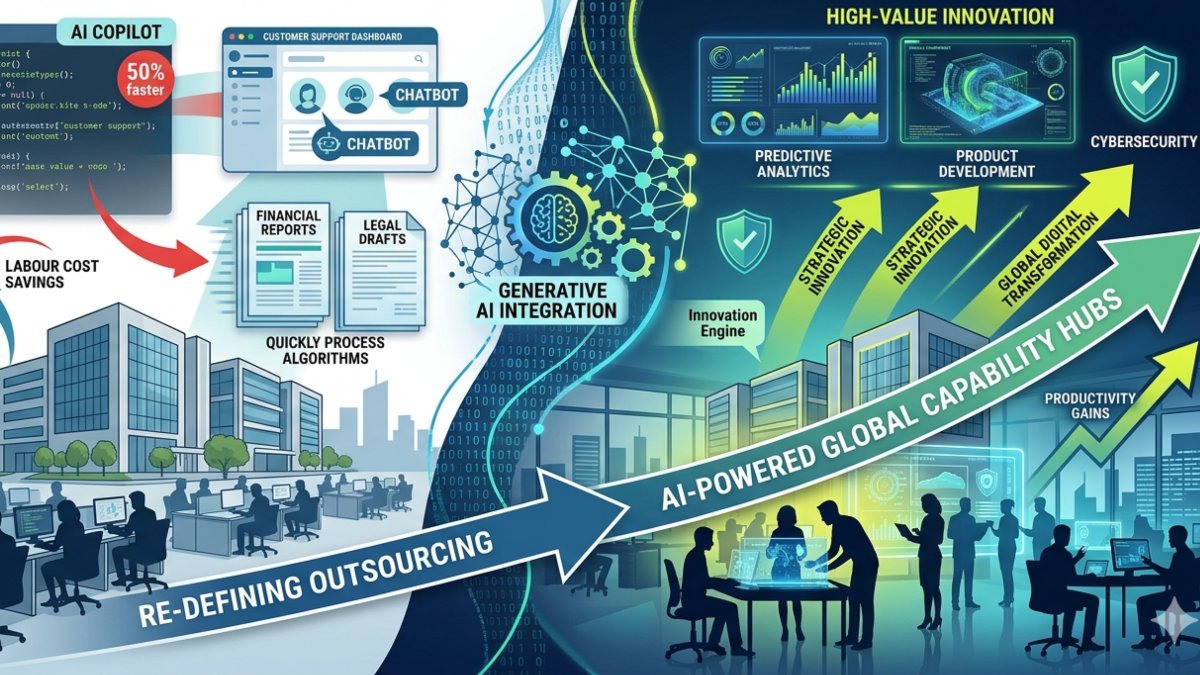
Not long ago, the idea that software could write software sounded fanciful. Today, it is routine. Across the world, engineers are using AI copilots that generate large sections of code in seconds. Studies suggest developers using such tools can complete certain programming tasks 40-55% faster than before. Customer service platforms are increasingly handled by intelligent chatbots. Financial reports, legal drafts, and marketing campaigns can now be prepared by algorithms in minutes. In boardrooms, executives are starting to reorganise entire workflows around AI.
Barely two years ago, generative AI tools were experimental curiosities. Today, they are rapidly becoming embedded in enterprise systems and everyday workflows. As productivity per employee rises sharply, a question that once seemed theoretical is now becoming urgent. What does the rise of AI mean for global outsourcing, especially for India’s vast ecosystem of global capability centres (GCCs)?
India is estimated to account for over half of the world’s GCCs and hosts more than 1,700 employing nearly two million professionals, serving some of the world’s largest corporations.At first glance, many routine tasks that once required large teams like coding support, testing, customer service, financial reconciliation, document processing, and basic analytics can now be automated or augmented by AI. Outsourcing thus inevitably begins to shift. Automation narrows the labour cost advantage that historically drove offshoring. Companies may therefore reconsider the location of certain operations. With smaller teams required, proximity to headquarters offers advantages of IP protection, regulatory compliance, and operational control. In some sectors, this could encourage a degree of “re-shoring” or “near-shoring” of work once sent offshore.
But to see this technological shift only through the lens of disruption would be to miss the larger opportunity. AI is not eliminating India’s role in the global technology economy. It is redefining it.
India’s GCC ecosystem has already moved far beyond the early outsourcing model of the 2000s. Many centres perform high-value functions ranging from product engineering and advanced analytics to cybersecurity and global digital transformation. MNCs are increasingly using India units as strategic innovation engines, not as mere execution hubs. AI is likely to accelerate this.
The most immediate change will be in the nature of work within GCCs. Routine back-office functions are likely to shrink as AI automates repetitive tasks. But demand will expand significantly for higher value roles like AI engineering, machine learning development, data architecture, cybersecurity, AI governance, and digital product design. Future GCCs may be smaller in manpower but richer in expertise.
India produces one of the world’s largest pools of engineers and tech professionals. Its vibrant startup ecosystem and long experience in managing global tech operations offer a strong foundation for the next phase of AI-driven innovation. Many MNCs are already expanding their AI research and development teams in India precisely because of this advantage.
Another emerging opportunity lies in what might be called “AI operations” for the industry focused around deploying, monitoring, and managing AI systems. AI models require continuous training, data preparation, localisation, security oversight, and performance optimisation. These functions cannot be fully automated and will require specialised teams with deep technical and analytical capabilities. India’s technology workforce is well placed to lead in this new segment.
India also enjoys a distinctive structural advantage in the form of its digital public infrastructure. Platforms like Aadhaar, UPI, DigiLocker, and ONDC have created one of the most sophisticated digital ecosystems at population scale—generating vast data sets and offering a real-world environment for developing and deploying AI solutions across sectors. At the same time, the changing technological landscape calls for a strategic response. First, India must invest aggressively in reskilling its workforce. Millions working in IT services and BPO will need to upgrade their capabilities in AI tools, data engineering, and digital product development.
Second, India must position itself as a hub for advanced GCC activities. Policy frameworks should encourage MNCs to locate AI research, product development, and digital innovation centres in India rather than limiting operations to routine service delivery. Third, the country must strengthen its domestic AI ecosystem by investing in high-performance computing infrastructure, research capabilities, and indigenous AI models trained on diverse data sets. This will ensure India remains an active contributor to global technological innovation rather than merely a consumer of foreign platforms.
Finally, AI adoption across India’s domestic economy must accelerate. AI has transformative potential across sectors—from manufacturing and logistics to agriculture, healthcare, governance, and tourism. A vibrant local market for AI applications will create new firms, capabilities, and employment opportunities.
The history of India’s technology sector has been one of reinvention. AI represents the next stage. In many ways, it may narrow the advantage of cheap labour but it dramatically amplifies the advantage of skilled talent at scale. Few countries combine that capability with India’s demographic depth, digital infrastructure, and entrepreneurial energy. AI may well mark the start of Indian GCCs’ most sophisticated chapter. If India moves decisively now, it could well become one of the principal architects of the global AI economy.
Disclaimer: The views expressed are the author’s own and do not reflect the official policy or position of Financial Express.