



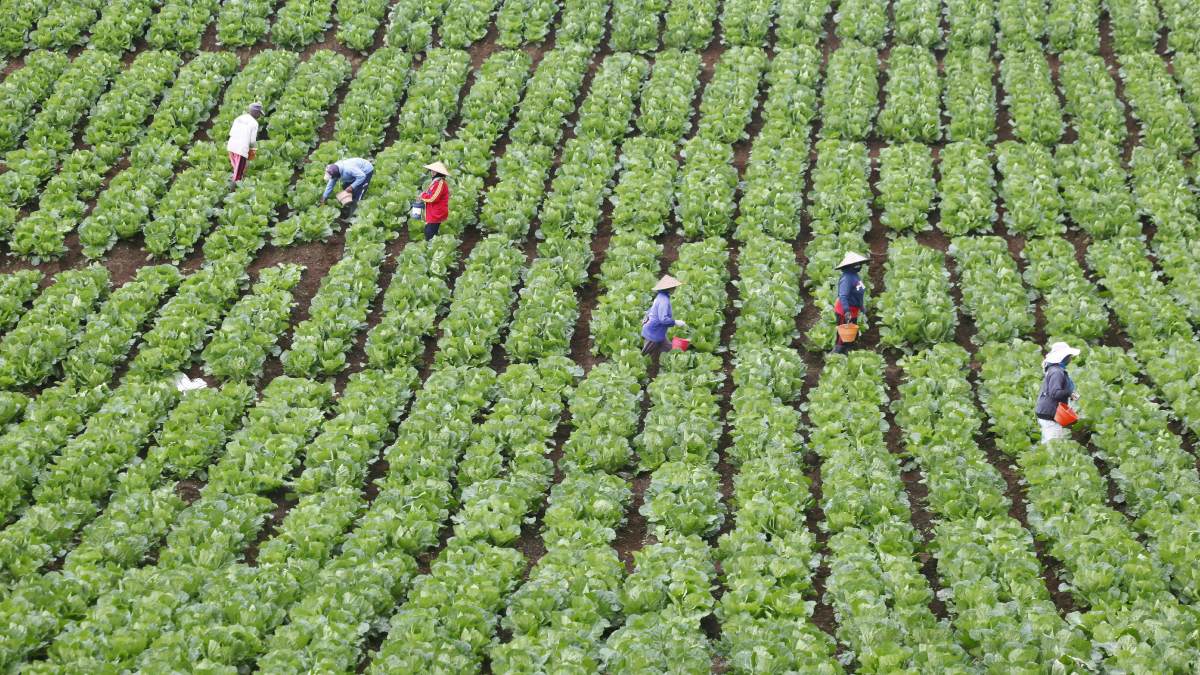
Amid the ongoing conflict in West Asia, the government has taken visible steps to shield Indian farmers. From ensuring steady fertiliser availability to preparing for higher subsidy support, the message has been clear—farmer welfare is not negotiable. This approach had also been evident in trade discussions with the US and European Union (EU), where India had consistently defended food security and rural livelihoods. The principle remains simple—economic engagement with the world must not come at the cost of the Indian farmer.
This thinking is most clearly reflected in India’s stance on foreign direct investment (FDI) in agriculture. While the country has opened up several sectors to global capital, it has drawn firm boundaries around traditional or general agricultural farming to protect its 126 million small and marginal farmers. Foreign investment is allowed in areas such as horticulture, seed development, and food processing but not in the cultivation of staple crops like food grains, pulses, and oilseeds. The idea is not to shut the door on investment, but to ensure that control over land and production remains with Indian farmers.
Despite a well-considered strategy to protect farmers, there continue to be calls from vested interests to open up India’s protected sectors, which are heavily dependent on the agri-value chain, to FDI. Lobbyists are pushing for FDI in ancillary activities, with the eventual aim of creating backdoor entry routes. Proponents argue that FDI can improve efficiency, align sourcing with manufacturing, and help India move up the value chain. However, one of the biggest misconceptions in this debate is that such investment will automatically empower farmers or lead to better value capture within the country.
There are several global examples that challenge the assumption that foreign investment benefits farmers. Take Brazil, for instance. While it is a major agricultural exporter, a large share of its soya bean value chain is controlled by multinational companies. Farming has increasingly shifted towards large-scale monoculture, leading to land consolidation and pushing out smaller farmers who are unable to compete with the capital and technology available to global players.
Experience from other markets also shows that large companies often move away from open, transparent procurement systems towards private contracts. This can reduce price discovery, limit competition, and weaken farmers’ bargaining power, sometimes even displacing them from established markets.
Russia offers another example. India once had a strong tobacco export relationship with the country. However, after foreign companies invested in Russia’s tobacco sector, sourcing patterns changed. Procurement shifted to other preferred geographies, and demand for Indian tobacco declined sharply. This highlights that foreign investment does not necessarily secure stable demand for Indian farmers and can just as easily redirect it elsewhere.
This is why for crops such as cotton and sugarcane that support millions of farmers, India has rightly prioritised tariff management and market access over foreign influence in farming. In trade discussions with the EU, the US, and Australia, this position has remained firm, with sensitive sectors like sugar kept out of liberalisation to protect domestic systems such as cooperatives.
Protective measures are a clear recognition of the structure of Indian agriculture. About 86% of the country’s small farmers operate on less than two hectares of land. These farmers do not have the scale or resources to compete with large global agribusinesses and multinationals on equal terms.
For instance, India’s dairy sector rests on a cooperative model that supports millions of small farmers and is deeply linked to rural livelihoods. On the other hand, farmers in the EU and US receive substantial government support, especially for commodity crops that feed into the global processed food industry. This allows MNC agribusinesses to export products at artificially low prices, a practice often described as “implicit dumping”.
If large MNCs enter processing at scale, directly or indirectly, the market could move towards a monopsony, where a few dominant buyers begin to dictate prices to cash crop farmers. This would limit farmers’ choices and reduce their ability to negotiate fair returns.
Many small farmers today rely on relatively transparent systems run by commodity boards for price discovery. The Tobacco Board regulates the trade in the sector as well. A shift towards FDI-driven processing could move transactions into private contracts, reducing transparency and tilting the balance of power away from farmers, resulting in a disastrous situation for small and marginal farmers.
India’s approach, therefore, is not about resisting globalisation, but about shaping it on its own terms. At its core, it is about safeguarding the foundation of the rural economy and ensuring national food security. As global uncertainties continue, from geopolitical tensions to climate risks, this approach becomes even more important. India’s farm policies underline a simple principle—growth and global integration must move forward, but not at the cost of its farmers. This is why keeping FDI out of such sensitive sectors remains both a practical and necessary choice.
The author is Chartered accountant, economist, and tax & business expert.
Disclaimer: The views expressed are the author’s own and do not reflect the official policy or position of Financial Express.