



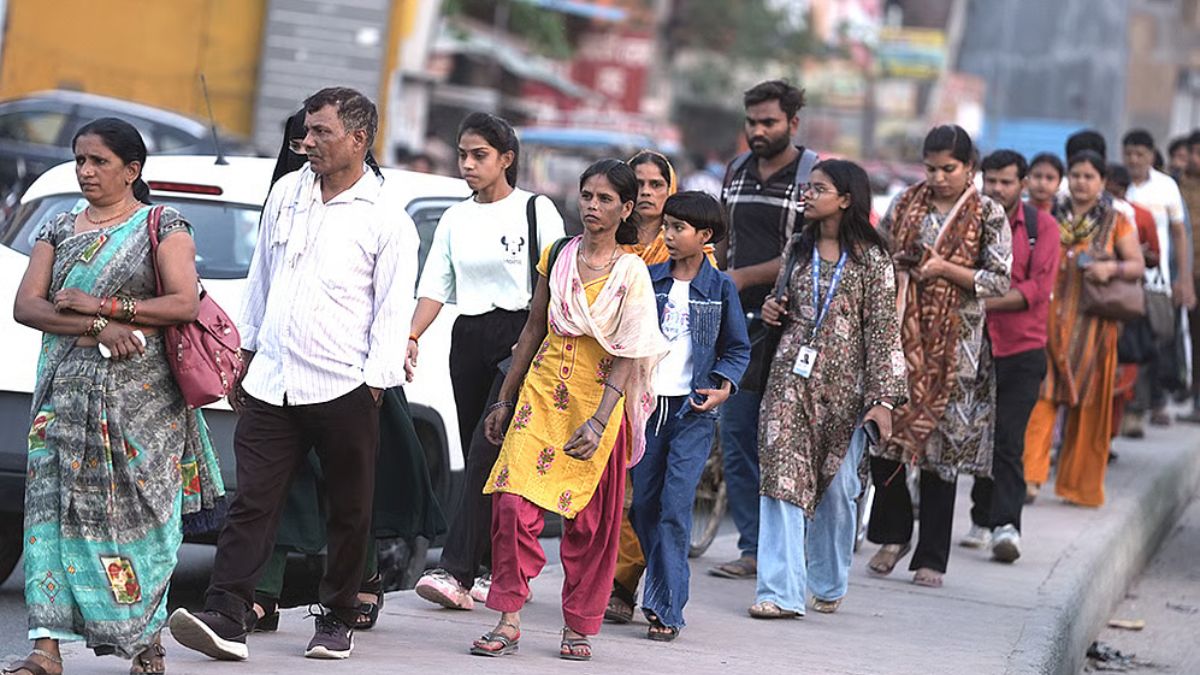
The images from Noida—angry workers, halted production lines, a breakdown of order inside what is meant to be one of India’s most modern industrial clusters—should not be dismissed as an aberration. They are a warning signal. Strip away the immediacy of the incident, and what remains is a stark question: can an economy that struggles to provide stable, dignified work to its young truly aspire to become a Viksit Bharat?
At the core of the crisis is a simple but stark reality: real wages for industrial workers have barely moved in a decade, even as the cost of living has steadily climbed. This is not an abstract macroeconomic observation. It translates into everyday hardship. Workers earning Rs 10,000–13,000 a month are expected to cover food, rent, transport, healthcare, and often support families back home.
Inflation—particularly in essentials—has quietly eroded whatever little purchasing power these wages once offered. The result is a silent squeeze that eventually becomes unsustainable. Noida was simply where it broke into the open.
The Indian income inequality paradox
India today faces a paradox: corporate profits have risen, but wages have not kept pace—a widening imbalance between capital and labour incomes, one that risks becoming economically and socially destabilising. This imbalance is not just about fairness. It has macroeconomic consequences.
When wages stagnate, consumption weakens. And in an economy where domestic demand is expected to drive growth, that becomes a binding constraint. The protests, therefore, are not just a labour issue—they are a demand-side warning.
What triggered the Noida unrest was not just low wages, but visible inequality in wages across regions. Workers saw that counterparts in neighbouring Haryana or Delhi earned significantly more for similar work, fuelling demands for parity. This is critical.
Discontent is rarely driven by absolute deprivation alone; it is sharpened by comparison. In an interconnected economy, such comparisons are immediate and unavoidable. When workers in Noida realise they are earning substantially less than those a few kilometres away, the legitimacy of the system itself comes into question.
Structure of employment
Another layer of the crisis lies in the structure of employment. Much of Noida’s industrial workforce is employed through contractors. This creates a system where accountability is diffused and workers’ rights are diluted. The recent crackdown on over 200 contractors for withholding wages, overtime, and bonuses underscores how widespread such practices have become.
For workers, this means insecurity is built into the system. They are easily replaceable, rarely unionised, and often excluded from formal grievance mechanisms. In such a setting, protest becomes the only available language
In response to the unrest, the Uttar Pradesh government raised minimum wages by around 20%. But even after the revision, monthly pay for unskilled workers remains in the range of Rs 13,000–14,000—hardly sufficient in an urban economy like Noida.
This points to a deeper issue: minimum wages in India are often closer to subsistence levels than to a “living wage”. The Constitution itself speaks of a living wage that ensures dignity, health, and basic comfort. In practice, however, enforcement is weak and wage revisions lag inflation.
A significant proportion of workers are still paid below even the prescribed minimum. To view the crisis purely through the lens of wages would be incomplete. Working and living conditions amplify the distress.
Reports from Noida highlight extreme heat inside factories, long hours, and cramped living spaces in worker colonies. These conditions erode not just physical well-being but also dignity—an intangible yet critical component of any development narrative.
India’s employment data often suggests improvement in the jobs situation. But these metrics mask a deeper problem: the proliferation of low-quality jobs. Even one hour of work per week can count as “employment” in official surveys, potentially understating the scale of distress.
What matters is not just whether people are working, but how they are working—and what they earn. In Noida, as across much of urban India, employment is increasingly characterised by informality, contractualisation, and wage compression.
Each year, millions of young Indians enter the workforce. This demographic surge is often described as a dividend. But without adequate job quality, it risks becoming a liability.
The Noida unrest is a glimpse of what happens when expectations collide with limited opportunity. Young workers, more aware and more aspirational than ever before, are unwilling to accept conditions that barely allow survival.
Importantly, Noida is not an isolated case. Worker protests have surfaced across multiple industrial hubs—Gurgaon, Sonipat, Surat—suggesting a broader pattern of discontent.
This is a national issue playing out in local theatres. The lesson from Noida is not that India’s growth strategy is failing, but that it is incomplete. First, wage growth must become a policy priority, not just employment generation. Without rising incomes, the growth story will remain fragile.
Second, minimum wage frameworks need strengthening and better enforcement. A floor that is not enforced is no floor at all. Third, labour market reforms must balance flexibility with security. The current tilt towards contractualisation has gone too far, eroding stability without necessarily improving productivity. Fourth, industrial policy must focus more explicitly on employment intensity. Capital-intensive growth alone cannot absorb India’s workforce.
The idea of Viksit Bharat is ultimately about lived experience. It is about whether growth translates into dignity and security for ordinary citizens.The Noida worker does not measure development in GDP terms. He measures it in the ability to afford rent, educate his children, access healthcare, and save for the future.
When those basic expectations remain unmet, the gap between promise and reality widens dangerously. The Noida unrest should be seen for what it is: not an aberration, but a warning. It tells us that growth without wage progression is unsustainable. That employment without dignity is unstable. And that aspiration without opportunity is combustible.
India’s path to becoming a developed economy will not be determined only by investment flows or export numbers. It will be determined by whether its workforce—especially its young workforce—feels secure, valued, and hopeful. Right now, in places like Noida, that feeling is in short supply.