



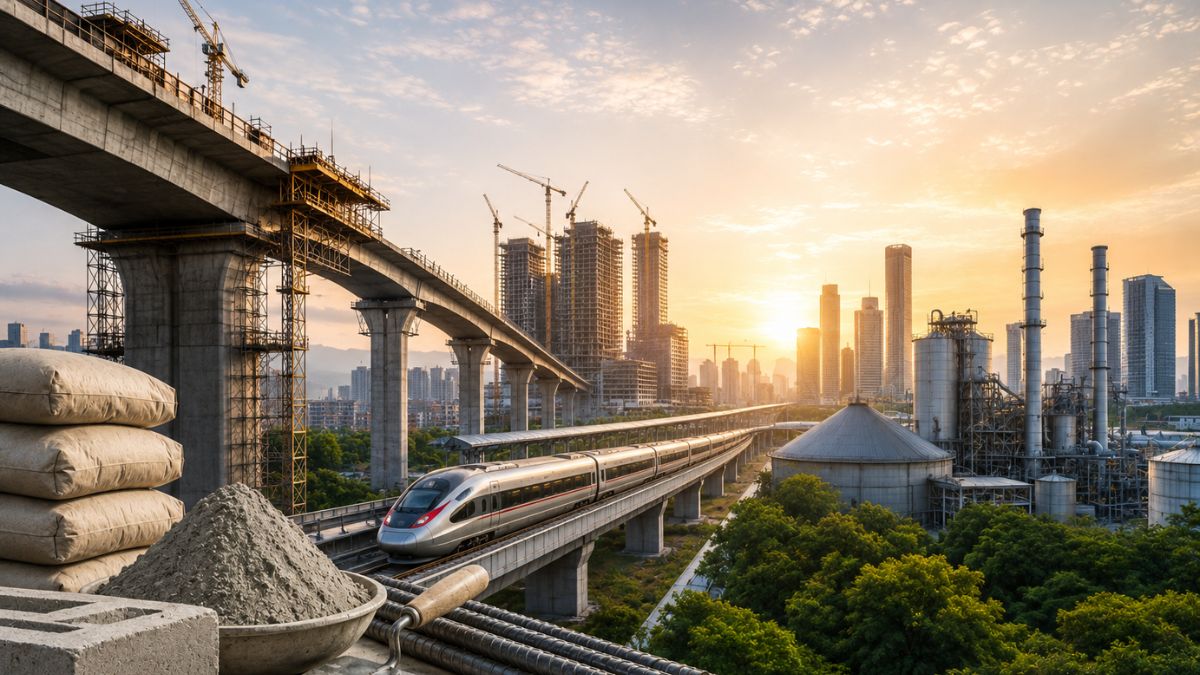
Cement is the physical grammar of development, and, undoubtedly, is indispensable in modern life. The material is the foundation of modern development, putting roofs over the heads of billions, fortifying our defences against natural disaster and providing a resilient infrastructure for transport, and industry.
As our planet hurtles towards a point of no return vis-à-vis global warming, every sector is working towards reversing this climate emergency by drawing up a contingency plan for curbing its carbon trail, and the Indian Cement Industry has established itself as one of the frontrunners in driving efficiency measures and setting ambitious net zero targets.
We are faced with the challenge of making available Cement in large volumes, the most significant building material that is essential to make climate resilient infrastructure, but with the least possible climatic impact. This can only be possible if we can achieve growth sustainably with lower specific CO2 emissions. By continuously deploying the Best Available Technology (BAT), the industry fosters resilient and modern manufacturing.
The Indian Cement Industry has shown efficiency at scale. It ranks among the most carbon-efficient globally, with specific CO₂ emissions per ton of cement being among the lowest, and energy efficiencies and Industrial by-products utilization among the highest in the world. Today, more than 1000 MW waste heat recovery electricity generation is taking place in the Indian Cement Industry which consumes no fossil fuel.
The Indian Cement Industry has been the first mover with regard to keeping pace with changing socio economic and environmental paradigms, whether it is adoption of new technologies, adhering to stricter environmental standards or utilizing other industries’ byproducts.
It is also aligned with the Swachh Bharat Mission of the Government of India. Thus, it serves three objectives a) making our cities clean b) reduces the landfills and related environmental hazards c) helps in the substitution of fossil fuels and reducing CO2 emissions.
Although the sector has largely captured energy-efficiency gains, deep abatement must come from fuel shift, renewable energy, clinker substitution, and carbon capture, utilisation, and storage and thus, visualising the future, India’s commitment to being net zero by 2070 unfolds new dimensions.
Such initiatives, however, require support of creating carbon markets, concessional green finance, green public procurement, strong incentives for R&D on innovative and disruptive technologies, to make them more attractive and viable.
Cement Industry is where the circular economy stops being theory and starts being practice. Cement plants across India are actively replacing traditional fossil fuels with waste derived alternatives like RDF and Non-recyclable plastic waste (NRPW) and using fly ash and BF slag as cementitious materials.
The Industry has transitioned from the traditional “take-make-dispose” model to the regenerative principles of a circular economy. This shift prioritizes the recycling and reuse of materials and energy, reducing waste and enhancing resource efficiency.
For an annual cement production of 490 million tonnes in India, the Industry consumes nearly 150 million tonnes of other industries byproducts apart from approximately 10% Thermal Substitution from alternate fuels derived from municipal solid wastes and various industrial combustible wastes — thereby, the industry acts as a massive waste management hub, reducing landfill pressure and dependence on virgin natural resources.
A few policy wrinkles, however, need to be ironed out to further enhance wastes utilization, including priority allocation of fly ash to the Cement Industry, strengthening the Polluter Pays Principle, collaborative efforts with waste generators and municipalities for alternative fuels pre-processing for improving the quality of alternative fuels.
The sector is also a vital revenue generator for the Central and State governments. The Indian Cement Industry is amongst the largest revenue contributor to the Indian Exchequer and the Indian Railways.
Today the Indian Cement Industry stands at the forefront of transformative change. By integrating green energy, adopting circular economy principles, and leveraging technological innovation, the sector is shaping a future where economic growth aligns with environmental sustainability.
The Industry is investing in latest technologies and innovative solutions to lower carbon emissions by reducing dependence on fossil fuels and achieve higher energy efficiency.
The Government’s thrust in this effort is reflected in the Union Budget 2026-27’s financial outlay of ₹20,000 crore over five years to scale CCUS technologies across five industrial sectors, including cement, steel, and power, highlighting its commitment to invest in cost efficient indigenous technologies.
The deepening collaboration between industry and policymakers is the bedrock of ensuring this sustainable transition. In this transformation, the Cement sector is, therefore, justified in demanding a fundamental shift in narrative: from being viewed as a hard-to-abate industry, it stands to be recognized as the critical enabler of industrial decarbonization itself.
Although the road ahead presents challenges, the industry is well positioned to drive meaningful progress and contribute to India’s vision of a net zero future.
The author is a Cement Industry veteran and is former director general at National Council for Cement and Building Materials, and Chief Sustainability Officer, Dalmia Cement (Bharat).
Disclaimer: The views expressed are the author’s own and do not reflect the official policy or position of Financial Express.