



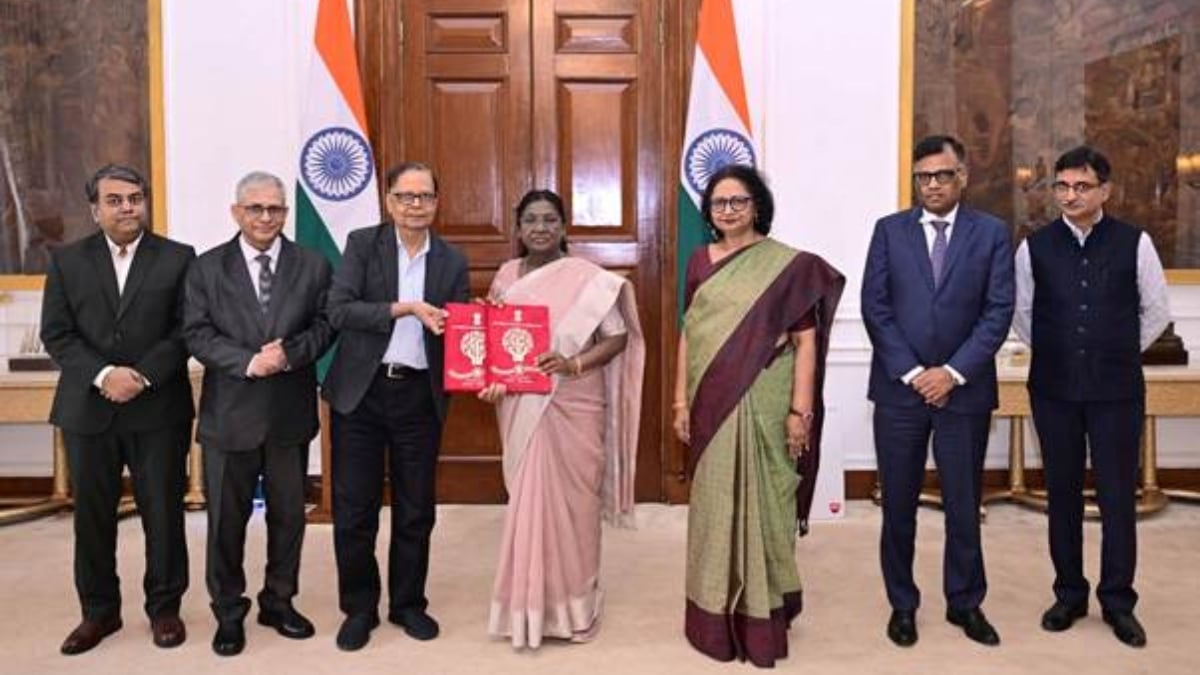
The report of the Sixteenth Finance Commission (16th FC) was unveiled along with the FY27 Union Budget. This report retained the approach followed by the 15th FC in several recommendations while proposing meaningful changes in others, a remarkably fine balance of continuity and change, with a focus on efficiency.
The two main recommendations of the FCs pertain to the sharing of taxes and grants by the Government of India (GoI) with the states. The 16th FC has recommended that 41% of the GoI’s divisible pool (defined as gross tax revenues less cesses, surcharges, and collection charges) be transferred to the state governments during its award period of FY27-31. This is known as vertical tax devolution and is in line with the level recommended by the 15th FC for FY22-26.
For splitting this amount between the individual states, referred to as their inter-se share, the FCs use a horizontal devolution formula. The 16th FC retained five of the six horizontal devolution criteria used by the 15th FC, i.e. population, area, forest, per-capita gross state domestic product (GSDP), and demographic performance. However, it changed the weights and/or calculation methodology for some of them, which raised the inter-se share of 14 of the 28 states for the 16th FC’s award period.
The 16th FC has introduced a new horizontal devolution criterion, contribution to gross domestic product (GDP), with a weight of 10%. This is a broad-based indicator and seems to have played a key role in lifting the inter-se share of states with largely healthy economic management.
Further, the Commission has reduced the weight of the area criterion to 10% from 15% assigned by the previous two FCs while also lowering the floor to 1.5%. The former would have lowered the inter-se share of states with very large geographical area, and the latter would have impacted that of states that are very small. However, this may not negatively impact those states that routinely report revenue surpluses, as this change may only compress the size of their surplus, and not pose a sizeable concern.
Tax devolution versus grants
The tax devolution is a formula-based transfer, and its appeal lies in its predictability (transferred by the GoI to the states on a monthly basis) and untied nature. A large portion of the grants, on the other hand, are subject to fulfilment of conditions by the state or materialisation of the contingency. In all, grants for the 16th FC period are 18% higher than the 15th FC’s award period.
The 16th FC has recommended a doubling in local body grants to Rs 7.9 lakh crore for FY27-31, from Rs 3.9 lakh crore transferred during the FY22-26 revised estimates (RE). The release of these remains contingent on the states completing the prescribed basic reforms. However, the untied component of such grants has been raised to 60% of the total by the 16th FC, from 40% in the previous five years, enhancing the flexibility of usage. Around 40% of the local body grants are tied towards spending in sanitation and solid waste management and/or water management sectors. Even though the local body grants are pass-through in nature, they play an important role in improving the socio-economic indicators of a state and augmenting the growth of its economy.
Disaster management support enhanced
Additionally, the 16th FC has proposed `1.6 lakh crore as disaster management grant to the states during FY27-31, up from Rs 1.3 trillion transferred during the previous five years.
In a departure from the practice, the 16th FC has discontinued revenue deficit grants to the states, which was an unconditional and untied source of grants. This was given to some states if the FC anticipated that even after considering their own revenues and tax devolution, the states may still report a revenue deficit, reflecting some inherent disability. The 16th FC assessed such grants to be ineffective in reducing the structural gaps and therefore shelved it. This change may nudge the erstwhile recipients to find durable solutions to structural revenue deficits, and perhaps also discourage announcements of open-ended welfare schemes.
On the borrowing limit, the 16th FC has capped the normal net borrowing limit for state governments at 3.0% of GSDP for its award period, in line with what prevailed during FY24-26.
This apart, the 16th FC has given a useful set of suggestions on fully discontinuing off-budget borrowings by states, strict adherence to the provisions of the Fiscal Responsibility and Budget Management Act and borrowing limits, and rationalising subsidies. We hope the states pay heed to these important suggestions.
The author is Chief Economist, Head-Research and Outreach, ICRA