




Picture this. You’re 33 years old. Your company just went public. And by lunch, you’re worth $37 billion.
That’s exactly what happened to Michal Strnad last Friday when his company, Czechoslovak Group, made its spectacular debut on the Amsterdam stock exchange. The shares opened at €25 and closed at €32.85, volatility typically reserved for speculative tech assets.
However, the reality is starker. This wasn’t some flashy tech startup. This was an arms manufacturer. And it just pulled off the biggest defense company IPO in history.
The war that changed everything
Rewind to 2022. Russia invades Ukraine. Suddenly, Europe realizes it has a problem. For decades, the continent had been content letting America handle the heavy lifting on defense. Military budgets were shrinking. Defense companies were seen as relics of a bygone era.
Then the tanks rolled into Ukraine, and everything changed.
Countries scrambled to boost military spending. Germany announced a €100 billion defense fund. Poland procured tanks with unprecedented urgency.. And defense stocks? They tripled in two years.
Enter CSG. The Prague-based company makes exactly what everyone suddenly needed: armored vehicles, ammunition, bullets, shells. The boring, unglamorous stuff that actually wins wars.
An IPO that broke records
When CSG announced its IPO, investors went into a tizzy. The company wanted to raise €3.8 billion. Investors placed $60 billion in orders. That’s 14 times oversubscription. About 40% of investors who wanted in, got absolutely nothing.
The deal was priced at €25 per share. By closing, shares traded at €32.85, up 31%. The company’s market value hit €33 billion, making it worth more than CEZ, the Czech Republic’s largest utility company and historically its most valuable listed firm.
Let that sink in. A company that makes bullets is now more valuable than the company that keeps the lights on in an entire country.
Michal Strnad: From scrap dealer to $37 billion tycoon
Michal Strnad didn’t exactly start from scratch. His father began trading old Soviet-era military equipment in the 1990s after the fall of communism. When Strnad inherited the company in 2018 at age 25, it was already substantial. But what he’s done since is remarkable.
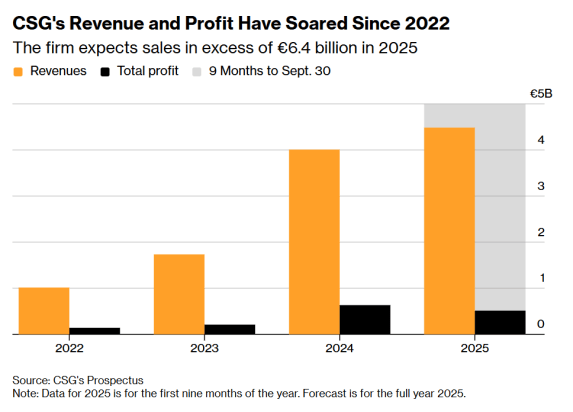
The company’s revenue has exploded. In 2022, before the Ukraine war, CSG brought in modest revenues. By 2025, they expect over €6.4 billion in sales. For 2026, they’re forecasting €7.4 to €7.6 billion.
Strnad personally pocketed nearly €3 billion from the IPO. His total fortune now sits at $37 billion. And he’s not planning to buy yachts or space rockets. Instead, he’s setting up a family office to invest in non-defense companies. Because apparently, when you’ve made your fortune in weapons, you diversify into literally anything else.
Geopolitical shift: Defense as the new safe haven
This IPO tells us three important things about where the world is heading.
First, defense is no longer a taboo investment. For years, many institutional investors avoided defense stocks for ethical reasons. That’s clearly changing. When BlackRock, Artisan Partners, and the Qatar Investment Authority commit €300 million each as cornerstone investors, you know the stigma is fading.
Second, Europe is serious about military independence. The continent is done relying on America for protection. With Trump back in the White House and threatening to use military force against NATO allies (yes, the Greenland thing), Europeans are betting big on homegrown defense capabilities.
Third, the Ukraine war isn’t ending anytime soon. CSG’s biggest customer is Ukraine. The massive order backlog and investor appetite suggest everyone expects sustained demand for years to come.
The bigger picture
CSG isn’t alone. Franco-German tank maker KNDS is planning its own listing this year. Defense stocks across Europe are hitting record highs. Goldman Sachs has a basket of European defense companies that has tripled in value over two years.
This is what market strategists call a “mega-trend in the making.” It’s not just about one war or one company. It’s about a fundamental shift in how Europe thinks about security, sovereignty, and defense spending.
The IPO was so hot that CSG only needed three days of order-taking. Usually, companies spend weeks roadshowing, meeting investors, building the book. CSG wrapped it up faster than most people plan a weekend trip.
What happens next?
CSG plans to use its stock as acquisition currency. They’ve already been on a shopping spree, including a $2.2 billion purchase of Kinetic, a leading U.S. ammunition maker that owns brands like Remington.
The company targets paying dividends of 30% to 40% of net profit starting in 2027. That’s a clear signal to investors: this isn’t just about growth, it’s about returning cash.
Meanwhile, Strnad might sell another €496 million worth of shares if banks exercise their overallotment option. Even after the IPO, he maintains control of the company.
The message is clear. In a world of rising geopolitical tensions, the business of war is booming. And investors can’t get enough.
Sonia Boolchandani is a seasoned financial writer She has written for prominent firms like Vested Finance, and Finology, where she has crafted content that simplifies complex financial concepts for diverse audiences.
Disclosure: The writer and her his dependents do not hold the stocks discussed in this article.
The website managers, its employee(s), and contributors/writers/authors of articles have or may have an outstanding buy or sell position or holding in the securities, options on securities or other related investments of issuers and/or companies discussed therein. The content of the articles and the interpretation of data are solely the personal views of the contributors/ writers/authors. Investors must make their own investment decisions based on their specific objectives, resources and only after consulting such independent advisors as may be necessary.